

The fastest way to stop texting and driving is to make your phone physically inaccessible or switch on a driving-focused blocking mode before you shift into gear, then back that up with a social commitment like a pledge or a designated texter. Drivers with high cell phone distraction are 240% more likely to crash. A pledge program is one way to build around this kind of pre-commitment.
TL;DR:
- Making your phone physically inaccessible and activating driving-focused modes drastically reduces the temptation to check texts while driving.
- Most modern phones can auto-activate driving modes via Bluetooth or motion sensors, but they are often left off and underused.
- Combining technological blocking with social commitments, such as pledges or family contracts, improves adherence to safe driving habits.
- High phone distraction increases crash risk by 240 percent, with texting creating a threefold threat by taking eyes, hands, and attention off the road.
- Small behavioral changes, like designated texters and monthly practice rehearsals, can significantly strengthen distraction-free driving routines.
Table of Contents
- Priority Checklist: Steps to Stop Texting and Driving Today
- What Phone Settings and Apps Actually Do
- Habit Change: Pledges, Contracts, and Social Rules
- What the Texting and Driving Law Usually Covers
- Why Phone Distraction Raises Crash Risk So Much
- Drive With Care’s Free Tools for Breaking the Habit
- A Straight Answer From Charles
- Take the Next Step With Drive With Care
- Sources
- FAQ
Priority Checklist: Steps to Stop Texting and Driving Today
You don’t need a new phone or a new car to fix this. You need a sequence you actually follow, in this order, every single time you drive.
- Make the commitment first. Say out loud (or sign something) that you won’t touch your phone while driving. Verbal or written commitments make the next steps stick.
- Get the phone out of reach. Glovebox, trunk, back seat, a lockbox bolted to the console. If your hand can’t find it, you can’t check it.
- Turn on Driving Focus or Do Not Disturb before you start the engine, not after you’re already merging onto the highway.
- Set your route and music before you move. Punch in the address, queue the playlist, then put the phone away. Pre-trip setup removes the reason to pick it back up.
- Tell people your rule. A short text or voicemail greeting saying “I’m driving, I’ll respond when I stop” removes the guilt of not replying instantly.
For anything urgent, an auto-reply template covers you: “Driving right now, will call you back within the hour.” Exceptions are simple: pull over for a call from a school, a doctor, or a family emergency contact, but do it parked, not moving.
Pro Tip: If your drive is under 15 minutes, stash the phone in the trunk before you leave rather than the glovebox. The extra ten seconds of friction to retrieve it at a red light is often the difference between checking a text and letting it go.
What Phone Settings and Apps Actually Do
Every modern phone has a driving mode buried in settings, and most drivers never turn it on.
On iOS, Driving Focus lives under Settings > Focus, and you can set it to activate automatically when your phone connects to car Bluetooth or detects driving motion. On Android, Do Not Disturb has a driving mode under Settings > Notifications, with similar auto-triggers tied to Bluetooth or motion sensors.
Third-party apps generally do one of three things:
- Auto-reply, sending a preset “driving” text to anyone who messages you.
- Lock the input, blacking out the keyboard or blocking app icons while the car is moving.
- Passenger override, letting a front-seat passenger unlock the phone for legitimate use like navigation.
Here’s the catch nobody advertises: switching to voice-to-text doesn’t solve the real problem. NHTSA and NTSB guidance both note that hands-free texting still pulls your brain off the road, even when your eyes and hands stay put. The distraction is cognitive, not just visual or manual. If you’re a parent setting this up for a teen driver, pair the phone-level block with actual verification, checking the settings yourself rather than trusting a screenshot.
Habit Change: Pledges, Contracts, and Social Rules
Technology alone rarely fixes a habit. What works better is combining a tech block with a social one, because a pledge or contract turns “I should stop texting and driving” into a specific, checkable commitment.

Drive With Care’s Safer Roads Now pledge works this way, and its parent-teen driving contract does the same for families. The CDC recommends exactly this kind of formal agreement paired with parents modeling the behavior themselves, since teens have the highest rates of handheld device use behind the wheel.
Two techniques worth stealing:
- Designated texter. Whoever’s riding shotgun handles all incoming messages and reads out anything urgent.
- Passenger intervention. Give riders permission in advance to say “put it down” without it turning into an argument.
Pro Tip: Run a “safety reset rehearsal” once a month, a short practice drive where a passenger deliberately tests whether you reach for the phone. Try the rehearsal guide once and you’ll notice how much of the habit is muscle memory, not willpower.
What the Texting and Driving Law Usually Covers
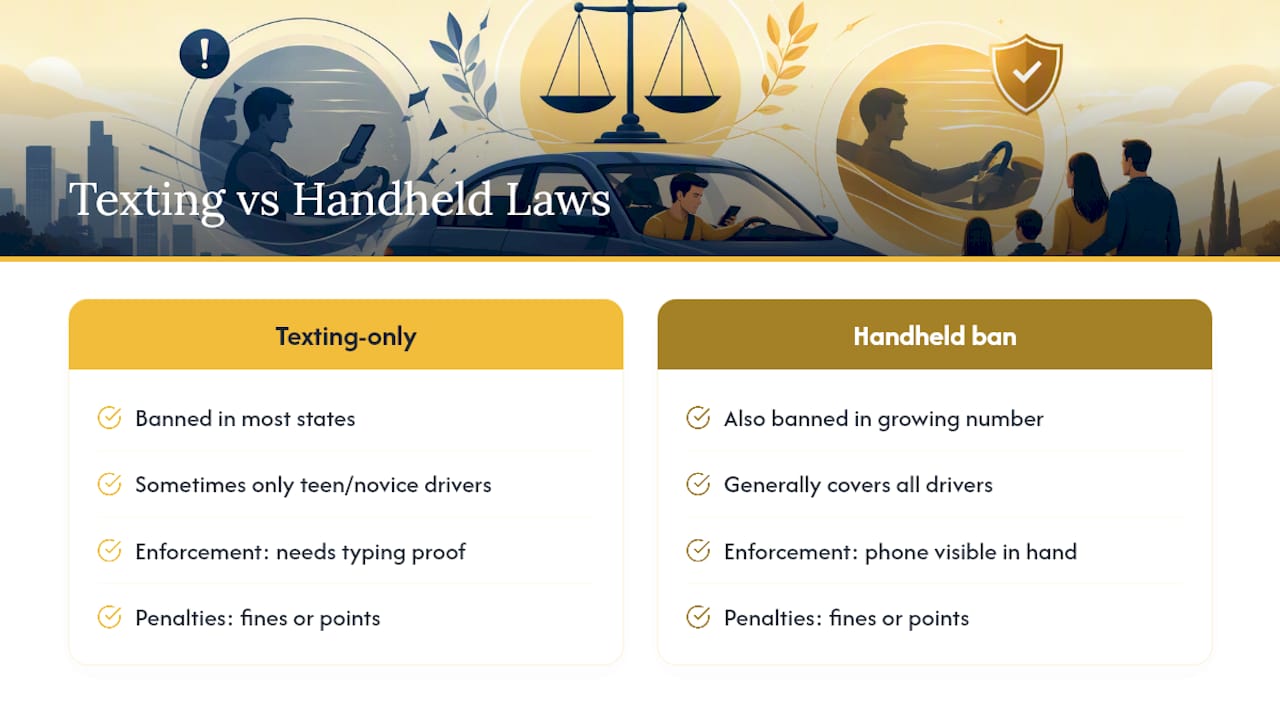
Most states ban texting while driving outright, and a growing number ban holding the phone at all, even for calls. Some laws only apply to novice or teen drivers; others cover everyone. Enforcement matters too. GHSA data shows handheld bans get enforced more consistently than texting-only bans, since an officer can spot a phone in hand far more easily than prove someone was typing a message.
Penalties range from a modest fine to points on your license, depending on the state. Rules shift often, so check your state’s distracted driving laws directly rather than relying on secondhand advice, including this summary.
Why Phone Distraction Raises Crash Risk So Much
The numbers explain why this topic gets treated as urgent rather than optional. Drivers with high cell phone distraction are 240% more likely to crash than drivers who aren’t distracted.
Reading or sending a single text takes your eyes off the road for about 5 seconds. At 55 miles per hour, that’s the length of a football field covered with your eyes closed.
Texas alone recorded 86,384 distraction-related crashes and 299 deaths in a single recent year, a reminder that the national totals aren’t abstract. Texting creates a triple threat: your eyes leave the road, your hands leave the wheel, and your attention leaves the driving task entirely. Any fix that addresses only one of those three isn’t really a fix.
Drive With Care’s Free Tools for Breaking the Habit
Drive With Care built its programs around one uncomfortable fact: human error accounts for up to 96% of traffic incidents, and phone distraction is one of the most preventable pieces of that number. The resource hub collects everything below in one place.
- The safety reset rehearsal, a practice drill for resisting the urge to check your phone.
People can sign pledges online, download contracts as PDFs, and run rehearsals on short, low-traffic drives.
A Straight Answer From Charles
I’ve spent enough time looking at crash data to know the fixes that get promoted hardest, apps, dashboards, warning chimes, aren’t the ones that actually change behavior. What works is boring: a phone you can’t reach, a rule you said out loud to someone else, and a passenger willing to call you out… If this guide gets one reader to sign the pledge or hand a contract to their teen this week,.
— Charles
Take the Next Step With Drive With Care
Some safety campaigns encourage making a specific commitment you can point to later, not just good intentions. The Safer Roads Now pledge takes two minutes to sign, and the parent-teen driving contract turns a family argument about phones into a written agreement both sides actually stick to.

If you’re a parent managing a new driver, pairing this contract with resources like young driver insurance guidance can help you connect safer habits to lower costs, too. And if you want to support the education and survivor programs behind this work, a donation to Drive With Care funds the pledge campaigns, family contracts, and rehearsal guides that keep this content free. Start by signing the pledge today, then bring the contract home for a family conversation this weekend.
Sources
- The Dangers of Texting While Driving | Federal Communications Commission
- What You Can Do to Prevent Distracted Driving | CDC
- Distracted driving | Governors Highway Safety Association
FAQ
Is there a way to disable texting while driving?
Yes. Both iOS and Android have built-in driving modes (Driving Focus and Do Not Disturb driving mode) that silence notifications and can auto-reply to messages once the phone detects you’re moving.
How do you tell someone to stop texting and driving?
Be direct and specific rather than vague: ask them to put the phone in the glovebox before starting the car, or ask if you can be their designated texter for the trip. Framing it as a small, concrete task works better than a general warning.
How do you break the habit of texting and driving?
Combine a physical barrier (phone out of reach) with a social commitment, like signing the Safer Roads Now pledge or running a safety reset rehearsal with a passenger who holds you accountable.
Is texting while driving worse than drinking and driving?
Texting produces a combined visual, manual, and cognitive distraction, and drivers with high phone distraction are 240% more likely to crash. Both behaviors are dangerous, and neither should be treated as the safer option.

