
Car maintenance checklist
What to check before you drive, every month, each season and on your maker’s schedule
Car maintenance is road safety. Your tires, brakes, lights and wipers decide whether you can stop, steer and see in time. When they fail, the risk reaches everyone around you.
This car maintenance checklist shows what to check at your mileage and on the calendar, from before every drive to every few years, plus the warning signs that mean stop now. It covers gas, hybrid and electric vehicles, and each item links to a plain guide.
Checklist by mileageChecklist by timeFree printable PDF
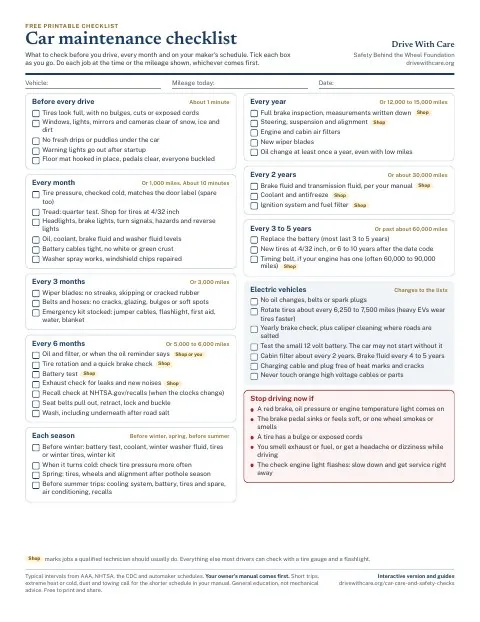
Checklist
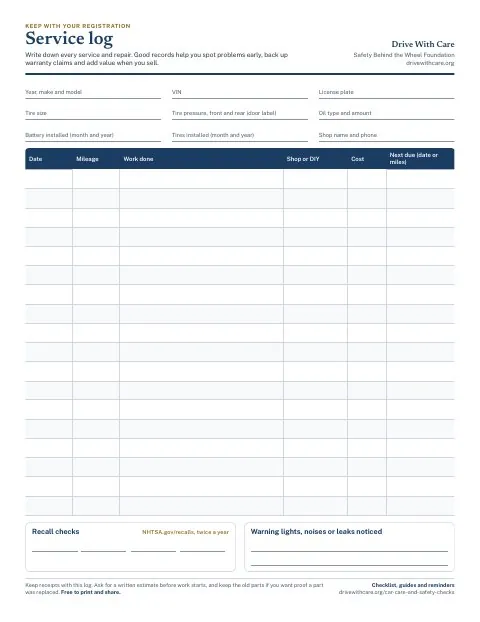
Service log
Why car maintenance is a road safety issue
1. Car maintenance
Small jobs, done on time
Tires, brakes, lights, wipers, fluids and sensors wear out slowly. Regular checks catch the wear before it turns into a failure.
2. Car safety
A car that can stop, steer and see
Good tires and brakes let you stop in time. Safety systems such as stability control and automatic emergency braking work through those same tires, brakes and clean sensors.
3. Road safety
Safer for everyone on the road
When a car fails, the danger reaches other drivers, passengers, people walking and biking, and road workers. Parts and cargo that fall off a vehicle become hazards for the next driver.
87 feet
longer to stop on a wet road at highway speed on tires worn to 4/32 inch, compared with new tires. [3]
48%
fewer single vehicle rollover crashes with electronic stability control, which brakes individual wheels to keep the car from sliding. [4]
200,000+
crashes over four years involved road debris, much of it parts and cargo that fell off vehicles. [5]
Sensors need care too. Toyota warns that dirt, bugs, ice, snow or a sticker in front of a camera or radar can affect its safety systems. [6] A few minutes of checks each month, plus service on schedule, keep all of these parts working for you and for everyone who shares the road with you.
Car maintenance checklist by mileage
Interactive checklist
What does your car need at this mileage?
Pick your vehicle type, then slide to your odometer reading. You will see what is due now, what is coming up and which guides explain each job.
Intervals are typical figures from AAA, NHTSA and published automaker schedules. Your owner's manual and oil life reminder come first. Short trips, extreme heat or cold, dust and towing call for the shorter schedule in your manual.
Where these intervals come from
Questions about the mileage checklist
What are the 30,000, 60,000 and 90,000 mile services?
They are common milestones, not fixed rules. AAA lists brake fluid, transmission fluid and coolant at about every 2 years or 30,000 miles. [13] Kelley Blue Book says timing belts are often replaced between 60,000 and 90,000 miles. [14] Shops often sell packages named for these milestones. Compare any package with your owner’s manual before you pay, and ask what each item costs on its own.
Do I go by miles or by time?
Whichever comes first. AAA pairs each job with both a time and a mileage, such as every 3 months or 3,000 miles. [13] If you drive only a little, the time limit usually comes first, so use the checklist by time as well. Change the oil at least once a year even if you are under the mileage. [12]
What does a car need around 100,000 miles?
The same safety checks as always, plus a closer look at parts that age: hoses, belts, engine mounts, suspension and the cooling system. Check your manual for its 100,000 mile items. If the engine has a timing belt that has never been replaced, it may be overdue. Kelley Blue Book says timing belts are often replaced between 60,000 and 90,000 miles. [14]
Do electric cars follow a mileage schedule?
Yes, a shorter one. The Department of Energy says fully electric cars need less maintenance than gas cars, with no engine oil, fewer fluids and brakes that usually last longer. [15] Tire rotation is the main mileage item. Tesla calls for it every 6,250 miles on the Model 3, [16] and Chevrolet listed every 7,500 miles for the Bolt. [17] Pick Electric vehicle in the checklist above, or read our EV and hybrid maintenance guide.
I bought a used car with no service records. Where do I start?
Run a free recall check with the VIN at NHTSA.gov/recalls. [18] Ask the seller or dealer for any records they have. Then have a shop do a full inspection, and treat any service you cannot confirm as due, such as the oil and filter, air filters, brake fluid, coolant and, if the engine has one, the timing belt. Set the slider to the car’s mileage to see what else is coming up.
Car maintenance checklist by time: monthly to yearly
Interactive checklist
What to check, and how often
Choose your vehicle type, then pick how often. Each list shows what to check, who usually does it and which guide explains it. Do each job at the time shown or the mileage shown, whichever comes first.
How often
Intervals follow AAA's time based checklist and published automaker schedules. Your owner's manual and maintenance reminder come first. Short trips, extreme heat or cold, dust and towing call for the shorter schedule in your manual.
Where these intervals come from
Questions about the time based checklist
What should I check before every drive?
Take about a minute. Look at the tires, clear the windows, lights, mirrors and cameras, glance under the car for fresh drips and make sure the warning lights go out after you start the car. Then check that the pedals are clear and everyone is buckled. Pick Before every drive in the checklist above for details.
How often should I check my tire pressure?
Check all four tires and the spare at least once a month, when the tires are cold. [2] Use the pressure on the label in the driver’s door frame, not the number molded into the tire. AAA suggests checking weekly once cold weather sets in. [13] See how to use a tire pressure gauge.
How often should I change my oil if I do not drive much?
At least once a year, even if you have not reached the mileage limit. [12] Oil breaks down with time as well as miles. Many short trips also count as hard use, so check whether your manual’s tougher schedule applies to you. [12]
How often should I check for recalls?
At least twice a year. NHTSA suggests doing it when the clocks change. [18] Enter your 17 character VIN at NHTSA.gov/recalls. Recall repairs are free. See how to check for recalls and safety defects.
How long do car batteries and wiper blades last?
Most car batteries last 3 to 5 years. [19] Have yours tested before winter once it is a few years old, and see our guide to battery testers. Wiper blades usually need replacing every 6 to 12 months, or sooner if they streak or skip. [20]
Stop driving now: warning signs that cannot wait
A maintenance schedule handles slow wear. These signs mean something may already have failed. Find a safe place to stop, turn on your hazard lights and follow the steps below. Lights and steps differ by vehicle, so your owner’s manual has the final word.
Comparison compiled by Safety Behind the Wheel Foundation
Warning signs that mean stop or slow down now
| Warning sign | What it may mean | What to do |
|---|---|---|
| Red brake warning light after the parking brake is released | Low brake fluid or a brake fault. Braking may be weaker | Park in a safe place right away and call for service. If the ABS light is also on, do not drive. Have the car towed. [7] |
| Red oil pressure light | The engine may not be getting enough oil | Stop safely, turn off the engine and do not drive. [7] |
| Engine temperature light, gauge in the red, or steam from under the hood | The engine is overheating | Pull over and turn off accessories. If you see steam, turn the engine off and wait. Never open a hot radiator cap. [8] |
| Flashing check engine light | A severe engine misfire | Slow down and get service as soon as possible. [9] |
| Brake pedal sinks or feels soft, or smoke and a burning smell from one wheel | A brake fluid leak, a brake fault or a stuck brake | Stop when it is safe and have the car towed. [10] |
| Bulge, deep cut or exposed cords on a tire | Damage inside the tire. It can fail without warning | Do not drive on it. Put on the spare or call for roadside help. |
| Exhaust smell inside the car, or headache and dizziness while driving | An exhaust leak letting in carbon monoxide, which has no smell or color | Open the windows, stop driving and get fresh air. Have the exhaust checked. [11] |
Source: Based on owner’s manual guidance from Mazda and Honda, and guidance from EPA, the FTC and CDC. [7, 8, 9, 10, 11]
Learn what every dashboard warning light means and how to pull over safely.
Step by step guides
Every part of this checklist has a full guide. They are grouped below by part of the car, with the best place to start marked in each group.
Basic checks and tools
Start with a simple routine for tires, brakes, lights and fluids. These guides also explain what a code reader can tell you and which warning signs mean a part needs replacing.
Tires and wheels
Tires are the only part of your car that touches the road. Learn how to check pressure and tread, choose replacements, tighten lug nuts and handle a flat.
Lights, wipers and windows
You need to see and be seen. Keep your lights working, your lenses clear and your windows clean in every season.
Safety parts you can check
Seat belts, head restraints and air bag warning lights all deserve a regular look. Check for open recalls, and be careful with aftermarket parts and cheap replacements.
Trailers, bikes and motorcycles
If you tow a trailer or ride a bike, scooter or motorcycle, it needs its own checks before you head out.
Frequently asked questions
How often should I service my car?
Follow the maintenance schedule in your owner’s manual, or your car’s maintenance reminder. As a rough guide, most engines need fresh oil every 5,000 to 7,500 miles and at least once a year. [12] Use the manual’s tougher schedule if you make many short trips, drive in extreme heat, cold or dust, sit in stop and go traffic, or tow. [12] Check tires, lights, fluids and wipers yourself once a month.
What should a car maintenance checklist include?
Tires, brakes, lights, wipers and washer fluid, engine oil and other fluids, the battery, belts and hoses, air filters, steering and suspension, the exhaust system, seat belts and air bags, and open safety recalls. Electric cars add charging equipment, the 12 volt battery and battery cooling. Use the checklists by mileage and by time above, or read our full guide to vehicle maintenance for safety.
Which car maintenance checks can I do myself?
Most monthly checks: tire pressure and tread, lights, wiper blades, washer fluid, oil and coolant levels, battery cables and seat belts. Our monthly car safety check walks you through them in about 10 minutes. Leave brakes, steering, suspension, air bags, high voltage parts and anything you are unsure about to a qualified technician. The FTC recommends getting a written estimate that needs your approval before the shop goes over a set amount. [10] See how to find a repair shop you can trust.
Is there a printable car maintenance checklist?
Yes. Our free printable car maintenance checklist fits on one page, with a second page for a service log where you write down each service, the mileage and when the next one is due. Print it, keep it in the glove box or share it with family.

More to read
Want to read more? Browse every vehicle safety and maintenance guide in our library, or see what to keep in your car emergency kit.
Sources and further reading
- 1NHTSA. Critical Reasons for Crashes Investigated in the National Motor Vehicle Crash Causation Survey (DOT HS 812 115). 2015. crashstats.nhtsa.dot.gov/…/812115
- 2NHTSA. Tires. nhtsa.gov/vehicle-safety/tires
- 3AAA Newsroom. Tread Lightly: Worn Tires Put Drivers at Risk. June 7, 2018. newsroom.aaa.com/…/tread-lightly-worn-tires-drivers
- 4NHTSA. Evaluation of Electronic Stability Control: FMVSS No. 126, an Update (DOT HS 813 749). October 2025. crashstats.nhtsa.dot.gov/…/813749
- 5AAA Newsroom. American drivers aren’t securing loads (AAA Foundation road debris study). August 11, 2016. newsroom.aaa.com/…/american-drivers-arent-securing-
- 6Toyota. Toyota Safety Sense Precautions. toyota.com/…/CFA_TSS_precautions.pdf
- 7Mazda. 2025 CX-5 owner’s manual, Stop Vehicle in Safe Place Immediately. mazdausa.com/…/08070301.html
- 8Honda owner’s manual. If the engine overheats. honda.ca/…/GUID-90619085-63C6-41D9-AA72-748
- 9U.S. Environmental Protection Agency. On board diagnostics (OBD) frequently asked questions for consumers (archived). webarchive.library.unt.edu/…/obd-faq.pdf
- 10Federal Trade Commission. Auto Repair Basics. consumer.ftc.gov/…/0211-auto-repair-basics
- 11Centers for Disease Control and Prevention. Carbon Monoxide Poisoning Basics. cdc.gov/co/faqs.htm
- 12AAA. How Often Should You Change Engine Oil? aaa.com/…/how-often-should-you-change-engi
- 13AAA. Time Stamped Car Maintenance Checklist. aaa.com/…/time-stamped-car-maintenance-che
- 14Kelley Blue Book. Car Maintenance Guide. kbb.com/car-advice/maintenance-guide
- 15U.S. Department of Energy, Alternative Fuels Data Center. Maintenance and Safety of Electric Vehicles. afdc.energy.gov/vehicles/electric-maintenance
- 16Tesla. Model 3 Vehicle Service Intervals. service.tesla.com/…/GUID-A84FDD77-7A8C-42F6-9385-E3F
- 17InsideEVs. Report on the Chevrolet Bolt maintenance schedule. 2016. insideevs.com/…/chevrolet-bolt-requires-almost-n
- 18NHTSA. NHTSA Urges Everyone to Check Recalls During Vehicle Safety Recalls Week. March 4, 2024. nhtsa.gov/…/nhtsa-urges-everyone-check-recal
- 19AAA. How Long Do Car Batteries Last? aaa.com/…/how-long-do-car-batteries-last
- 20AAA, The Auto Club Group. When to Replace Your Windshield Wipers and Why It Matters. acg.aaa.com/…/when-to-replace-your-windshield-
The two interactive checklists list their own sources under “Where these intervals come from.” Intervals are typical figures. Your owner’s manual comes first.
These guides offer general education, not mechanical advice. Follow your owner’s manual, and see a qualified mechanic for brakes, steering, air bags or anything you are not sure about.
Keep learning
Safe Driving Resource Center
Guides, self-checks and articles for drivers, parents of new drivers, and families recovering after a crash.
