The safety reset rehearsal: Practice the pressure
A safety rehearsal before your teen driving alone for parents
Safety Behind the Wheel Foundationdrivewithcare.org
Last reviewed:
Overview
Practice the words before the pressure happens
Most teens know the safe answer when they are calm. The real challenge comes when pressure shows up in the car. A friend laughs. Someone refuses to buckle up. A phone buzzes. The weather gets worse. The teen feels embarrassed, tired, rushed, or afraid. That is why every family should practice unsafe driving situations before a teen drives alone.
This is not a lecture. It is rehearsal. The goal is simple. When pressure happens, the teen already knows what to say and what to do.
The Drive with Care Family Safe Driving Agreement asks young drivers to avoid phone use, require seat belts, follow passenger limits, avoid impaired driving, adjust for weather, speak up when unsafe, and call for help before taking a risk. Safety rehearsal turns those commitments into real life habits.
Why safety rehearsal works
Under pressure, the brain does not always rise to the level of good intentions. It often falls back on what has already been practiced. When a teen has said the words out loud before, those words become easier to use in a real moment of pressure. Rehearsal helps teens respond with calm authority instead of freezing, laughing it off, giving in, or staying silent.
Safety rehearsal helps with peer pressure, fear of embarrassment, decision fatigue, confusion about who is in charge, fear of punishment, fatigue, bad weather, emotional stress, and unfamiliar roads. It gives the teen a simple plan before the risky moment happens.
The core safety identity
Before practicing any scenario, the teen should memorize one sentence.
“I’m the driver. I’m responsible. This car does not move unless it is safe.”
This sentence matters because it gives the teen authority before pressure starts. It also changes safety from something the teen is being forced to obey into something the teen is leading.
How parents should run the rehearsal
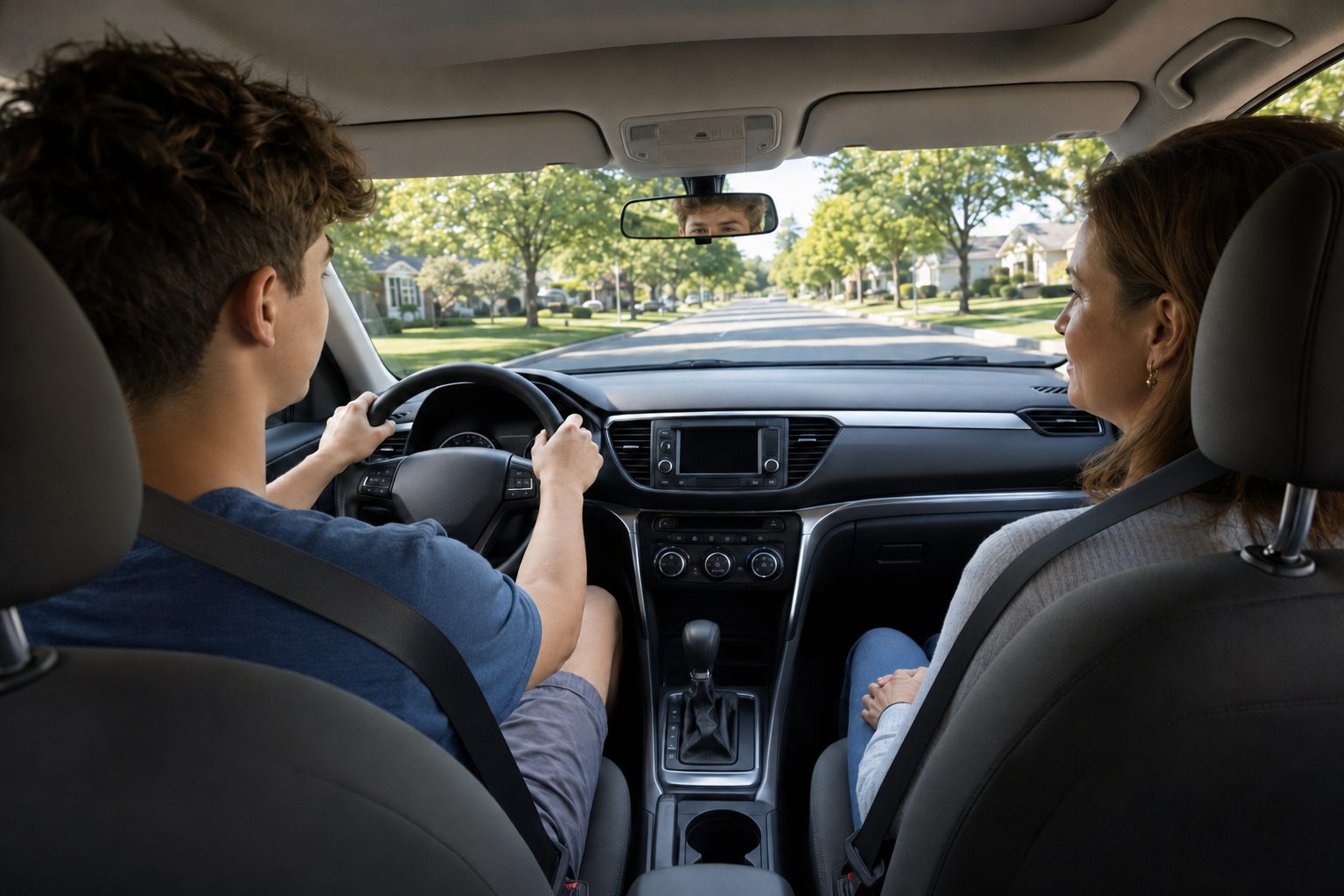
Parents should keep the rehearsal short, calm, and realistic. The goal is not to scare the teen or lecture them. The goal is to help the teen practice speaking with confidence.
A parent can start by setting the scene. For example, the parent might say, “You are driving with two friends. One starts filming and says, ‘Go faster, this will be funny.’ What do you say?” The teen should answer out loud with a clear response such as, “No. I’m not risking a crash for a video. Put the phone down or I’m pulling over.”
Then the parent should add realistic pressure. The parent might say, “They laugh and call you dramatic.” The teen should repeat the boundary by saying something like, “You can laugh, but I’m still not doing it.” Finally, the parent should ask what action comes next. The teen might answer, “I pull over safely, stop the car, and call home if needed.”
This approach is effective because it practices not only the first response, but also the second response after the pressure increases.
Parent coaching rules
Parents should keep the practice short and make the teen say the words out loud. They should add realistic pressure, praise firm responses, and let the teen choose language that sounds natural. The teen does not need to sound perfect. The teen needs to sound clear, calm, and ready.
Parents should not mock the teen’s answer, give long speeches after every scenario, make the teen feel childish, use fear tactics, turn rehearsal into punishment, or demand perfect wording. The goal is not a perfect script. The goal is a usable script.
The six essential safety rehearsal scenarios
Every teen should practice the following six situations before driving alone.
1. A friend says, “Just check your phone”
The teen is driving. The phone buzzes. A friend says, “Just check it real quick.”
The teen should practice saying, “I’m pulling over before I touch my phone.” Other strong responses include, “Read it to me or it can wait,” “I’m not checking my phone while driving,” and “I’ll respond when I’m parked.”
The parent should add pressure by saying, “They tell you it only takes two seconds.” The teen should repeat, “Two seconds is still too long. I’m driving.”
If the pressure continues, the teen should ignore the phone, ask a passenger to read the message only if necessary, pull over safely before handling the phone, or put the phone in driving mode before the next drive.
This scenario helps teens manage phone urgency, social pressure, and impulse control.
2. A passenger refuses to buckle up
A passenger says, “Relax, it’s not far.”
The teen should practice saying, “I’m not driving unless everyone buckles up.” Other strong responses include, “This car does not move until everyone is buckled,” and “It’s my car rule. Buckle up or get another ride.”
The parent should add pressure by saying, “They roll their eyes and say you are being extra.” The teen should repeat, “Maybe, but I’m still not moving until everyone is buckled.”
If the passenger still refuses, the teen should keep the car in park, repeat the rule once, end the ride if needed, or call home for help.
This scenario helps teens resist embarrassment and understand that the driver is in charge of the vehicle.
3. A friend who drove starts acting impaired
The teen is at an event. The person who was supposed to drive starts acting impaired, high, overly tired, reckless, or unsafe.
The teen should practice saying, “I’m calling home. I’m not riding with them.” Other strong responses include, “I’m not getting in that car,” “We need another ride,” and “I’d rather deal with consequences than get hurt.”
The parent should add pressure by saying, “The friend says, ‘I’m fine. Stop making it weird.’” The teen should repeat, “I’m not arguing. I’m not riding with you.”
If the pressure continues, the teen should step away from the car, call a parent or caregiver, use the family safety phrase, contact a backup adult, or use another safe ride option.
This scenario is where the family pickup promise is especially important. The teen must know that if they call for help because they are unsafe, the first response will be safety, not immediate punishment, yelling, or shame. This scenario helps teens overcome fear of punishment, social embarrassment, and pressure to ride with an unsafe driver.
4. The teen feels too tired to drive home
It is late. The teen is exhausted after school, work, sports, studying, or an event.
The teen should practice saying, “I’m too tired to drive safely. I need help getting home.” Other strong responses include, “I need a safety reset,” “I’m not alert enough to drive,” and “Can you pick me up or help me make a plan?”
The parent should add pressure by saying, “You are worried your parent will be annoyed or disappointed.” The teen should repeat, “I’d rather call than risk driving tired.”
If the teen is too tired to drive, they should not start driving. If they are already driving, they should pull over safely, call a parent, caregiver, or backup adult, and wait somewhere safe and public.
This scenario helps teens recognize fatigue, reduce shame, and ask for help before taking a risk.
5. Someone pressures the teen to speed
Friends are in the car. Someone says, “Go faster,” “You drive so slow,” or “Race them.”
The teen should practice saying, “Stop pressuring me. I’m driving.” Other strong responses include, “I’m not speeding to impress anyone,” “I’m responsible for everyone in this car,” and “I’m not risking my license or your life.”
The parent should add pressure by saying, “They laugh and say you are scared.” The teen should repeat, “Call it whatever you want. I’m not speeding.”
If the pressure continues, the teen should slow down if needed, pull over safely, tell passengers the ride will end if they keep pushing, or call home if the car becomes unsafe.
This scenario helps teens handle peer approval, identity pressure, and thrill seeking.
6. Weather suddenly gets worse
The teen is driving and heavy rain, fog, snow, ice, flooding, or poor visibility suddenly gets worse.
The teen should practice saying, “Conditions changed. I’m slowing down and making a safer plan.” Other strong responses include, “I’m pulling into a safe place,” “I need help deciding what to do,” and “I’m not driving faster than I can see.”
The parent should add pressure by saying, “You are worried about being late.” The teen should repeat, “Being late is better than crashing.”
If weather worsens, the teen should slow down, increase following distance, turn on headlights when appropriate, avoid flooded roads, pull over somewhere safe if visibility or control feels poor, and call a parent or caregiver.
This scenario helps teens manage decision fatigue, weather judgment, and the pressure to keep going when conditions are no longer safe.
Additional rehearsal scenarios
Families can use these scenarios after practicing the six essentials.
If passengers are too loud or distracting, the teen can say, “I need it quiet. I’m driving,” “Turn the music down,” or “If it keeps going, I’m pulling over.” The coaching point is simple. The teen should not ask timidly. The teen is the driver and is in charge of the vehicle.
If someone wants to film or post while the teen is driving, the teen can say, “No. I’m not making content while driving,” “Put the phone down or I’m pulling over,” or “I’m not risking a crash for a video.”
If the teen is running late, the teen can say, “I’m late, but I’m not speeding,” “Being late is better than crashing,” or “I’m not making up time on the road.” This matters because being late is one of the most common reasons teens justify speeding.
If a friend wants a ride but there are too many passengers, the teen can say, “I can’t. I’m already at my limit,” “I’m not breaking the passenger rule,” or “You’ll need another ride.”
If the teen feels emotionally upset before driving, the teen can say, “I’m too upset to drive right now,” “I need ten minutes before I get behind the wheel,” or “I need a safety reset.” Parents should treat emotional overload as a real driving risk, similar to fatigue.
If an aggressive driver is behind them, the teen can say, “I’m not competing with them,” “I’m creating space,” or “Their anger is not my emergency.” The teen should not brake check, gesture, race, or respond emotionally. They should move over when safe or pull into a safe public area if needed.
If the teen misses a turn or takes the wrong exit, the teen can say, “I missed it. I’ll reroute,” “A wrong turn is not an emergency,” or “I’m not making a sudden move.” This is important because many unsafe maneuvers happen when a driver panics after missing a turn.
If a friend says, “My parents let me,” the teen can say, “That’s fine. These are my rules,” “I’m the driver, so I decide,” or “I’m not arguing about safety.”
If a passenger refuses to stop unsafe behavior, the teen can say, “I’m pulling over now,” “I will not drive while you do that,” or “Safety reset. This stops now.” This connects directly to the family agreement’s safety reset phrase.
The 10 minute safety rehearsal format
Families do not need a long session. Ten minutes is enough when it is repeated regularly.
In the first minute, the parent should set the tone by saying, “This is not a test. We are practicing so you do not have to figure it out under pressure.” For the next several minutes, the family should practice three scenarios. Choose one phone or distraction scenario, one passenger pressure scenario, and one unsafe ride or unsafe condition scenario.
Then the parent should add realistic pressure. For example, the parent can say, “They laugh,” “They call you dramatic,” “They say it is only five minutes,” or “They say their parents allow it.” The teen should repeat the boundary calmly and clearly.
At the end, the parent should ask what action comes next. The teen’s answer should be specific. Good action steps include pulling over, keeping the car parked, ending the ride, calling home, using the safety phrase, or getting another ride.
The 4 line script every teen should practice
This script works for many unsafe driving moments.
Name the risk. “This does not feel safe.”
Set the boundary. “I’m not driving unless this changes.”
Give the action. “I’m pulling over, calling home, waiting, or getting another ride.”
Repeat without arguing. “I said no. I’m responsible for this car.”
This script is important because teens often lose the moment by over explaining. Short, repeated statements work better under pressure.
How parents should respond when the teen calls for help
Parents must rehearse their response too. When the teen calls, the parent should begin by saying, “I’m glad you called. Are you safe right now?” Then the parent should ask, “Where are you?” Then the parent should say, “Stay where it is safe. I am helping you now.”
Parents should not begin with, “What did you do?” “Why are you there?” “I told you this would happen,” “You are grounded,” or “Who are you with?” Those questions can wait. The first priority is getting the teen home safely.
The family agreement says safety calls are protected calls. That means the conversation can happen later, when everyone is safe and calm.
Safety rehearsal completion checklist
Checklist from Safety Behind the Wheel Foundation
Before driving alone, the teen should be able to say and demonstrate the following.
☐ I can tell passengers to buckle up.
☐ I can refuse to check my phone.
☐ I can pull over safely if distracted.
☐ I can refuse to ride with an impaired driver.
☐ I can call home without fear of immediate punishment.
☐ I can say, “I need a safety reset.”
☐ I can handle teasing without changing my decision.
☐ I can slow down or stop when weather gets worse.
☐ I can refuse to speed when late or pressured.
☐ I know who to call if I feel unsafe.
Keep learning
Safe Driving Resource Center
Guides, self-checks and articles for drivers, parents of new drivers, and families recovering after a crash.