
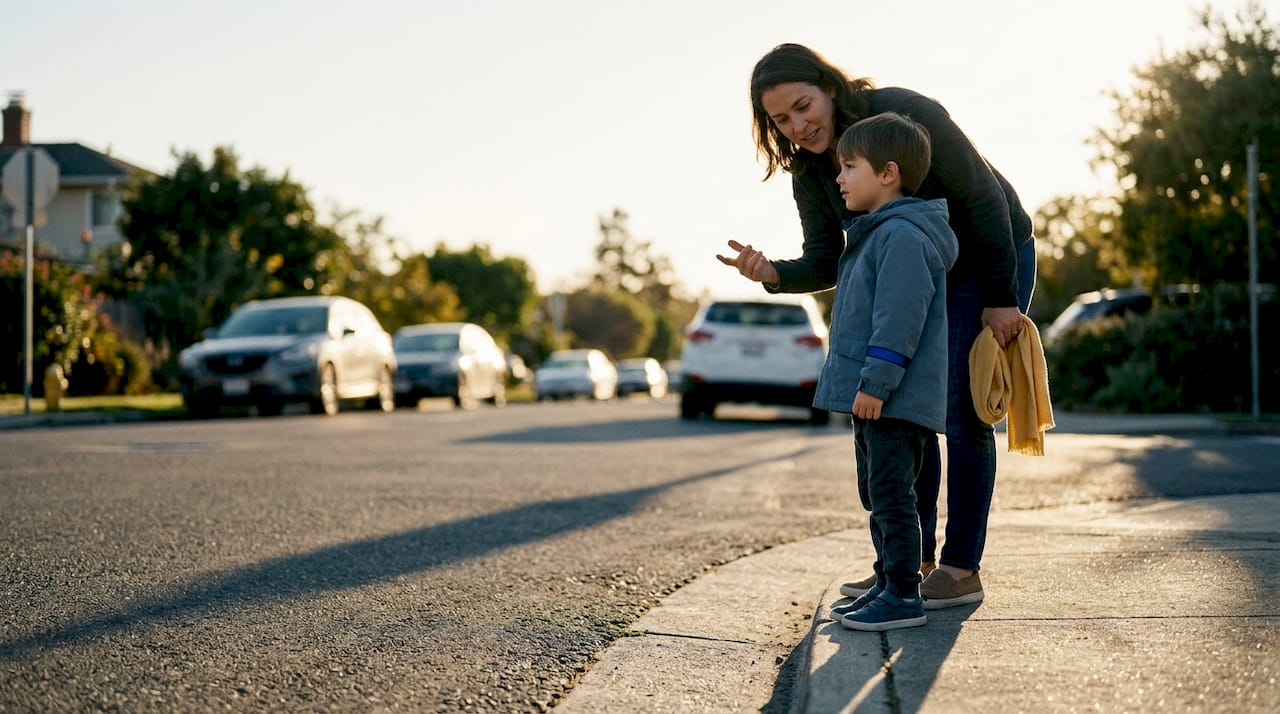
Road safety storytelling means using picture books, comics, social stories, and guided narratives to teach children specific safety behaviors instead of just reciting rules. The fastest way to start: pick one behavior, like stopping at the curb, and one story format your child or class already enjoys, then practice it together this week. Research from Pakistan backs this approach, and Drivewithcare builds its programs around the same idea.
TL;DR:
- Repeating storytelling sessions every few weeks significantly improves long-term road safety behavior compared to a one-time reading.
- Matching story formats to developmental stages enhances retention, with picture books for preschoolers, comics for teens, and role-play for practical skills.
- Reinforcing key crossing behaviors through discussion, physical practice, and family involvement sustains safety habits over time.
- Emotional and relatable survivor stories are most effective when paired with clear, actionable safety instructions rather than graphic shock tactics.
- Consistent practice and refreshers, not single events, are essential for embedding road safety behaviors in children’s routines.
Table of Contents
- Why Stories Work for Teaching Road Safety
- Story Formats You Can Use Right Now
- Which Story Fits Which Age and Behavior?
- Turning a Story Into Practiced Behavior
- What the Research Actually Recommends
- Ready-to-Use Templates for Busy Teachers and Parents
- Where Storytelling Fits Into Safer Roads Now
- Bring These Stories Into Your Classroom or Home
- Sources
- FAQ
- A Personal Take on Why Most Programs Undersell Repetition
Why Stories Work for Teaching Road Safety
Children under eight learn road rules poorly from lectures and well from pictures with a plot. A study of primary school children in Pakistan found that pictorial storybooks paired with classroom discussion measurably improved road-traffic injury prevention knowledge, with gains that held up better than passive instruction alone. The reason isn’t mysterious: a story gives a child a character to follow, a moment of risk, and a resolution, which mirrors how young brains organize memory in the first place.
Stories also do something a safety poster can’t. They build social-emotional skills, the kind that let a child pause and think instead of bolting after a rolling ball. That pause, self-regulation, is the actual skill behind “look both ways.” A rule without that pause is just words a child forgets under pressure.
A child who has practiced a story’s pause-and-check moment ten times is far more likely to do it for real than one who has only heard “look both ways” said out loud once.
Statistic Callout: In the same Pakistani intervention, knowledge gains held at a two-month follow-up but showed measurable decline compared to the immediate posttest, a clear signal that one story session isn’t enough. Retention needs refreshers, not a one-time read.
That decline matters more than the initial gain. A single story is a good start. Regularly revisiting the story, with a quick practice walk to the corner, is what actually changes behavior over a school year.
Story Formats You Can Use Right Now
Different ages respond to different formats, and matching the format to the child matters as much as the content itself. A five-year-old needs a picture book with one character and one lesson. A twelve-year-old needs something closer to a comic, with peer dynamics and real consequences.
Here are the formats worth building around:
- Social stories and picture books work best for preschool and early primary kids, using a single child character, simple pictures, and one behavior per story (stop, look, cross).
- Comics and short graphic narratives suit older children and adolescents. WHO and UNICEF’s comic-based guidance uses this format specifically because it delivers social and emotional learning through scenarios teens actually recognize, like peer pressure to cross against a light.
- PowerPoint slides and printable PDFs are the workhorse for classrooms and school assemblies, letting a teacher pace a story across a lesson and pause for discussion.
- Interactive tools, including simple role-play or VR-based rehearsal, let children physically practice a crossing decision rather than just watch one. Design research on conversational storytelling apps suggests these tools can capture how kids actually respond to a scenario, not just whether they liked it.
- Adapted, local-language versions matter more than most programs admit. A story translated word for word often loses the local landmarks, traffic patterns, or family roles that make it feel real to a specific classroom.
For accessibility, keep sentences short, use consistent character illustrations across pages so kids don’t lose track of who’s who, and read the same story aloud before asking a child to read it alone. A guide on social stories for kids offers additional practical tips on selecting and adapting material for classroom use.
Which Story Fits Which Age and Behavior?
Age-matching a story to a behavior sounds obvious until you watch a well-meaning teacher try to explain four-way stop etiquette to a five-year-old. Each age band can absorb a different number of steps and a different level of abstraction.
- Ages 3 to 5: One behavior per story, maximum. “Stop at the curb, hold a hand, cross when told.” The story beat should follow a real sequence, curb, stop, look, listen, hold hand, cross, with no side plot to distract from it.
- Ages 6 to 8: Two linked behaviors, such as checking both directions and using a crosswalk, told through a character who almost makes a mistake and corrects it. This age group responds well to a near-miss moment because it creates useful tension without being frightening.
- Ages 9 to 12: Multi-step scenarios involving independence, like walking home with friends or biking to a store, where peer influence enters the story. This is also the age where child restraint and seatbelt habits still need reinforcing, since older kids are the ones most likely to skip a seatbelt because “it’s just a short ride.”
After any story, a quick comprehension check works better than a quiz. Ask the child to retell the story’s key decision in their own words, or act out the crossing sequence with you playing the “car.” If they freeze or skip a step, that’s the exact spot to revisit next time, not a sign the whole story failed.
Turning a Story Into Practiced Behavior
A story alone changes what a child knows. Discussion and practice change what a child does. The gap between those two things is where most road safety lessons quietly fail, because reading a book about crossing safely and actually stopping at a curb under real traffic noise are not the same skill.
Simple prompts and activities close that gap:
- Ask a comprehension question (“What did the character do first?”), a behavior question (“What would you do at this corner?”), and a reflection question (“Has this happened to you?”).
- Run a “story replay” where kids physically act out the character’s steps, curb, stop, look, hold hand, cross, using tape on the floor to mark the curb.
- Send home a one-page checklist so a parent can reinforce the same three steps on the actual walk to school.
- Have kids draw their own version of the story’s crossing scene, which reveals whether they understood the sequence or just enjoyed the pictures.
Pro Tip: Run the same story twice a month for six weeks rather than once and moving on. Spaced repetition is what turns a story into a habit, and it costs nothing but five extra minutes.
Short, frequent refreshers beat one long annual assembly. A ten-minute session every few weeks keeps the story’s lesson active in a child’s memory, especially heading into a new school term or a change in season when walking routes shift.
What the Research Actually Recommends
The strongest evidence doesn’t say stories alone fix behavior. It says stories plus practice, plus periodic refreshers, do. A randomized trial on children’s traffic safety%20compared%20to) found that combining adult-guided discussion with VR-based practice produced larger improvements in traffic safety literacy and actual street-crossing behavior than routine education on its own.
Reading a story to a child and then asking them to act it out isn’t a nice extra step. It’s the difference between a lesson that sticks for a week and one that sticks for a season.
Statistic Callout: The same Pakistani storybook study that showed strong immediate gains also showed those gains softening two months later, reinforcing that a single reading session is a starting point, not a finish line.
WHO and UNICEF’s own comic-based guidance for adolescents backs the same principle from a different angle: a comic works because it pairs a relatable scenario with a classroom discussion, not because the artwork alone teaches anything. Emotionally engaging content, including survivor testimony, tends to land harder when it’s paired with a clear instructional takeaway rather than graphic detail for its own sake, according to research on effective road safety campaigns.
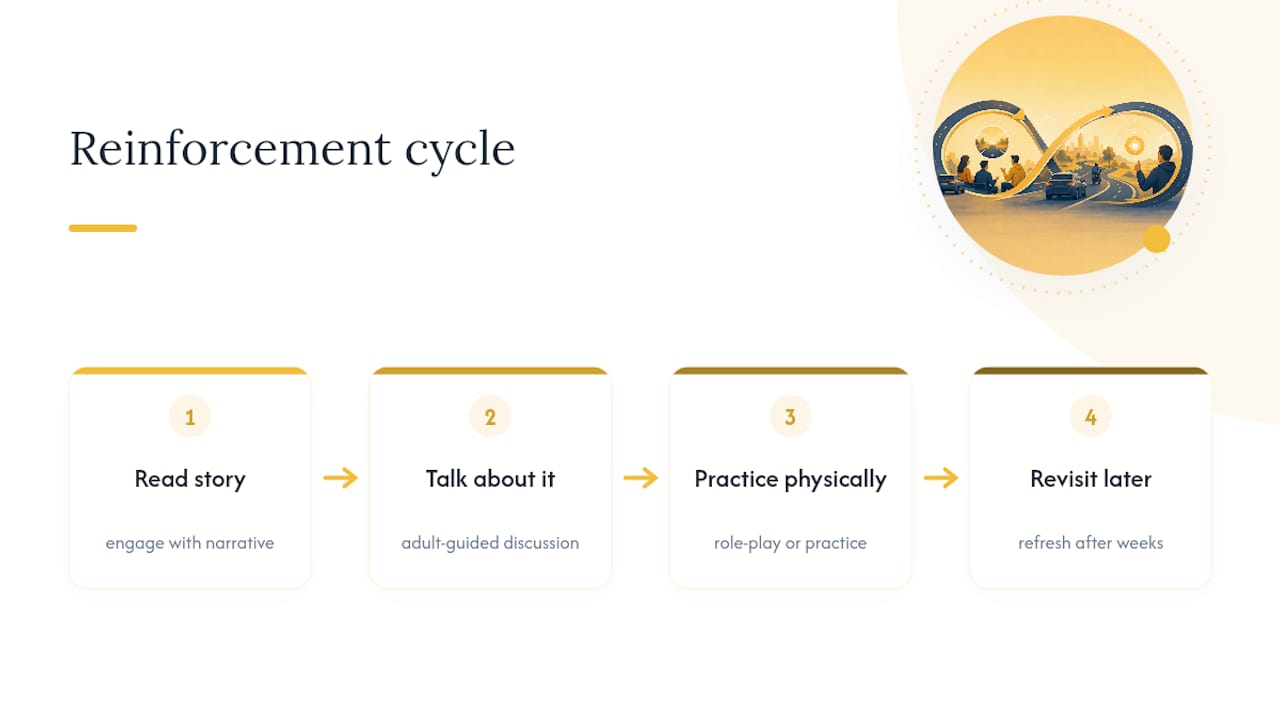
The practical takeaway for a parent or teacher is simple even if the research is layered: read the story, talk about it, practice the behavior physically, and come back to it in a few weeks. Skip any one of those four steps and the lesson decays faster.
Ready-to-Use Templates for Busy Teachers and Parents
You don’t need to write a story from scratch. A basic skeleton works for almost any age group once you fill in the specifics.
- One-page social story template: Character name and age → the setting (a specific street or crosswalk your child recognizes) → the single behavior being taught → a small challenge or near-miss moment → the correct action → a closing line that names the behavior directly (“I stop, I look, I hold hands”).
- 5-minute micro-plan: Read the one-page story aloud once, ask one comprehension question, then physically walk through the sequence in the room or hallway. This fits into a car ride, a bedtime routine, or a homeroom warmup.
- 20-minute classroom plan: Read the story, hold a five-minute group discussion, split into pairs for a role-play of the crossing sequence, then close with a one-sentence pledge from each child about what they’ll do at their own street corner.
For remote lessons or school assemblies, a PowerPoint version of the same story with voiceover narration keeps the pacing intact even without a live reader in the room. If you want a structured practice format beyond the story itself, Drivewithcare’s safety reset rehearsal walks through how to rehearse a safety response under simulated pressure, which works well as a follow-up to any crossing story.
Where Storytelling Fits Into Safer Roads Now
Drivewithcare built its Safer Roads Now initiative around a simple observation: human error causes the overwhelming majority of traffic incidents, and error is rarely fixed by a rule alone. It’s fixed by a habit, and habits form through repetition, not memorization.
Safer Roads Now pairs personal survivor stories with community engagement and data analysis, the same three-part structure this article has been describing at a smaller scale for classrooms. Thousands of drivers have already joined a pledge program, and partnerships with driving schools and local agencies bring a similar story-driven approach into classrooms. If your school or community group wants to build on the templates above, that partnership network is a practical next step, and a safe driving agreement between teens and parents extends the same pledge-based thinking into the teen years.
Bring These Stories Into Your Classroom or Home
Reading a story once a year isn’t a program. It’s a start. Support organizations help parents and educators turn that start into something that actually holds, through downloadable toolkits based on evidence, partnership programs for schools and driving instructors, and pledge campaigns that keep families practicing long after the story ends.

If your school or community group wants a ready-made toolkit or wants to discuss a partnership session, Drivewithcare’s safety awareness programs page is the place to start that conversation. Organizations that want to fund this kind of storytelling work directly can explore the Safety Supporter Partnership at $250, or step up to the Community Safety Partner Partnership at $1,500 for a more involved role in local programming. Individual supporters can back the same work with a one-time gift of $10 to $250 through Donate Now. Every dollar goes toward the templates, refreshers, and program partnerships that keep road safety stories in front of kids past the first reading.
Sources
- Teaching children road safety through storybooks: an approach to child health literacy in Pakistan
- The comic story of Magnificent Mei and friends
- Child restraint systems: one family buckles in ahead of Viet Nam’s new law
FAQ
Can You Tell Me a Short Story About Road Safety?
A simple version: a child named Sam reaches a curb, stops, looks left, looks right, listens for cars, holds an adult’s hand, and crosses only when the street is clear. This exact beat sequence, curb, stop, look, listen, hold hand, cross, is the structure research recommends for a single-behavior story aimed at ages three to five.
What Are the Golden Rules for Road Safety?
There’s no single universally agreed “10 golden rules” list, but the core behaviors consistently taught across programs include stopping at the curb, looking both ways, crossing only at marked crossings, holding an adult’s hand, wearing a seatbelt or using a child restraint system, and never running into the street after a ball or pet. Correct child restraint use alone reduces death risk by 71% for babies under one and 54% for children aged one to four.
Can You Give an Example of a Short Speech About Road Safety?
A five-minute speech works best built around one story, not a list of statistics: introduce a relatable character, describe a moment where they almost make a mistake crossing the street, show the correct action they take instead, and close with a direct call to the audience to practice that same action this week. Pairing the story with one clear instruction, rather than several rules at once, tends to land harder with young listeners, according to research on effective road safety campaigns.
What Are Some Good Examples of Road Safety Stories?
Strong examples include a picture book about a child learning to stop and check before crossing, a comic following a teen who resists peer pressure to jaywalk, and a survivor’s personal account paired with a clear instructional takeaway. Drivewithcare’s Safer Roads Now initiative uses this last format directly, combining survivor stories with community engagement to reinforce lasting behavior change.
How Often Should Road Safety Stories Be Repeated?
Plan on revisiting the same story or behavior roughly every few weeks rather than once a year. A Pakistani classroom study found that knowledge gains from a single storybook session declined over a two-month follow-up, which is the clearest evidence that refreshers, not one-time lessons, drive lasting behavior change.
A Personal Take on Why Most Programs Undersell Repetition
Most road safety programs treat storytelling as a one-time event: an assembly, a book fair visit, a single classroom reading. That’s the mistake. The evidence is consistent on one point that gets ignored constantly: knowledge from a single story session fades within a couple of months. Nobody builds a curriculum around that fact, because refreshers are less exciting than a big kickoff event.
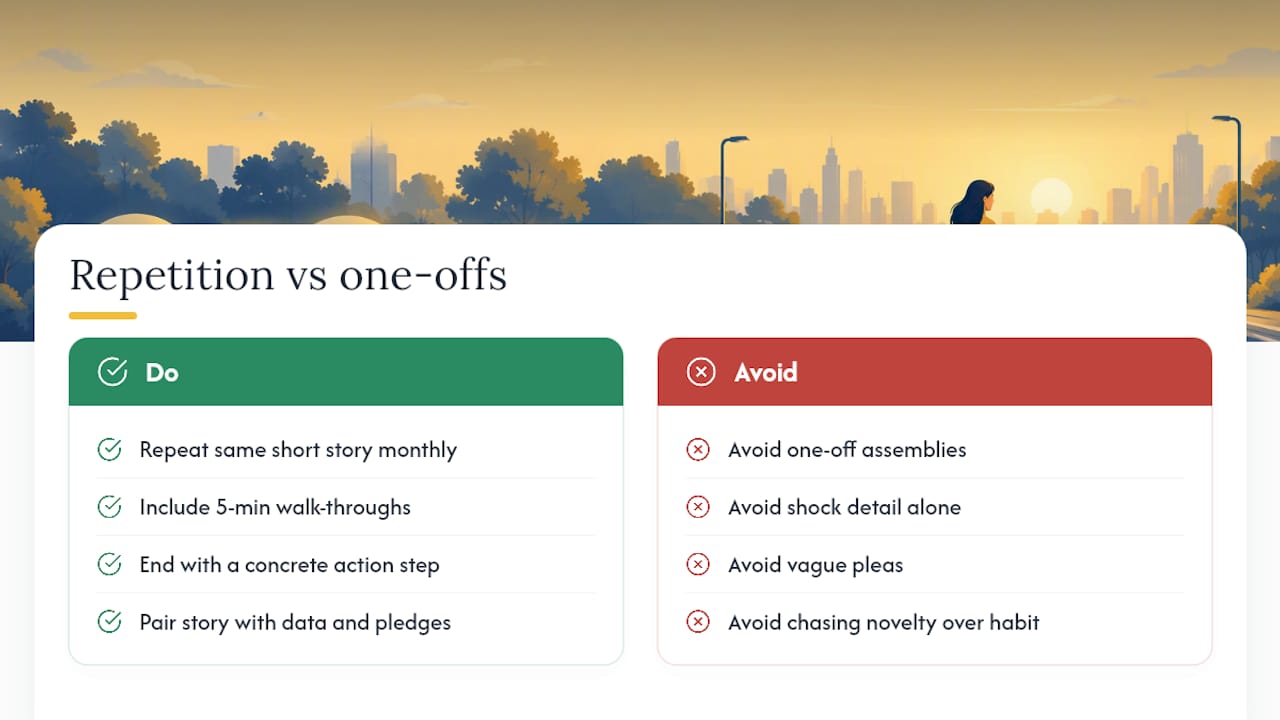
What actually works looks unglamorous. It’s the same short story read three or four times across a semester, paired with a five-minute walk-through each time, not a new elaborate production every time. Schools chase novelty because it’s easier to fund a one-off assembly than a recurring fifteen-minute habit. But the research points the other way: a child who practices the same crossing sequence monthly is safer than one who saw a spectacular VR demo once and never touched it again.
There’s also a quieter issue with how survivor stories get used. Too many programs lean on graphic detail to shock an audience into caring, when the evidence actually favors pairing emotional weight with a specific, actionable instruction. A survivor’s story that ends with “so please be careful” teaches nothing. One that ends with “so I always check my mirror twice before changing lanes” gives a listener something to actually do. Drivewithcare’s model, pairing personal narrative with concrete data and community pledges, gets this balance closer to right than most one-off campaigns manage. The organizations that will move the needle on child pedestrian safety over the next decade are the ones willing to repeat a simple story often, not the ones chasing the next flashy format.
— Charles

