

Defensive driving, in the community sense, means safety-focused education, pledge campaigns, and survivor-support programs designed to change driver behavior rather than a state-approved course you take for an insurance credit. The evidence is mixed but clear: these programs reliably improve knowledge and attitudes, yet a systematic review found no consistent drop in crashes from education alone. If you want real impact, the next step is joining or supporting a locally run program, such as Drive With Care’s Safer Roads Now, rather than a one-off class.
TL;DR:
- Short-term knowledge and attitude improvements from educational programs fade without ongoing reinforcement or integration with other safety measures.
- Effective crash reduction relies on combining education with engineering, enforcement, and emergency response, not on education alone.
- Local community-led programs with dedicated coordinators and data-driven goals outperform generic statewide campaigns or one-off classes.
- Insurance discounts for defensive driving are modest, usually lasting one to three years, and often exclude high-risk drivers or certain coverage types.
- Sustainable behavior change requires community involvement, personal stories, and follow-up, rather than solely relying on a single educational session.
Table of Contents
- Why This Definition Matters (and Who This Guide Is For)
- What the Research Shows About Defensive Driving Education
- The 4E Framework and Why Local Ownership Wins
- Building a Program That Actually Gets Measured
- Why Personal Stories Stick When Statistics Don’t
- How Families, Donors, and Community Groups Can Get Involved
- How Defensive Driving Courses Fit Into Insurance Discounts
- What Insurers Look For Before Granting a Discount
- How Discount Policies Vary Across Insurance Providers
- How to Verify and Apply for Your Discount
- Where These Discounts Fall Short
- What Drive With Care Believes About Real Behavior Change
- Join Drive With Care’s Safer Roads Now Effort
- Sources
- FAQ
Why This Definition Matters (and Who This Guide Is For)
Search results on “defensive driving insurance discount” mostly point to insurer-approved courses that shave a few dollars off a premium. This guide takes a different angle. It treats defensive driving as the community education, pledge, and survivor-support work that groups like Drive With Care run, aimed at changing behavior, not qualifying for a rate cut.
That distinction matters because the audiences are different. You might be a parent trying to keep a new driver alive on the road, a survivor looking for a way to turn a crash into prevention work, a community group weighing whether to launch a program, or a donor deciding where dollars do the most good. Realistic outcomes here look like fewer near-misses, stronger family agreements, and sustained local partnerships. This article won’t walk you through insurance paperwork. It walks you through building something that actually reduces harm.
What the Research Shows About Defensive Driving Education
Education changes what people know. It does not reliably change what they do behind the wheel, at least not by itself.
The core finding: A pooled analysis of driver education trials found a relative risk for crash reduction of roughly 0.98, with a confidence interval of 0.96 to 1.01. That number sits right on the line of “no effect.” Drivers who complete a course tend to score better on knowledge tests and report better intentions right afterward, but those same drivers don’t crash noticeably less than drivers who skipped the course.
Two things follow from that finding, and community programs need to grapple with both:
- Short-term gains in test scores and stated attitudes are real and measurable, but they fade without reinforcement.
- Long-term crash and injury reduction requires more than a classroom. IIHS guidance is direct on this point: education has to pair with engineering fixes, enforcement, and evaluation to move the needle on actual outcomes.
That’s not an argument against education. It’s an argument for building education into something bigger.
The 4E Framework and Why Local Ownership Wins
Programs that actually reduce crashes rarely rely on a single lever. The traffic safety field organizes its work around four categories, often called the 4E’s:
- Engineering covers physical fixes, such as better signage, protected turn lanes, or speed bumps near schools.
- Education covers the classroom and workshop content, the piece most people think of first.
- Enforcement covers traffic law application, from speed checks to sobriety checkpoints,.
- Emergency care covers how fast and how well a community responds once a crash happens.
Community Traffic Safety Programs, or CTSPs, build all four into one locally run structure. A federal review of CTSPs counted at least 334 of these programs serving roughly 100 million people, each anchored by a coordinator and a task force that mixes public agencies with private partners like hospitals, insurers, and driving schools.
The coordinator role is the piece easiest to underestimate. A program with a strong, networked coordinator who can pull local crash data and turn it into a specific local ask, more lighting on a dangerous curve, a school-zone speed campaign, tends to outperform a generic statewide push. National campaigns provide the research; local coordinators provide the traction.
Pro Tip: Before your group commits to a curriculum, ask what your local CTSP or safety task force already measures. Piggybacking on an existing data set saves months of setup work.
Building a Program That Actually Gets Measured
A program without a measurement plan is just a nice event. Here’s the order that keeps a pilot from becoming a one-time favor to a school and nothing more:
- Run a needs assessment first. Pull local crash data, police reports, and school or workplace incident logs to find your actual problem, whether that’s distracted teen drivers, impaired commuters, or a dangerous stretch of road.
- Write SMART objectives. A goal like “reduce reported near-misses among teen drivers by 15% in six months” is measurable in a way “raise awareness” never will be.
- Pick your KPIs before you pick your content. Knowledge scores, self-reported behavior, pledge sign-ups, and event frequency all work, but decide which ones matter before designing the workshop around them.
- Choose your intervention format. Survivor speakers, peer-leader sessions, school modules, or a safe-ride pilot all fit different budgets and different problems.
- Set a pre/post evaluation window. Test knowledge and attitudes before the program and again afterward, then again a few months later to see what actually held.
A program planning guidebook developed for teen driver initiatives recommends splitting evaluation into process measures (did the program run as planned) and impact measures (did anything actually change). Skipping the impact side is the single most common mistake groups make, and it’s the reason so many well-meaning programs can’t answer a funder’s simplest question: did this work?
Why Personal Stories Stick When Statistics Don’t
Fear-based messaging tends to fade fast. What sticks, according to research on education-based road safety interventions, is content built around real, relatable stories, not shock tactics.
The mechanism is simple: a story that feels like it could happen to you creates a stronger emotional imprint than a statistic. A Slovenian study on road safety education found that program participants showed a weaker link between traffic violations and accidents than nonparticipants, a sign that the training shifted actual responsibility, not just quiz scores.
The catch is durability. Research on the Safe Drive Stay Alive intervention found that knowledge and attitude gains can fade within a couple of months without reinforcement. Three tactics help close that gap:
- Bring in survivor speakers whose stories match your audience’s age and situation, not a generic cautionary tale.
- Train peer leaders, students or coworkers already respected by the group, to carry the message after the formal session ends.
- Schedule a top-up touchpoint at the two or three month mark, even something as light as a five-minute refresher or a reminder pledge signing.
Pro Tip: Calendar your top-up session when you launch the program, not after you notice engagement dropping. By the time you notice, the gains are usually already gone.
How Families, Donors, and Community Groups Can Get Involved
You don’t need a transportation department budget to make a difference here. Small, well-targeted support often moves a pilot program further than a large, unfocused grant.
What tends to need funding:
- Curriculum materials and printed pledge cards
- Modest stipends for peer leaders or guest survivor speakers
- Evaluation costs, including pre/post survey tools and basic data analysis
Volunteer roles that don’t require a safety background:
- Hosting a pledge event at a school, workplace, or community center
- Coordinating logistics for a survivor speaker series
- Helping distribute and collect pre/post surveys
When you approach a school, police department, or hospital as a partner, ask a specific question rather than a broad one. Don’t ask “will you support road safety.” Ask “will you share your last two years of local crash data” or “can we use fifteen minutes of your driver’s ed orientation for a pledge signing.” Specific asks get specific yeses. Groups can also explore Drive With Care’s safety awareness programs for a working example of how community engagement, data, and personal stories combine in practice.
How Defensive Driving Courses Fit Into Insurance Discounts
Separate from the community programs at the center of this guide, many drivers also encounter defensive driving in a narrower context: a specific class, often several hours long, that some insurers recognize with a small premium reduction. It’s worth understanding briefly, since the phrase shows up everywhere and readers researching community programs sometimes assume the two are the same thing.
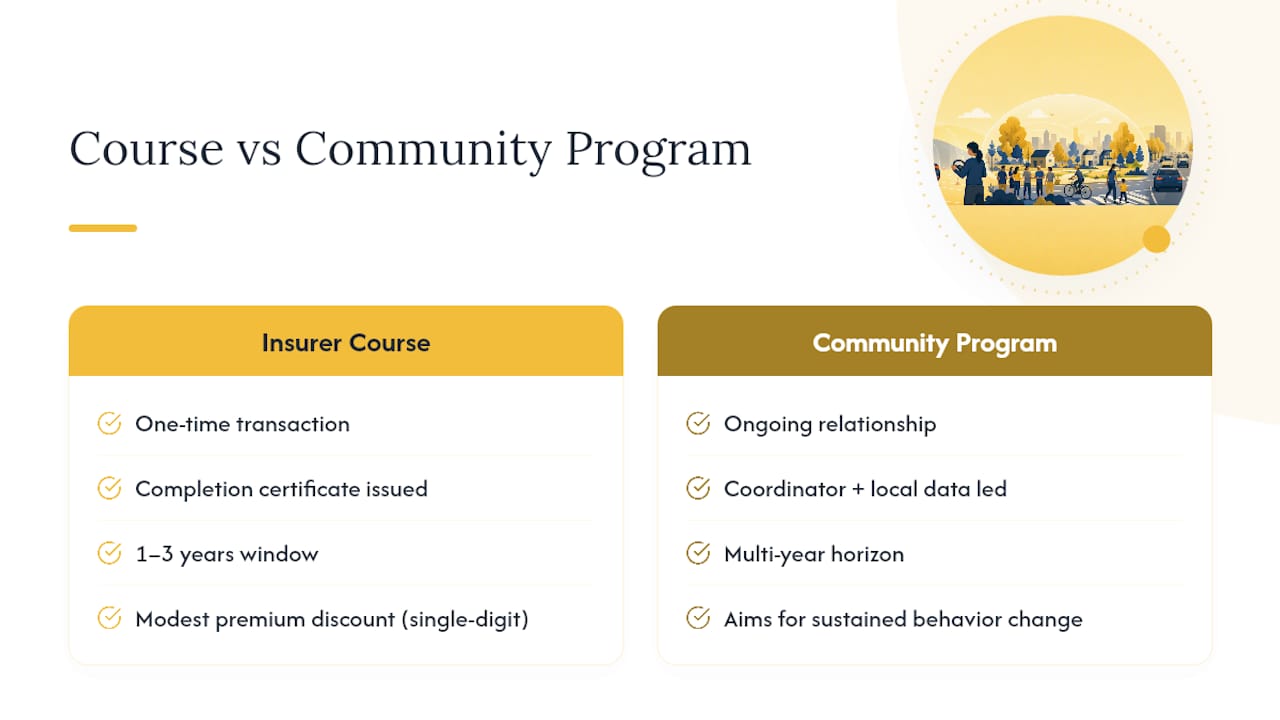
These insurer-recognized courses typically cover hazard recognition, following distance, and reaction-time drills, then issue a completion certificate. The logic insurers use is straightforward: a driver who has recently reviewed core safety habits is a marginally lower statistical risk, at least for a defined period after completion. The discount is usually modest, often a single-digit percentage off the driving-related portion of a premium, and it typically applies for a set window, commonly one to three years, before the driver needs to retake the course to keep the credit.
This is a different mechanism from what CTSPs and community pledge programs aim for. A discount course is a one-time transaction between a driver and an insurer. A community program is an ongoing relationship between a coordinator, local data, and a population of drivers, aimed at behavior change over years, not a single renewal cycle. Both have a place. If your primary interest is lowering a premium, a state-approved course through your insurer is the right path. If your interest is reducing crashes in your community or supporting survivors, the programs described throughout this guide are where the evidence points.
What Insurers Look For Before Granting a Discount
Insurers don’t treat every completed course the same way, and the criteria vary by company and by state. A few patterns show up consistently across the industry, though exact terms always come from your specific policy.
Most insurers require the course to come from an approved or state-certified provider list. A class that isn’t on that list, no matter how good the content, usually won’t qualify for a credit. Age also plays a role in some states, where the discount is explicitly tied to older drivers as a way to offset age-related risk factors, while other states apply it to any licensed driver regardless of age.
Driving history matters too. A driver with a recent at-fault accident or multiple moving violations may find the discount doesn’t apply, or applies at a reduced rate, since insurers reserve the biggest incentives for drivers they already consider lower risk. Some insurers also cap how the discount stacks with other reductions, so a driver already receiving a multi-policy or good-student discount might see a smaller additional credit than the course technically offers.
Course format matters as well. Some insurers accept only in-person classes, others accept online courses, and a growing number require a specific number of instructional hours, often between four and eight, to qualify. Renewal timing is the detail people miss most often: the discount usually expires after a set period, and failing to retake the course before that window closes means the credit quietly disappears from the next renewal without any notice beyond the fine print in the policy documents.
How Discount Policies Vary Across Insurance Providers
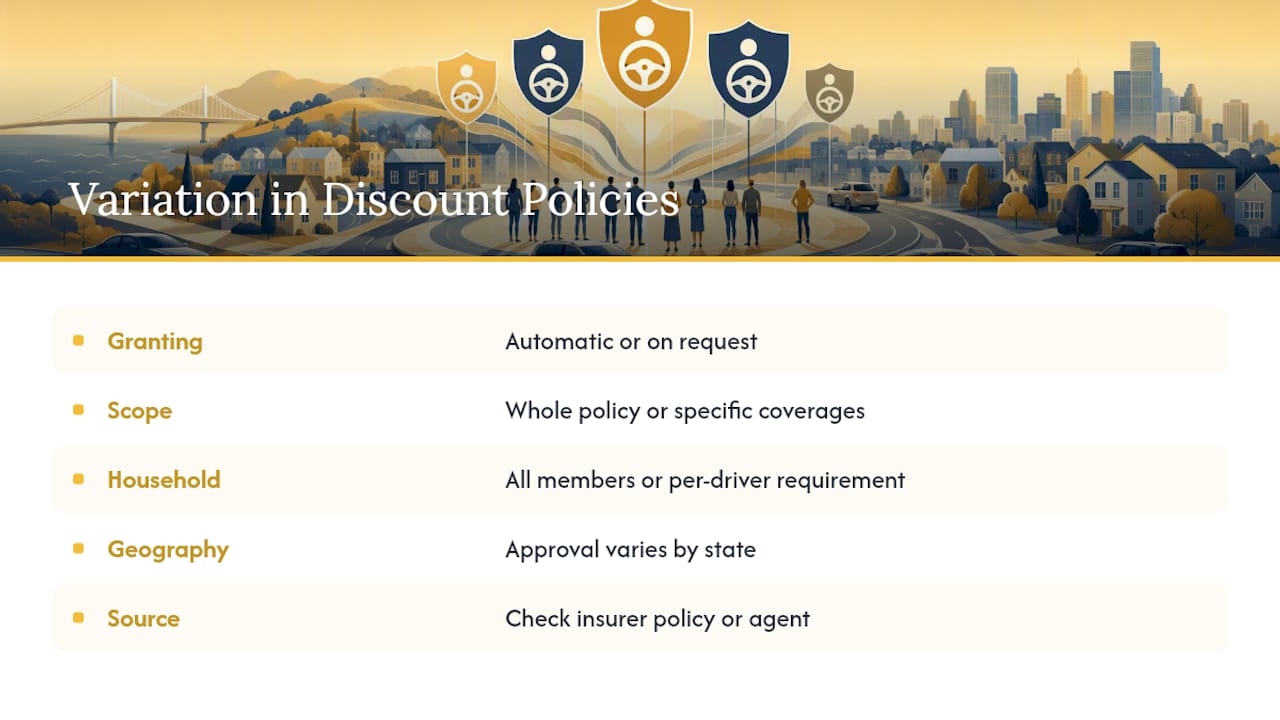
Every insurer sets its own rules for defensive driving discounts, and the differences can be significant enough to change which course makes sense for a given driver. Some insurers offer the discount automatically once proof of completion is submitted, while others require the driver to request it specifically through an agent or online account.
The size of the discount also varies. Some carriers apply the credit to the entire policy, while others limit it to specific coverage types, like liability or collision, leaving other parts of the premium untouched. A handful of insurers extend the discount to household members who share a policy, meaning one completed course by a teen driver or a senior parent can lower the rate for the whole family plan, while other carriers require every listed driver to complete the course independently to receive any credit at all.
Geography adds another layer. State insurance regulators often set minimum standards for what counts as an approved course, and insurers build their discount rules around those state requirements. That means a course accepted for a discount in one state might not qualify in a neighboring state, even from the same national insurance company. Drivers who move, or who hold policies that cover vehicles registered in different states, should confirm eligibility separately for each location rather than assuming a prior approval carries over.
Because these policies shift by company and by state, and because insurers update their approved-provider lists periodically, the only reliable source for current terms is your specific insurer’s policy documents or a direct conversation with your agent.
How to Verify and Apply for Your Discount
Completing a course doesn’t automatically lower your premium. You have to close the loop with your insurer, and skipping a step is the most common reason drivers assume they got a discount when they didn’t.
Start by confirming, before you enroll, that the course is on your insurer’s approved list. Calling ahead takes ten minutes and can save you from paying for a class that doesn’t qualify. Next, keep the completion certificate the course provider issues. Most insurers require the original document, or a clear copy, not just a verbal confirmation that you finished.
Submit the certificate through whichever channel your insurer designates: an online policy portal, a mailed form, or your agent directly. Ask explicitly how the discount will appear, whether it’s an immediate adjustment or something that applies at your next renewal, since the timing differs by carrier. Request written confirmation once it’s processed, ideally an updated declarations page showing the new premium, so you have a record if the credit doesn’t show up correctly.
Finally, mark your calendar for the discount’s expiration date. Since most of these credits last one to three years, set a reminder several months before it lapses so you can retake the course and resubmit paperwork without a gap in savings. Drivers who let the window close often don’t notice the loss until they compare renewal premiums months later and can’t figure out why the rate went up.
Where These Discounts Fall Short
The discount is smaller than most drivers expect, and it comes with more conditions than the marketing suggests. Framing it as a meaningful budget fix, rather than a modest bonus, sets up disappointment.
Coverage limits are the biggest gap. Many policies apply the discount only to liability coverage, leaving comprehensive and collision premiums, often the largest share of the bill, completely untouched. A driver expecting a break on their full premium may find the actual savings amount to just a few dollars a month.
Eligibility exclusions cut out entire groups of drivers. High-risk drivers, those with recent DUI convictions, multiple at-fault accidents, or license suspensions, are frequently barred from the discount regardless of course completion, since insurers view the course as a modest risk offset rather than a mechanism for erasing a poor driving record. Some insurers also exclude commercial policies or vehicles used for rideshare work, even when the same driver’s personal policy would qualify.
The discount also isn’t permanent, and renewal requirements catch people off guard. Letting the certification lapse means losing the credit silently at the next renewal, with no guarantee the insurer will flag the change. And because state regulations vary, a driver who relocates may discover their prior course no longer satisfies the new state’s approved-provider requirements, forcing a retake even though nothing about their driving changed.
What Drive With Care Believes About Real Behavior Change
Most defensive driving content treats the classroom as the finish line. It isn’t. The evidence throughout this guide points to a harder truth: a single course, however well designed, rarely survives contact with real-world habits for more than a few months without reinforcement.
That’s the gap Drive With Care built its work around. As a nonprofit focused on transforming road safety through education and support for drivers and accident survivors, the organization treats human error, a factor in the overwhelming majority of crashes, as something that requires ongoing engagement, not a one-time lesson. Its Safer Roads Now initiative combines personal survivor stories, community partnerships, and local data analysis, the same combination the research in this article shows actually sustains behavior change over time. The organization runs a pledge program and forms partnerships with driving schools and local agencies that align with community traffic safety principles.
The honest position is that education alone won’t save lives. Sustained, locally rooted programs that pair stories with data and follow-up might.
— Charles
Join Drive With Care’s Safer Roads Now Effort
If you’ve made it this far, you already understand why a single class rarely changes behavior on its own. What does work is the combination this guide has walked through: real stories, local data, and follow-through, which is exactly what Drive With Care’s Safer Roads Now programs are built around.
Two things you can do right now. First, sign the Drive With Care safety pledge and get your family or workplace to join you, a small commitment that research on peer-driven behavior change suggests carries more weight than it looks like on paper. Second, if you’re part of a school, employer, or community group weighing whether to launch or fund a program, reach out through the safety awareness page to request a consultation or explore sponsoring a pilot. Donors and corporate partners can also review current resources to see where funding is most needed right now.
Sources
- Systematic review on driver education effectiveness (PMC)
- Review and Analysis of Community Traffic Safety Programs
- Education alone won’t make drivers safer or reduce crashes — IIHS
FAQ
Does a Community Safety Program Guarantee Fewer Crashes?
No single program guarantees a crash reduction. Pooled research on driver education puts the crash-reduction effect close to zero on its own, which is why the strongest programs combine education with local data, enforcement, and follow-up.
What Makes a CTSP Different From a One-Time Safety Class?
A CTSP is a sustained, locally coordinated structure with a dedicated coordinator, a task force of public and private partners, and ongoing funding, rather than a single class with no follow-up.
How Soon Do Education Program Gains Fade Without Reinforcement?
Knowledge and attitude gains from education-based interventions can start slipping back toward baseline within a couple of months, which is why planners build in top-up sessions rather than treating the initial workshop as complete.
Can a Community Group Start a Program Without a Large Budget?
Yes. Small grants covering curriculum materials, speaker stipends, and basic evaluation tools are often enough to pilot a program, and partnering with an existing group like Drive With Care can reduce startup costs further.
Is a Defensive Driving Insurance Discount the Same as a Community Safety Program?
No. An insurance discount course is a short, insurer-approved class tied to a premium credit, while community programs like Drive With Care’s Safer Roads Now focus on sustained behavior change through stories, data, and local partnerships.

