

Slow down well below the posted limit, double your following distance to at least 4 to 6 seconds, and never drive into standing or moving water. Those three habits address most of the risk rainy weather driving carries. Nearly 75% of weather-related crashes happen on wet pavement, and almost half occur while it’s actually raining, so these are not optional suggestions.
TL;DR:
- Reduce your speed by 5 to 10 mph in light rain and more in heavy downpour or standing water to maintain better control and traction.
- Increase following distance to 4 to 6 seconds to allow for longer stops on wet pavement, which roughly doubles stopping distances.
- Avoid driving through deep standing water; if visibility is lost or the depth cannot be judged, turn around to prevent the risk of flooding or vehicle sweep-away.
- Check tire tread depth regularly, replacing tires with less than 1.6 millimeters of tread to prevent hydroplaning, and always keep wiper blades and lights in working order.
- Slow down before entering curves and avoid mid-curve braking, and pass carefully only when visibility and oncoming lane conditions are clear, to prevent skidding and loss of control.
Table of Contents
- Rainy Weather Driving: Speed, Space, and Steering Basics
- Hydroplaning: How to Prevent It and Recover Safely
- Getting Your Car Ready Before the Rain Starts
- Standing Water and Flooded Roads: Where the Real Danger Hides
- Deciding Whether to Drive at All in Heavy Rain
- What Drivewithcare Does for Drivers in the Rain
- Braking on Wet Roads: Why Gradual Beats Sudden
- Where to Position Your Car in the Lane
- Curves and Passing: Extra Caution Points in Wet Weather
- Building a Rain-Ready Emergency Kit
- The Mistakes That Keep Repeating in Rainy Weather Driving
- Support Safer Roads With Drivewithcare
- Sources
- FAQ
Rainy Weather Driving: Speed, Space, and Steering Basics
Every one of these adjustments comes down to one physical fact: wet asphalt cuts your tires’ grip, and grip is what stops you, turns you, and keeps you pointed straight.
Start with speed. There’s no universal formula, but a solid rule of thumb is cutting 5 to 10 mph off your normal pace in light rain, and more in heavy downpours or standing water. On a highway typically driven at 65 mph, that might mean settling into 55. In a 35 mph zone, drop to 25 or 30 when the rain picks up.
Following distance matters just as much as speed. Stopping distances on wet pavement run at least double what they are on dry roads, so the recommended 2 to 3 second gap used in dry conditions should stretch to 4 to 6 seconds in rain. Pick a fixed point on the road, like a sign or overpass, and count the seconds between when the car ahead passes it and when you do.
- Turn off cruise control the moment rain starts; it holds your speed steady when you need to ease off power to regain traction, and manual throttle control lets you react instantly to a slick patch.
- Brake and accelerate gradually. Sudden inputs are what break traction in the first place.
- Turn your headlights on, even in daylight. Low beams cut through rain and spray far better than daytime running lights alone, and they make you visible to oncoming traffic.
- Run your wipers and rear defogger together. A clear windshield that fogs up from the inside defeats the purpose of new wiper blades.
- Choose the middle lanes on multi-lane roads when it’s practical. Water pools in the outer lanes and along the crown of the road.
Pro Tip: If your wipers can’t keep up with the rain no matter how fast you set them, that’s your car telling you to slow down further. Visibility loss and traction loss usually arrive together.
Hydroplaning: How to Prevent It and Recover Safely
Hydroplaning happens when a layer of water builds up faster than your tire tread can channel it away, and your tire literally lifts off the pavement to ride on a film of water. Worn tread and higher speeds both raise the odds sharply, since tread grooves are what pump water out from under the contact patch.

Preventing it starts before you feel it. Slow down anytime you see standing water, and avoid driving directly through the deepest-looking puddles. If a vehicle ahead of you has already passed through safely, following its tire tracks is often your best bet, since it has effectively cleared a path.
If you do feel the car go light and start to drift, the recovery sequence is short and worth memorizing:
- Ease off the accelerator immediately. Do not brake hard and do not lift off suddenly, either. Let the car slow on its own.
- Steer where you want to go, keeping your hands steady rather than jerking the wheel to correct.
- Wait for the tires to regain contact with the road surface. You’ll usually feel a slight bump or renewed resistance.
- Brake gently only after traction returns. Modern anti-lock brakes are built for exactly this moment. Let ABS pulse the brakes for you instead of pumping the pedal yourself. Fighting the system with rapid on-off pressure defeats its purpose and can extend your stopping distance.
Getting Your Car Ready Before the Rain Starts
A car that’s ready for wet roads starts with tires. Run the classic coin test: insert a penny into the tread groove with Lincoln’s head down. If you can see the top of his head, your tread has worn past the safe minimum. Tire makers generally recommend replacement before tread depth reaches 1.6 millimeters, or about 2/32 of an inch, since shallow tread can no longer channel water fast enough to prevent hydroplaning.
Check tire pressure cold, before you’ve driven, since underinflated tires flatten the contact patch and reduce the grooves’ ability to clear water. Wiper blades that streak, skip, or leave arcs of haze need replacing, and washer fluid should never run dry going into rainy season.
- Test brakes for pulling, grinding, or a soft pedal feel on a quiet street before you need them in traffic.
- Check that every light works: headlights, taillights, and brake lights, since visibility runs both directions.
- Look at tread depth on all four tires monthly, not just the front pair.
- Top off washer fluid and inspect wiper blades for cracking or hardened rubber.
Pro Tip: A simple monthly walk-around, tires, wipers, lights, fluid, catches most of the equipment failures that turn ordinary rain into a real hazard.
Standing Water and Flooded Roads: Where the Real Danger Hides
Water depth is deceptive because you’re judging it from inside a car, often in low light, with rain distorting your view. Underneath that water can be a washed-out roadbed, a missing section of pavement, or a current far stronger than it looks from the driver’s seat.
The National Weather Service puts hard numbers on the risk: just 12 inches of moving water can carry away a small car, and 2 feet of rushing water can sweep away most vehicles, including SUVs and trucks. That’s roughly knee-deep water lifting a compact sedan off the road entirely.
Twelve inches of moving water can carry away a small car. Two feet can carry away most SUVs and trucks.
The decision rule is simple: if you cannot see the road surface through the water, or you can’t tell how deep it is, turn around. Find a higher route or wait it out rather than guessing.
- Never drive around a barricade blocking a flooded road, even if other cars have gone through.
- If water starts rising around a stopped vehicle, abandon it and move to higher ground immediately rather than staying inside.
- Call for emergency help once you’re safely clear, not while still in the vehicle.
Deciding Whether to Drive at All in Heavy Rain
Sometimes the safest move is not driving in the first place. Before you leave, run through a short checklist:
- Check the forecast and local alerts. Flood warnings and road closures posted by local authorities carry more weight than your own read of the sky.
- Be extra cautious on the first rain after a dry spell. Weeks of accumulated oil and grime on the pavement mix with the initial rainfall, creating a surface slicker than a normal rainstorm produces later.
- Favor main roads over shortcuts. Low-lying or unsealed roads flood faster and drain slower than well-maintained highways.
- Weigh visibility, accumulation, and official advisories together. If two of the three point toward staying home, they usually should.
What Drivewithcare Does for Drivers in the Rain
Drivewithcare exists because human error drives the overwhelming majority of crashes, wet roads included, and most of that error is preventable with the right habits and the right information at the right moment. Our Safer Roads Now initiative pairs data-driven education with survivor stories to make safety guidance stick, rather than fade after one read.
Drivers who want a concrete first step can take the Drive With Care safety pledge, a public commitment to habits like the ones covered here. This article was written by Charles, drawing on federal crash data and driver-training guidance to translate research into behavior you can use on your next wet commute. Our resource library has printable checklists and community program details for readers who want to go further.
Braking on Wet Roads: Why Gradual Beats Sudden
Slamming the brakes on wet pavement is one of the fastest ways to lose control, because a locked or overloaded tire can’t grip a wet surface the way a rolling tire can. The technique to build instead is called threshold braking: applying firm, steady pressure right up to the edge of lockup, then holding it there rather than stomping the pedal.
In practice, that means pressing the brake pedal smoothly and increasing pressure gradually as you slow, rather than snapping your foot down. If you feel the pedal pulse or the car start to shudder, that’s your anti-lock system doing its job, and the correct response is to keep steady pressure on the pedal, not release it and reapply in short bursts.
Sudden stops carry a second risk beyond your own car: the vehicle behind you. Given that stopping distances roughly double in the rain, a driver following at a normal dry-weather gap may not have room to react to your sudden stop, even if your own braking is flawless. Smooth, early braking gives everyone around you more time to respond.
The safest approach is to start slowing down earlier than you think you need to. Spot a red light, a slowing car ahead, or a curve coming up, and begin easing off the accelerator well before you’d normally brake. That extra margin turns a potential emergency stop into a controlled, gradual one, which is exactly where wet-road braking needs to happen.
Where to Position Your Car in the Lane
Lane position in the rain is about more than staying centered. Water pools at the lowest points of the road, typically along the outer edges near the curb and in the ruts worn into the pavement by heavy trucks. Riding in the tire tracks left by traffic ahead of you, rather than dead center in the lane, often means less standing water under your own tires.
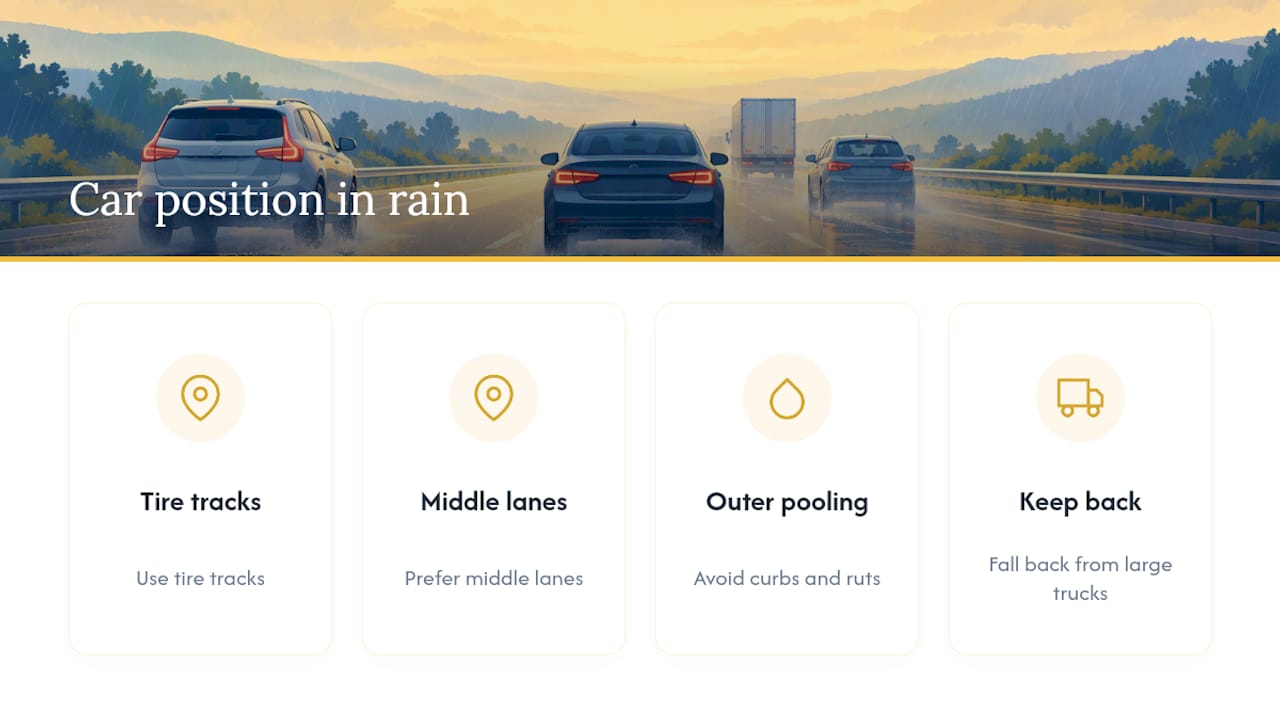
On multi-lane roads, the middle lanes usually drain better than the outer ones, since road crowning is designed to shed water toward the shoulders. Staying out of the far right lane, when traffic allows, keeps you clear of the deepest pooling and away from storm drains that can back up during heavy rain.
Splash from other vehicles is its own hazard, capable of blinding your windshield for a full second or more at highway speed. Hanging back from large trucks and buses gives their wake time to settle before it reaches you. Passing a truck in heavy rain means committing to the maneuver quickly. Lingering alongside it in blinding spray is worse than staying behind it.
Watch for the vehicles around you doing the same thing. If everyone starts drifting toward the same side of a lane, that’s a reliable sign of pooling water on the other side, and a cue worth acting on even before you see the water yourself.
Curves and Passing: Extra Caution Points in Wet Weather
Curves are where lost traction turns into a real problem fastest, because cornering asks your tires to grip in two directions at once, sideways and forward. The fix is straightforward: slow down before you enter the curve, not while you’re in it. Braking mid-curve shifts weight forward and unloads the rear tires right when you need their grip most.
Take a smoother, more gradual line through the curve than you would on a dry day, and resist the urge to accelerate out of it the way you might normally. A little patience through a wet curve costs you a few seconds. A skid costs you far more.
Overtaking in the rain deserves the same patience. Reduced visibility, spray, and longer stopping distances all stack against you, so any passing maneuver needs more room and more time than it would in dry conditions. Only pull out to pass when you can see well down the road ahead. Confirm the oncoming lane is clear for longer than usual, and complete the pass in one smooth motion rather than hesitating halfway.
Electronic stability control and ABS help enormously in both curves and passing maneuvers, but they manage the physics you hand them. They can’t create grip that isn’t there. Treat these systems as a backstop for a mistake, not a reason to take a curve or a pass faster than the rain allows.
Building a Rain-Ready Emergency Kit
A basic emergency kit turns a bad situation, a stall in heavy rain or a wait for a flooded road to clear, into a manageable one. Keep these items in the car year round, not just when a forecast looks bad:
- A flashlight with fresh batteries, for signaling and for checking under the hood in the dark.
- A phone charger or portable power bank, since a dead phone in a roadside emergency cuts off your ability to call for help.
- A blanket or two, particularly useful if you’re stopped for an extended wait in cold, wet weather.
- A basic first aid kit and a reflective triangle or flares for roadside visibility.
- Bottled water and non-perishable snacks for longer delays.
- A small towel, useful for wiping down foggy windows or wet hands after checking tires in the rain.
Storing these items in an easy-to-reach spot, rather than buried under other cargo, matters more than people expect. In an actual emergency, digging through a trunk in the rain is the last thing you want to do.
The Mistakes That Keep Repeating in Rainy Weather Driving
The same three mistakes show up again and again: overconfidence at highway speed, underestimating how deep floodwater really is, and leaving cruise control engaged because the road “still feels fine.” None of these are knowledge gaps. Drivers generally know better. They just don’t act on it until conditions force the issue.
Two habit changes fix most of this. Build a standing rule of driving conservatively slower with more following distance the moment rain starts, no exceptions for familiar roads. Pair it with a five-minute pre-trip check before any drive in wet weather. Consider taking the Drive With Care pledge to make that commitment concrete.
— Charles
Support Safer Roads With Drivewithcare
Drivewithcare turns the guidance in this article into a movement, not just a checklist, by pairing survivor stories and community partnerships with the kind of data you’ve just read. Taking the Drive With Care safety pledge costs nothing and puts your name behind the exact habits covered here: slower speeds, longer following distances, and respect for standing water.

If you want to do more than pledge, a donation funds the education programs, survivor support services, and community outreach that make this kind of guidance reach more drivers before a crash happens, not after. Every contribution, whether it’s a smaller one-time donation or a larger commitment through our partnership programs, goes directly toward reducing the human error behind the vast majority of crashes. Take the pledge today, then consider donating to help extend this kind of resource to more communities.
Sources
- Weather-Related Crash Statistics — FHWA
- Turn Around Don’t Drown — National Weather Service
- Gov
- Driving in heavy rain — Continental Tires
FAQ
Is It Safe to Drive in Rainy Weather?
Driving in rain is safe when you adjust your habits to match the conditions: lower speed, longer following distance, and full visibility through working lights and wipers. It becomes dangerous mainly when drivers keep dry-weather habits, since 75% of weather-related crashes happen on wet pavement.
How Many Inches of Rain Can a Car Drive Through?
It depends far more on whether the water is moving than on the raw depth. The National Weather Service warns that just 12 inches of moving water can carry away a small car, and 2 feet of rushing water can carry away most vehicles, including SUVs and trucks.
How Do I Drive When It’s Raining?
Slow down, increase your following distance to 4 to 6 seconds, turn off cruise control, and turn on your low-beam headlights. Keep steering and braking smooth, avoid deep standing water, and choose middle lanes when the road allows it.
How Slow Should You Drive When It’s Raining?
A common guideline is cutting 5 to 10 mph off your normal speed in light rain, and considerably more in heavy downpours or standing water. Stopping distances on wet pavement run at least double what they are on dry roads, so the extra margin gives you time to react.
What Should I Do if I Start Hydroplaning?
Ease off the accelerator immediately without braking hard, and steer gently in the direction you want to go. Wait for the tires to regain contact with the road, then apply the brakes gradually, letting anti-lock brakes modulate the stop rather than pumping the pedal yourself.

