

Every additional teen passenger raises a young driver’s crash risk, and one adult in the car cuts it sharply. A 2012 study found that 16- and 17-year-old drivers carrying one teen passenger faced a 44% higher fatal crash risk per mile, a risk that roughly doubled with two passengers and nearly quadrupled with three or more. The NHTSA and CDC both confirm the pattern. What follows is the evidence behind it, why it happens, and what parents, educators, and policymakers can do about it.
TL;DR:
- Adding a single teen passenger increases fatal crash risk by 44%, while three or more passengers nearly quadruple the risk per mile driven.
- Having an adult passenger reduces crash risk by approximately 62%, partly by curbing risky behaviors encouraged by peer passengers.
- Highest risk occurs for 16- and 17-year-olds, especially during nighttime, weekends, or when not wearing seat belts, with neonates being most vulnerable.
- Peer pressure, distraction, and low seat-belt use are key behavioral mechanisms that escalate risk when teens drive with friends.
- Implementing graduated licensing restrictions, clear rules, supervised practice, and crash-avoidance vehicles can significantly reduce teen crash rates.
Table of Contents
- How Teen Passengers and Risk Are Connected, by the Numbers
- Who Faces the Highest Passenger-Related Risk
- What Actually Happens Inside the Car
- Reducing Teen Passenger Risk: What Parents and Educators Can Do
- What Works at the Policy Level
- Why This Data Changes How I Think About Teen Driving Rules
- Support the Programs Behind This Research
- Sources
- FAQ
How Teen Passengers and Risk Are Connected, by the Numbers
The relationship between passenger count and crash risk isn’t a vague correlation. It’s one of the most consistently replicated findings in teen driving research, and it scales predictably with each added passenger.
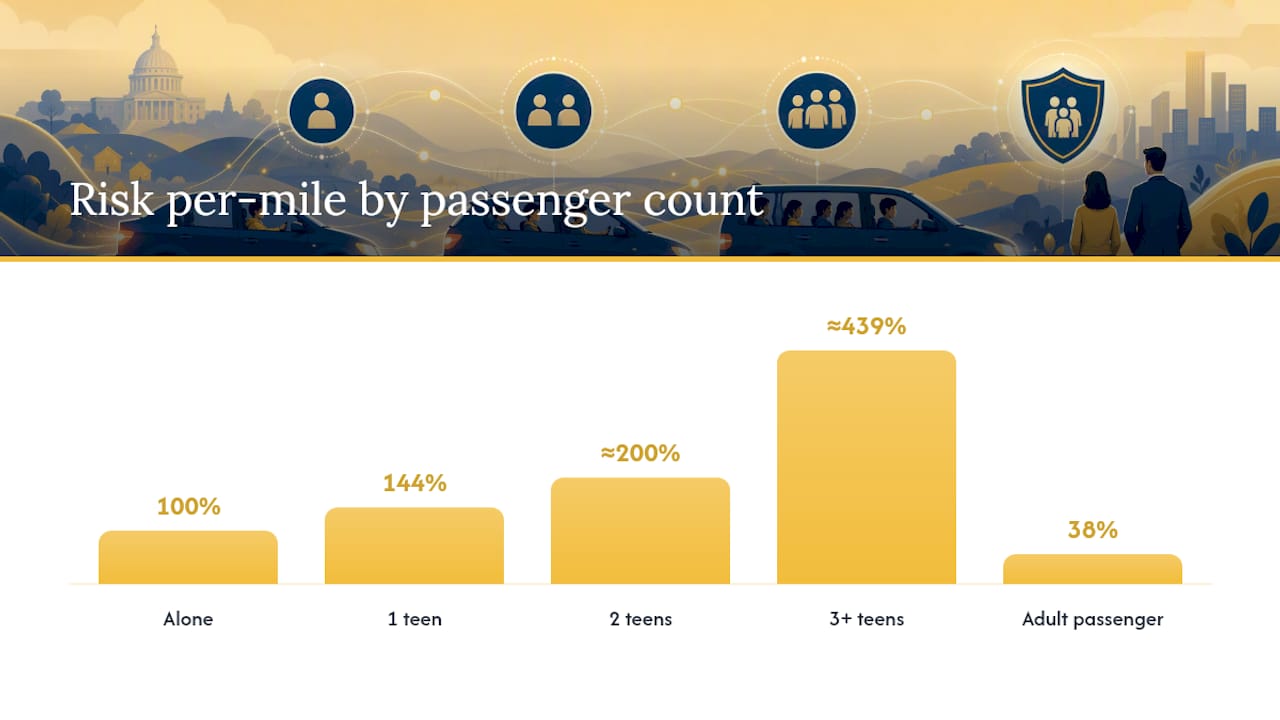
The foundational figure comes from a 2012 study published in Traffic Injury Prevention, which analyzed fatal crash data for 16 and 17-year-old drivers. Researchers calculated per-mile fatal crash risk relative to driving alone:
- One teen passenger under 21: 44% higher fatal crash risk (relative risk of 1.44)
- Two teen passengers: approximately double the fatal crash risk compared to driving alone
- Three or more teen passengers: nearly quadruple the risk (relative risk near 4.39)
Statistic Callout: A 16-year-old driving alone faces a baseline fatal crash risk. Add three teenage friends, and that risk climbs to roughly four times the baseline, per mile driven, according to the Traffic Injury Prevention analysis.
These are per-mile estimates, which matters. A teen who drives fewer total miles with friends in the car might still accumulate meaningful risk exposure on the trips that do happen, since the danger compounds with every additional passenger rather than diluting across more driving overall.
Not every passenger raises risk equally. Research compiled by Simons-Morton and colleagues found that an adult passenger in the car is tied to a roughly 62% reduction in fatal crash risk for novice teen drivers, the opposite effect of a same-age peer. The presence of an experienced adult appears to suppress the exact behaviors, speeding, distraction, showing off, that peer passengers tend to encourage. This is the core reason graduated licensing systems treat “adult supervision” and “peer passengers” as two entirely different categories of risk, not two points on the same scale.
Who Faces the Highest Passenger-Related Risk
Passenger risk isn’t evenly distributed across all teen drivers. Certain ages, driving conditions, and passenger combinations concentrate the danger far more than others.
Newly licensed 16 and 17-year-olds carry the highest risk profile of any age group on the road, largely because inexperience and peer sensitivity peak at exactly the age when independent driving begins. The CDC identifies this age band, along with nighttime driving and low seat-belt use, as the three risk factors that compound most dangerously when combined.
A few patterns stand out in the data:
- Male teen drivers carrying male teen passengers show measurably higher rates of speeding and risky maneuvers than other passenger combinations.
- Nighttime driving multiplies fatal crash rates for teens well beyond the risk seen during daylight hours, and adding passengers after dark compounds that effect further — making driver fatigue remedies essential for safer nighttime trips.
- Weekend evenings combine two risk factors at once: more passengers in the car and less parental oversight of timing and destination.
- Teens in fatal crashes are disproportionately unbelted compared to older drivers, and passenger-heavy trips tend to have lower belt-use rates across the board.
None of these factors operates alone. A 17 year old driving three friends home from a Friday night event, unbelted, after 9 p.m., sits at the intersection of nearly every risk factor the research identifies simultaneously. That overlap, not any single variable, is what turns a routine drive into a statistical outlier.
What Actually Happens Inside the Car
The statistics describe the outcome. The mechanism is behavioral, and it’s more specific than “distraction.”
Peer influence changes what a teen driver pays attention to and how they weigh risk in the moment. A driver alone monitors the road. A driver with friends in the car starts monitoring the social dynamic too, and that split attention costs reaction time exactly when it matters most. Research on risk-taking friend groups found that novice drivers who socialize with peers already prone to risky behavior show crash and near-crash rates roughly double those of drivers with more cautious friend groups, independent of who happens to be in the car on any given trip.
Three mechanisms tend to show up together:
- Peer pressure and showing off. Teen passengers, even without saying a word, can shift a driver toward faster speeds, closer following distances, and more aggressive lane changes.
- Physical and cognitive distraction. Conversation, phone use, and simple movement in the cabin pull visual and mental attention away from hazard detection.
- Reduced seat-belt compliance. Groups of teens are less likely to buckle up consistently than solo drivers, which turns a survivable crash into a fatal one.
Pro Tip: Before your teen is allowed to drive with friends, rehearse a “safety reset” conversation together, a short script they can use to ask a friend to stop distracting them or to pull over if things feel unsafe. Practicing the words in a calm moment makes them far easier to use under real pressure. Drive With Care’s guide on what to say when driving pressure shows up walks through exact phrasing for common scenarios.
Reducing Teen Passenger Risk: What Parents and Educators Can Do
Evidence-based prevention doesn’t require guesswork. Decades of graduated driver licensing research point to a specific set of interventions that measurably reduce passenger-related crashes, and parents can put most of them into practice this week.
Graduated Driver Licensing (GDL) systems that restrict teen passengers during the intermediate licensing phase are the single most studied policy lever here. The CDC’s prevention research shows GDL systems are associated with meaningful reductions in both injury and fatal crash rates among 16-year-olds when they include passenger limits alongside nighttime driving curfews.
Parents don’t need to wait on state law to apply the same logic at home. A practical rollout looks like this:
- Set the rules in writing. A signed driving contract that caps passenger numbers, sets a curfew, and spells out consequences removes ambiguity before a Friday night decision has to be made in the moment.
- Practice under real conditions. Supervised driving hours should include nighttime, highway, and bad-weather practice, not just quiet daytime streets, since those are the conditions where passenger risk peaks.
- Monitor without micromanaging. Parental-monitoring apps and vehicle “driving report cards” give parents visibility into speed, braking, and phone use without needing to ride along every time.
- Enforce consistently. A rule that’s only enforced sometimes teaches a teen that the rule is negotiable, which defeats the purpose of having one.
Vehicle choice matters here too. The Insurance Institute for Highway Safety recommends prioritizing crash-avoidance features like automatic emergency braking when choosing a car for a new driver, since these systems can compensate somewhat for the reaction-time lag that passenger distraction creates.
Schools and community programs have leverage too. Passenger limits on school-sponsored trips, structured prom and graduation-night safe-ride programs, and outreach timed to National Teen Driver Safety Week all give educators concrete tools rather than one-off assemblies.
Pro Tip: Put your teen’s driving contract somewhere visible, like the fridge or car visor, rather than filing it away after signing. Contracts that stay out of sight tend to stop shaping behavior within a few weeks.
What Works at the Policy Level
Individual family rules matter, but the largest population-level reductions in teen crash risk have come from graduated licensing policy, not parental effort alone.
The GDL elements tied to the biggest measurable effects include a minimum age for full, unrestricted licensing, a mandatory minimum of supervised practice hours, and passenger restrictions during the first months of independent driving. The CDC’s evaluation of GDL programs found reductions in both injury and fatal crash rates tied to states with stronger versions of these three elements combined, compared to states with weaker or partial systems.
Jurisdictions that have layered passenger caps on top of nighttime curfews tend to see the strongest combined effect, since the two restrictions target different risk windows, late-night driving and social driving, that otherwise compound each other. Policymakers considering new or strengthened restrictions should look at:
- Passenger limits during the first six to twelve months of independent licensing, not just the learner’s permit stage
- Nighttime curfews that align with actual fatal-crash-rate curves rather than arbitrary hours
- Enforcement coordination between law enforcement, schools, and licensing agencies, so restrictions are visible and consistently applied
Any pilot program should collect baseline data before rollout, seat-belt use rates, incident logs, citation counts, so the actual effect of a new policy can be measured against a real starting point rather than assumed.
Why This Data Changes How I Think About Teen Driving Rules
Most advice to parents treats teen passenger risk as a communication problem: talk to your kid, set expectations, hope it sticks. The data tells a different story. The 1.44x to 4.39x relative risk climb with each added passenger isn’t about attitude or maturity. It’s about exposure, and exposure is something adults can actually control through rules, not just conversation.
What surprises me most in this research is how binary the adult passenger effect is. That asymmetry suggests families are underusing one of the cheapest interventions available: more supervised driving, later into the licensing process, even after a teen technically qualifies to drive alone. The connection between friend groups and crash rates reinforces the same point. Risk clusters around specific social dynamics, not around teen drivers as a category, which means the fix is specific too: fewer peer passengers, more structured supervision, and rules that hold even when they’re inconvenient on a Friday night.
— Charles
Support the Programs Behind This Research
Funding supports the work described in this article: the safe driving contracts, the rehearsal scripts for peer pressure, and the community education that turns GDL research into practice at the family and district level. A donation or partnership helps expand education programs, survivor support resources, and the community outreach that reaches parents before a crash happens, not after.

Individual gifts of any size through Donate Now support these programs directly, and organizations looking for a deeper commitment can explore the Safety Supporter Partnership for $250. Schools, driving instructors, and local agencies wanting to co-brand education efforts can also review the Community Safety Partner Partnership. If you’re ready to put research into action in your own community, start with a donation today.
Sources
- Teen Driver Risk in Relation to Age and Number of Passengers
- Teen safe driving: How teens can be safer drivers (NHTSA)
- Risk factors for teen drivers (CDC)
- The effect of passengers and risk-taking friends on risky driving and crashes/near crashes among novice teenagers (Simons-Morton et al.)
FAQ
What age are the riskiest drivers?
Drivers aged 16 and 17 face the highest crash risk of any age group, largely due to inexperience combined with high sensitivity to peer passengers. The CDC identifies this age range as the peak risk window, especially in the first year of independent licensing.
What are the 8 danger zones for teenage drivers?
Common danger zones cited by traffic safety researchers include driving with teen passengers, nighttime driving, not wearing a seat belt, distracted driving (including phone use), speeding, alcohol or drug impairment, inexperience with hazard recognition, and drowsy driving. These factors frequently overlap, and combinations like nighttime driving with passengers present the highest risk.
What is the greatest danger factor for teen drivers?
The presence of teen passengers is one of the most significant and well-documented risk factors, raising fatal crash risk by 44% with one passenger and roughly fourfold with three or more. Nighttime driving and seat-belt nonuse compound this risk further when they occur together.
What is the most common violation for a teen driver?
Speeding is consistently among the most common violations cited in teen driver crashes, often intensified by the presence of peer passengers who encourage faster driving. Seat-belt nonuse is also disproportionately common among teens involved in fatal crashes, according to CDC data.
Does Drive With Care offer resources for parents on passenger rules?
Yes. Drive With Care provides a downloadable safe driving contract that includes passenger limits, along with rehearsal scripts to help teens handle peer pressure before it happens on the road.

