

The most effective road safety curricula for novice drivers combine a short evidence-based film or scenario prompt, a facilitated interactive workshop, and ongoing behavior-change tools like pledges and if-then plans, backed by supervised practice. This mix draws on Graduated Driver Licensing research and interactive-workshop evidence, and it shapes Drive With Care’s own Safer Roads Now programming. Below are practical templates, activities, and simple ways to measure whether any of it is working.
TL;DR:
- Behavior-focused driver curricula should include active practice, commitments, and scenario rehearsals rather than relying solely on lectures or videos.
- Measuring program success effectively involves tracking simple indicators like attendance, pledges signed, and pre/post surveys of intentions and knowledge.
- Tailoring content to target specific behaviors such as passenger limits or night driving, backed by local crash data, enhances relevance and impact.
- Including survivor stories, family contracts, and peer modeling increases emotional engagement and reinforces behavior change.
- Short, repeated micro-refresher sessions for licensed drivers help maintain safer driving habits over time.
Table of Contents
- 1. Ten ready-to-run curriculum ideas for driver programs
- 2. How to design a curriculum that targets real behavior
- 3. Module templates you can schedule this month
- 4. Activities, prompts, and scripts for facilitators
- 5. Measuring impact without a research budget
- 6. Why survivor-informed design shapes our approach
- How an organization supports your program
- FAQ
- Sources
1. Ten ready-to-run curriculum ideas for driver programs
Most road safety programs fail for the same reason: they lecture instead of rehearse. The ideas below borrow from models with actual behavioral evidence behind them, starting with the one that anchors most of what follows.
- Short film plus facilitated ORID workshop: the DriveFit model pairs a 40-minute film with a 45-minute facilitated discussion using Objective-Reflective-Interpretive-Decisional questions, built around 16 behavior-change techniques, as detailed in the DriveFit Intervention Guide.
- GDL-aligned staged modules: build lessons around passenger limits, night-driving restrictions, and supervised-hour logging, since GDL programs are linked to a median reduction in first-year crash rates for 16-year-olds.
- Parent-teen safe driving contracts: a written agreement with specific rules and consequences, reinforced by a family pledge.
- Peer-led mentor sessions: slightly older drivers model safe choices and walk through real decision points.
- Pressure rehearsal role-plays: structured scenarios where teens practice refusing a risky ask from a passenger or friend.
- If-then action planning postcards: a written implementation intention (“If my friends ask me to speed, then I’ll say I promised my parents I wouldn’t”) that the driver keeps.
- Hands-on vehicle-control sessions: low-speed, closed-course practice for skid recovery, mirror checks, and parking.
- Simulator or scenario drills with reflection: a short simulated drive followed immediately by a debrief, not just the drive itself.
- Community empathy events: survivor stories paired with a pledge station where attendees commit to specific behaviors.
- Micro-refresher modules: five-minute re-exposure sessions for already-licensed drivers, timed around rule changes or seasonal risks.
Education alone has a mixed track record. A systematic review of systematic reviews found that driver training improves knowledge and skills but does not reliably reduce crashes unless it is combined with other measures and targeted behavior-change techniques. That is why nearly every idea above pairs information with practice, commitment, or both.
Pro Tip: Never run the film or lecture alone. Pair every piece of content with a discussion, a decision, or a written commitment, or the message fades within days.
2. How to design a curriculum that targets real behavior
A curriculum is only as good as the objective behind it. Start by naming the specific behavior you want changed, not a vague goal like “raise awareness.”
- Write objectives as behaviors, not topics: “limits passengers to zero for the first six months” beats “understands passenger risk.”
- Match the audience and delivery mode: pre-license teens need different dosage and tone than licensed adults attending a refresher.
- Set a realistic session count and reinforcement schedule rather than a single one-off event.
- Pull local crash and casualty data where available so the curriculum targets the behaviors that actually matter in that community, instead of generic topics.
- Build in behavior-change techniques directly: goal-setting, peer modeling, and written if-then plans rather than information delivery alone.
Passenger presence is one of the clearest, best-documented risk factors for teen drivers. Epidemiological reviews show risk multipliers for teen drivers carrying teen passengers ranging across studies, which is why passenger-limitation content earns a place in nearly every module template below. Knowledge transfer matters, but it has to be paired with active practice. A session that only explains why night driving is risky builds awareness. A session that also has the teen log supervised night-driving hours builds perceived control, the sense that the driver can actually manage the risk, which is what predicts follow-through.
Pro Tip: If you can only measure one thing before launch, measure baseline intentions. A short pre-survey on what the driver plans to do gives you the comparison point your post-survey needs.
3. Module templates you can schedule this month
These five templates can be adapted directly into a session calendar. Each one names its audience, structure, and the commitment device that closes it out.
- Pre-license template: film screening, facilitated reflection using ORID-style questions, then a commitment postcard the driver signs and keeps.
- Novice driver multi-session template: three to five sessions tracking supervised practice goals, passenger management rules, and progressive night-driving exposure, logged on a simple first-year driving guide.
- Family workshop template: parent orientation covering GDL basics, contract signing between parent and teen using a safe driving contract, then a joint practice plan both sign.
- Community workshop template: a short local data snapshot, a survivor story, a pledge station, and a sign-up table for partner organizations.
- Micro-refresher template: a 10 to 15 minute session for experienced drivers focused on recent rule changes and vulnerable road users like cyclists and pedestrians.
Family involvement deserves its own weight in this list. Parents who sign a written contract and set a joint practice schedule are reinforcing the same if-then logic that makes the postcard exercise work, just over a longer timeline. Coordinators running family sessions can lean on the parent playbook for talking points on setting rules without turning the conversation into a lecture.
4. Activities, prompts, and scripts for facilitators
A workshop lives or dies on its discussion prompts and role-play scripts. Keep these concrete and specific rather than abstract.
- Use polling tools like Mentimeter with ORID-structured questions: “What did you notice in the film?” then “How did that make you feel?” then “What would you do differently?”
- Script pressure-rehearsal role-plays around specific, common scenarios: a friend asking for “just one quick ride” after drinking, or a passenger demanding music volume that drowns out hazard awareness. Detailed scripts for these situations are available in the pressure rehearsal activity guide.
- Hand out if-then postcards at the end of every session and collect a copy for follow-up, not just a verbal pledge.
- Choose low-cost simulation options such as a basic driving simulator or a paper scenario walkthrough, then always close with a reflection question, never with the drill itself.
- Frame sessions around decisions and skills, not fear. Alarmist messaging tends to disengage teen audiences rather than motivate them.
For scripting peer-pressure conversations specifically, facilitators can draw on language from talking points on driving pressure built for exactly this setting.
Pro Tip: Keep every role-play under five minutes. Longer scenarios lose the group’s attention and dilute the specific decision point you’re trying to rehearse.
5. Measuring impact without a research budget
Coordinators do not need a full evaluation team to show a program is working. A few simple indicators, tracked consistently, go a long way with partners and donors.
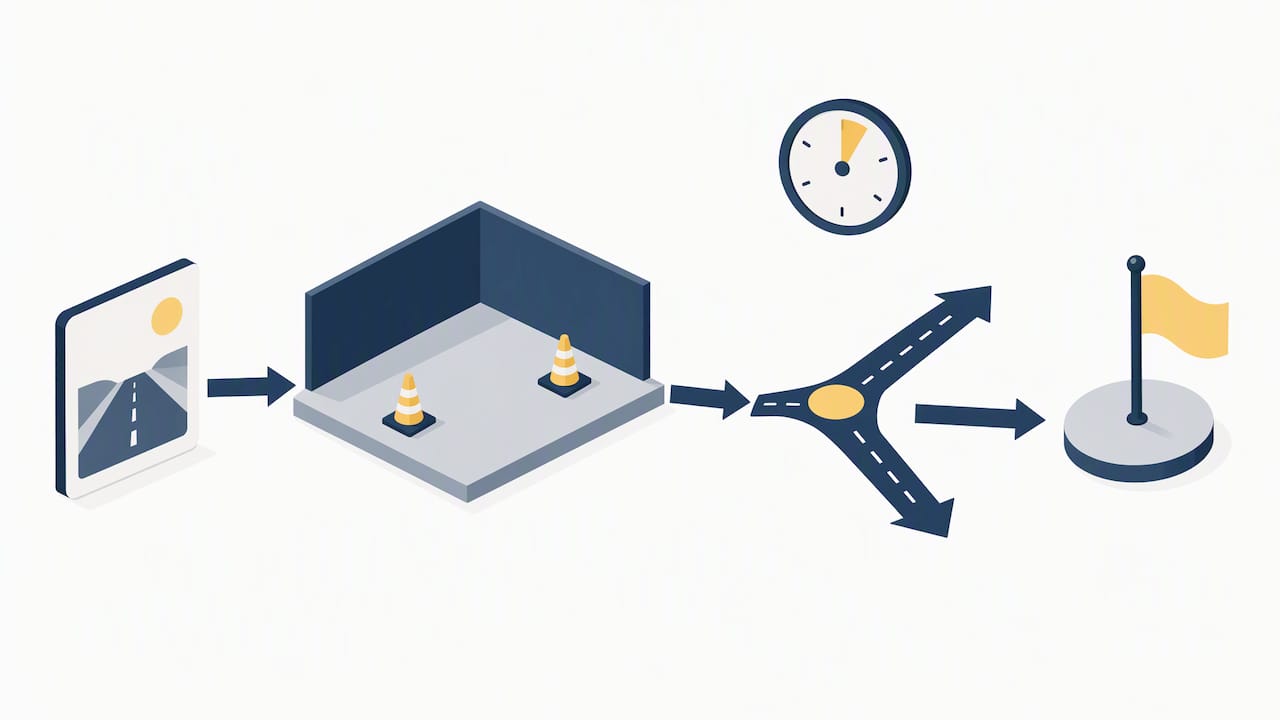
- Track process indicators: attendance counts, pledges signed, and simple pre/post surveys on intentions and knowledge.
- Log behavioral proxies: supervised-practice hours, parent confirmation forms, and self-reported behavior changes at the next session.
- Schedule micro-refreshers three to six months out to re-expose participants and check whether the behavior held.
- Collect longer-term indicators carefully and only where privacy and consent allow it, such as license status or self-reported incidents.
- Summarize all of this in a short outcome report partners can read in under five minutes.
Interactive workshops that combine knowledge with peer modeling show stronger behavioral results than single-channel content, according to 2025 research in Frontiers in Public Health, though the same research notes that riskier behaviors like speeding remain harder to shift than habits like helmet use.
6. Why survivor-informed design shapes our approach
Human error drives most traffic incidents, which is why Drive With Care built Safer Roads Now around survivor stories, community engagement, and data analysis rather than information alone. That combination is what pushed us toward curricula built on rehearsal and commitment, not just content delivery.
— Charles
How an organization supports your program
Running a strong curriculum gets easier with partners who already have the templates, pledge tools, and facilitator resources built. Organizations and donors who want to put these ideas into action can work with us directly.
- Explore partnership programs for driving schools, sponsors, and community organizations.
- Download pledge materials and handouts from our resources page.
- Support program delivery through a Road Safety Partner Partnership or by starting with a direct donation.
Contact us to talk through which partnership level fits your organization’s goals and timeline.
FAQ
Does driver education actually reduce crashes?
Education alone shows mixed results for crash reduction, but it improves knowledge and skills reliably. Reviews of the evidence recommend pairing education with other measures, such as GDL restrictions and behavior-change techniques, rather than relying on classroom content by itself.
How long should a driver safety workshop session run?
The DriveFit model uses a 40-minute film followed by a 45-minute facilitated workshop, which works well as a baseline length for pre-license audiences, per the DriveFit Intervention Guide. Shorter micro-refresher sessions of 10 to 15 minutes work better for re-exposure with already-licensed drivers.
Why include parents in a teen driving curriculum?
Parents reinforce the same commitment habits that pledges and if-then plans build during a workshop, extending the behavior-change window well past a single session. A written safe driving contract between parent and teen gives that reinforcement a concrete, signed structure.
Do survivor stories belong in a driving curriculum?
Survivor stories build empathy and motivation in ways that statistics alone rarely achieve, which is part of why a Safer Roads Now approach centers them in community events. They work best paired with a concrete next step, like a pledge station, rather than standing alone.
What is the simplest way to measure whether a workshop worked?
Track attendance, pledges signed, and a short pre and post survey on intentions and knowledge, then follow up with a behavioral proxy like logged practice hours or a parent confirmation. That combination gives coordinators a funder-ready outcome summary without needing a dedicated research team.
Sources
- Study reporting GDL benefits (PubMed entry)
- Frontiers in Public Health (2025) on interactive workshops and behavior change
- Is driver education contributing towards road safety? A systematic review of systematic reviews (PMC)
- DriveFit Intervention Guide (Road Safety GB)

