
Employers should adopt a written workplace distracted driving policy that bans all phone use, handheld and hands-free, while employees drive on company business. The policy should cover company vehicles, personal vehicles used for work, and company-issued devices, with only narrow, documented exceptions for emergencies. Back it up with three things: a written rule, a signed acknowledgement from every employee, and enforcement that doesn’t bend for your best performers.
TL;DR:
- Companies should enforce a strict, written no-phone policy covering all employees on any vehicle used for work, including personal vehicles if used for business.
- The policy must clearly define distracted driving, specify scope, and require phones to be silenced and stowed before driving, with limited, documented exceptions.
- Enforcement needs consistent training, acknowledgment forms, and discipline protocols, with managers modeling compliance to influence employee behavior effectively.
- The policy should be stricter than state laws, accounting for regional legal differences and addressing federal restrictions for commercial drivers.
- Monitoring can include voluntary reporting or telematics tools, but must be transparent about privacy and aligned with a structured discipline ladder.
Table of Contents
- What Should a Workplace Distracted Driving Policy Cover?
- Sample Policy Language You Can Adapt Today
- How to Roll Out and Enforce the Policy
- Do Distracted Driving Laws Vary by State?
- How Do You Know if the Policy Is Working?
- Where to Find Templates, Training, and Support
- Why Leadership Behavior Beats Policy Language
- Put This Policy to Work With Drive With Care
- Sources
- FAQ
What Should a Workplace Distracted Driving Policy Cover?
A policy that only says “don’t text and drive” leaves too much open to interpretation. NIOSH recommends banning all phone use, including hands-free, while an employee drives a company vehicle, and banning company-issued phone use while driving a personal one. That’s a stricter line than most companies start with, and it’s the right one.
Distraction breaks into three types: visual (eyes off the road), manual (hands off the wheel), and cognitive (mind off driving). Texting hits all three at once, which is why NIOSH flags it as uniquely dangerous. Hands-free calling removes the manual piece but leaves cognitive distraction fully intact. A driver on a hands-free call is still mentally rehearsing the conversation instead of scanning for hazards.
Your written policy needs to spell out:
- A clear policy statement defining distraction types and stating the no-phone rule in plain language, not legal jargon.
- Scope: who it covers (all employees, contractors, temps), when it applies (any company business, not just commute-adjacent trips), and which vehicles count (company fleet and personal cars used for work).
- Device handling rules: phones go on silent or in a bag before the ignition starts; voicemail and auto-reply texts handle incoming calls.
- Documented exceptions: pulling over to answer, or narrow allowances for emergency responders and specific dispatch protocols.
- Acknowledgement and training records: signed forms, refresher dates, and who owns the file.
Pro Tip: Put the acknowledgement form in the same packet as your other annual compliance paperwork (harassment policy, safety data sheets). Bundling it with routine signatures gets a far higher completion rate than sending it as a standalone email.
Sample Policy Language You Can Adapt Today
You don’t need a lawyer to draft the core statement. You need language specific enough to survive a bad day and simple enough that a new hire understands it in one read.
Sample policy statement (copy and adapt):
“Employees may not use handheld or hands-free mobile devices to talk, text, browse, or navigate while operating a vehicle on company business, whether in a company vehicle or a personal vehicle used for work. Devices must be silenced and stowed before the vehicle is in motion. Employees who need to make or receive a call must pull over to a safe, legal location first.”
Build out the rest with these clauses:
- Company-issued devices: “Company phones and tablets must remain in Do Not Disturb or driving mode for the full duration of any work-related trip.”
- Personal vehicles on company business: “This policy applies equally to personal vehicles used for company errands, client visits, or deliveries, regardless of who owns the phone plan.”
- Passengers and designated texters: “A passenger, not the driver, must handle any urgent messaging or navigation input.”
- Documented exceptions: “Contacting emergency services, or responding to a supervisor’s request to pull over and call back, are the only sanctioned exceptions. Both must be logged.”
For acknowledgement, keep it short: “I have read and understand the distracted driving policy. I understand that violations may result in disciplinary action up to termination.” One signature line, one date, filed with HR.
A manager’s response script for a first violation should sound like this: “I need to flag that we received a report of phone use while driving on [date]. Let’s review the policy together and talk about what got in the way.”
How to Roll Out and Enforce the Policy
A policy nobody trains on is a policy nobody follows. Launch it with a checklist, not a memo blast.
- Get leadership sign-off first, including a statement from the CEO or ops director that it applies to everyone, no exceptions for title.
- Announce it at an all-hands or team meeting, not buried in an email chain.
- Run a short training session covering the four distraction types and the company’s specific rules.
- Collect signed acknowledgements before anyone drives on company business again.
Daily operations matter more than the launch event. Set clear rules for who can contact drivers and when. Dispatchers should hold non-urgent messages until a driver has stopped. If a job involves a passenger, designate them as the one who handles texts and navigation input, never the driver. And give employees explicit permission to let calls go to voicemail while driving. One practical rollout note from a Texas A&M Transportation Institute presentation makes the point directly: organizations should tell employees outright that they won’t be penalized for not answering while driving. Without that explicit permission, employees assume the boss expects an instant reply, policy or no policy.
Monitoring can be as simple as voluntary self-reporting and periodic ride-alongs, or as involved as telematics and phone-blocking software. Tools range widely, from a basic Do Not Disturb setting to enterprise-grade fleet monitoring, and whichever you pick needs a clear privacy policy attached. Employees should know exactly what’s tracked and why.
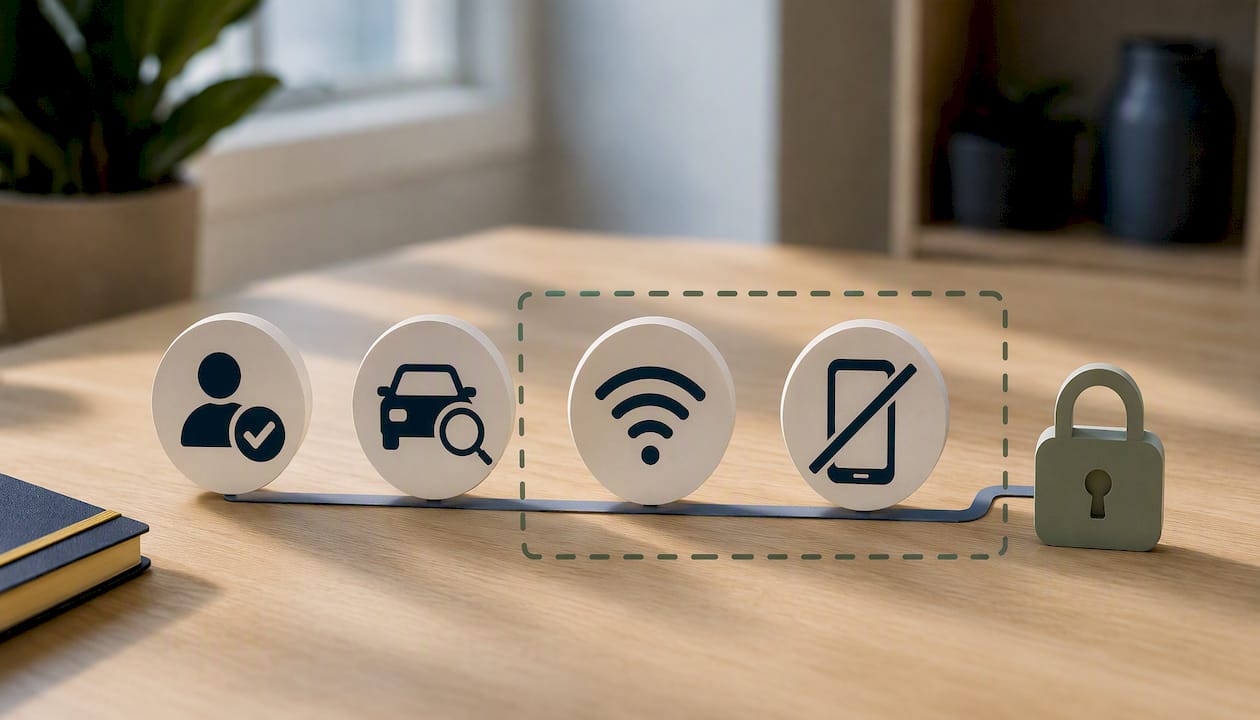
Pro Tip: Build your discipline ladder before you need it. A first offense gets a documented conversation and retraining. A second gets a formal written warning. A third triggers suspension or termination. Write the thresholds down so managers aren’t improvising in the moment.
Do Distracted Driving Laws Vary by State?
Yes, and that variability is exactly why your company policy should be stricter than any single state’s minimum. Federal rules already set a floor for certain drivers: FMCSA prohibits texting and handheld device use for commercial motor vehicle operators, and if your fleet includes CDL drivers, your policy needs to align with those federal standards without exception.
Beyond commercial driving, state laws on handheld device use, hands-free allowances, and even eating or eyes-off-road distractions differ enough that a policy written for one headquarters state can leave gaps elsewhere. OSHA provides general workplace safety guidance that supports a no-phone standard, but it doesn’t replace a state-by-state legal check.
Practical drafting note: don’t chase the lowest common denominator across states where you operate. Write to the strictest standard, document that a legal or HR professional reviewed the policy against current state law, and revisit it annually.
How Do You Know if the Policy Is Working?
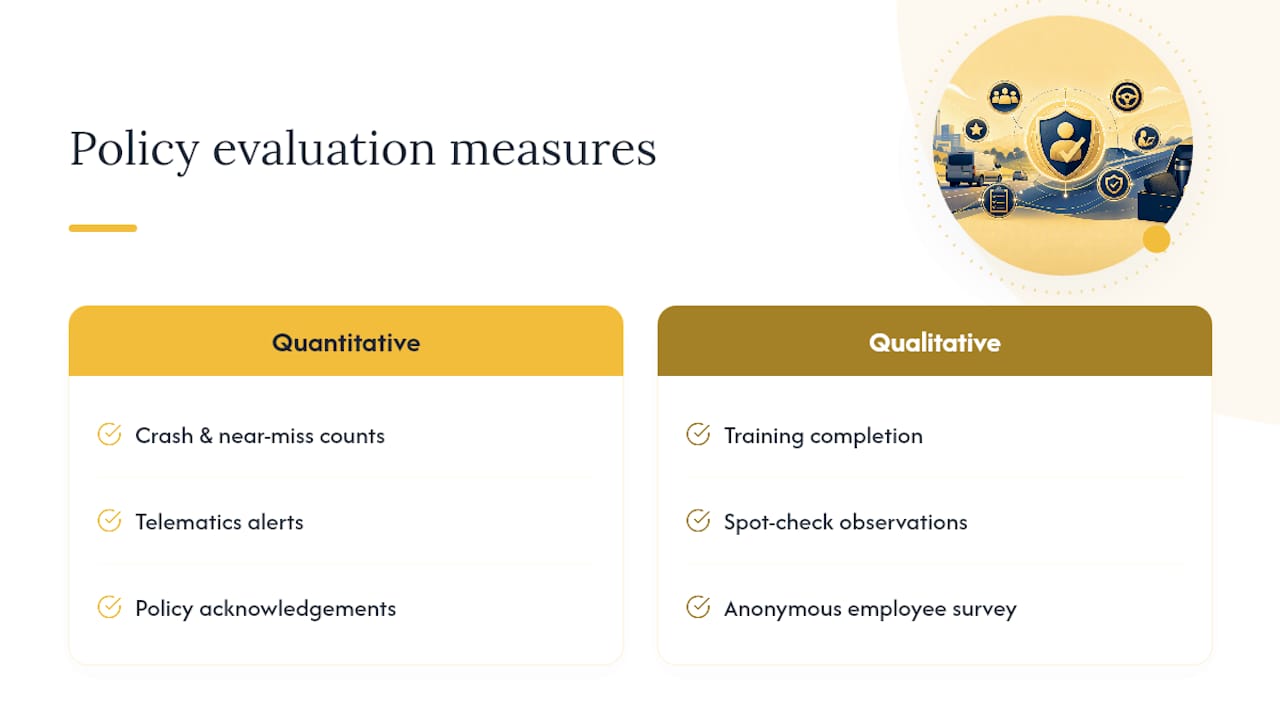
Track a mix of hard numbers and softer signals. Crash and near-miss counts, telematics alerts for phone handling or hard braking, and policy acknowledgement rates give you the quantitative side. Training completion, spot-check observations, and a short anonymous employee survey round it out.
In 2024, distracted driving contributed to 3,208 deaths and more than 315,000 injuries nationwide, a scale that makes even modest internal reductions worth measuring closely. Employer programs that pair clear policy with real training and visible leadership backing have shown substantial drops in reportable incidents after rollout.
A reasonable cadence: check compliance at 30 days, review operational friction at 90 days, and assess actual incident impact at six months.
Where to Find Templates, Training, and Support
Drive With Care built its Safer Roads Now initiative specifically around the gap between knowing distracted driving is dangerous and actually changing behavior behind the wheel. The organization’s pledge program has collected thousands of individual safe-driving commitments, and its resource library includes materials employers can adapt for internal campaigns.
The article was put together drawing on federal guidance and employer case evidence rather than a single company’s internal playbook.
For acknowledgement and waiver language you can borrow directly, the organization’s volunteer agreement template offers a useful structural starting point:
- Pledge program materials for employee behavioral campaigns
- Downloadable resource kits for internal safety communications
- Partnership inquiries for tailored workplace training sessions
Why Leadership Behavior Beats Policy Language
The best-written policy fails the moment a manager takes a call while driving to a client site with an employee in the passenger seat. I’ve seen this pattern show up again and again in workplace safety writing: companies spend weeks wordsmithing the policy document and almost no time asking whether leadership will actually live it.
The single highest-leverage move isn’t better legal language. It’s requiring managers to model the exact behavior expected of frontline drivers, visibly and consistently, because employees calibrate their own compliance against what they watch, not what they read.
— Charles
Put This Policy to Work With Drive With Care
Writing the policy is the easy part. Getting a workforce to actually live it, especially when a manager is calling with something “urgent,” is where most companies quietly fail. Drive With Care built its Safer Roads Now initiative around exactly that gap between having a rule on paper and changing what people do behind the wheel.

You can point your team to the Drive With Care Safety Pledge as a low-lift way to reinforce your written policy with a personal commitment, or pull from the organization’s downloadable resource kits for internal training decks and campaign materials. Employers who want something more hands-on, like a facilitated session that walks staff through real pressure scenarios, can look at the safety reset rehearsal to practice the exact moments where policy tends to break down. If your organization is exploring a broader partnership around training or sponsorship, reach out through the Drive With Care homepage to start that conversation.
Sources
- Distracted Driving at Work | Motor Vehicle (NIOSH/CDC)
- Put the Phone Away or Pay | Distracted Driving | NHTSA
- Distracted driving | FMCSA
FAQ
Can My Employer Make Me Drive My Car for Work?
Yes, employers can require employees to use personal vehicles for work tasks, but a solid workplace distracted driving policy should extend the same phone-use rules to those trips as it does to company vehicles.
What Are the Four Categories of Distracted Driving?
Distraction is generally grouped into visual, manual, and cognitive types, with texting often called out separately because it combines all three at once, per NIOSH.
Can My Boss Make Me Use My Phone While Driving?
A properly written policy should do the opposite: explicitly protect employees who decline calls or delay responses while driving, since implied pressure to answer is one of the biggest drivers of violations.
Do Distracted Driving Laws Change by State or Year?
Yes. State laws on handheld device use and hands-free allowances vary and change over time, which is why employers should verify current local rules rather than assuming one policy fits every location, and set company standards stricter than any state minimum.
What Should Happen if an Employee Violates the Policy?
Document the incident, walk through a manager conversation and retraining for a first offense, and escalate through a written warning, suspension, or termination for repeated violations, following whatever discipline ladder your written policy establishes.

