
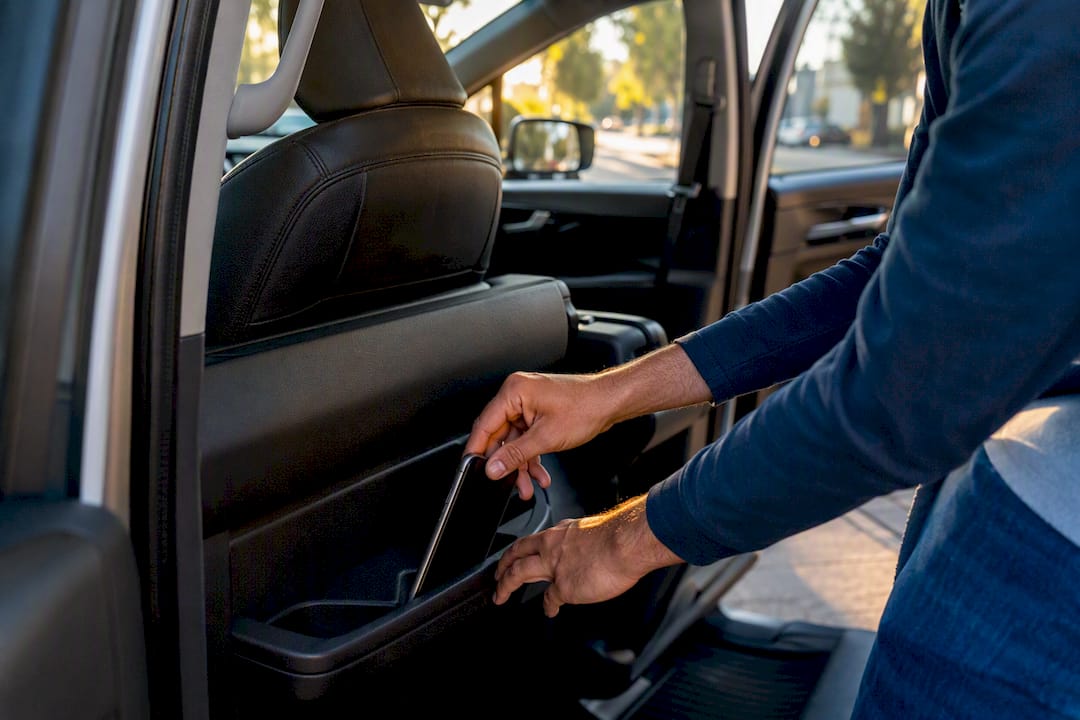
The most effective distracted driving prevention step is simple: put your phone out of reach and give the road your full attention before you shift into drive. Two moves make that real. First, turn on Do Not Disturb or your phone’s Driving Focus mode before you start the engine. Second, physically stow the phone in the glove box, back seat, or trunk so reaching for it takes real effort. NHTSA reports that distracted driving caused thousands of deaths and hundreds of thousands of injuries in 2024, and Drivewithcare built its entire pledge program around closing that gap between knowing better and driving better.
- Enable Driving Focus or Do Not Disturb before you turn the key.
- Physically remove the phone from arm’s reach, not just silence it.
Thousands of deaths and hundreds of thousands of injuries were tied to distracted driving in a single year, according to NHTSA.
Key Takeaways
Distracted driving prevention works when drivers combine phone-blocking habits, tech settings configured correctly, and rehearsed responses practiced before pressure hits.
| Point | Details |
|---|---|
| Stow the phone first | Physically remove it from reach before starting the car, not just silence it. |
| Configure blockers fully | Set geofencing or blocking apps to restrict calls and internet, not just texting. |
| Rehearse, don’t just warn | Practice what to say when interrupted; rehearsed responses outperform one-time lectures. |
| Sign a written commitment | A pledge or parent-teen contract turns intention into an accountable promise. |
| Recruit your passengers | A designated texter and an engaged passenger reduce a driver’s distraction load. |
Table of Contents
- Your Distracted Driving Prevention Checklist
- Phone Settings and In-Car Tech: What Helps and What Doesn’t
- Teen Distracted Driving: The S‑M‑A‑R‑T Method for Parents
- What Passengers and Callers Can Do
- Why Distracted Driving Prevention Matters: Laws and Enforcement
- How to Make Safer Driving Habits Actually Stick
- The Gap Between Knowing the Risks and Actually Changing Behavior
- Frequently Asked Questions
- Sources
Your Distracted Driving Prevention Checklist
Distracted driving falls into three buckets: taking your eyes off the road, taking your hands off the wheel, and taking your mind off driving. A good prevention checklist attacks all three, in order of impact, not in order of convenience.
- Stow the phone before you start the car. A phone in the console still tempts you. A phone in the trunk doesn’t.
- Turn on Driving Focus or Do Not Disturb. This kills notification pings before they become notification checks.
- Set your route before you move. Punching an address into GPS at a red light still counts as manual and visual distraction.
- Adjust your seat, mirrors, and climate controls before shifting into drive. Do it once, not repeatedly at 45 mph.
- Finish eating before you leave, or wait until you arrive. One hand on a sandwich is one hand not on the wheel.
- Skip grooming tasks in the car. Makeup, shaving, and hair fixes belong at a mirror that isn’t moving 60 miles per hour.
- Keep music and playlist choices decided before departure. Scrolling through songs is a visual task disguised as a small one.
- Actively scan the road every few seconds. Check mirrors, blind spots, and the path ahead in a steady rotation, not a fixed stare.
- Pull over for any call or text that truly can’t wait. A parking lot costs you two minutes. A crash costs far more.
- Recheck your mirrors and surroundings after any interruption. Passengers, kids, or a dropped object can pull your focus for a beat longer than you realize.
The reason texting sits at the top of every list isn’t an accident. Sending or reading a text pulls your eyes off the road for about five seconds, and at 55 miles per hour that’s the length of a football field driven completely blind. Visual distraction is the easiest to fix and the most punishing to ignore.
Pro Tip: If you’re expecting an urgent call, build in a scheduled stop, like a coffee break fifteen minutes into your drive, instead of answering on the move. Long car rides with family also work well with a designated texter in the passenger seat.
Drivewithcare’s safety pledge program gives this checklist some teeth. A written commitment, even an informal one taped to your dashboard, makes these habits stick longer than good intentions alone.
Phone Settings and In-Car Tech: What Helps and What Doesn’t
Do Not Disturb and Driving Focus modes silence texts and calls automatically, and most phones let you set an auto-reply so people know you’re driving instead of ignoring them. That single setting change removes the temptation loop before it starts.
Geofencing and cell-phone-blocking apps go a step further for parents managing teen drivers or fleets managing employees. The National Safety Council recommends geofencing because it removes the choice entirely once the vehicle crosses a set speed or location threshold. The catch: many of these apps default to blocking only texting. Go into the settings and manually restrict calls, social media, and internet access too, or the “protection” leaves the biggest distractions untouched.
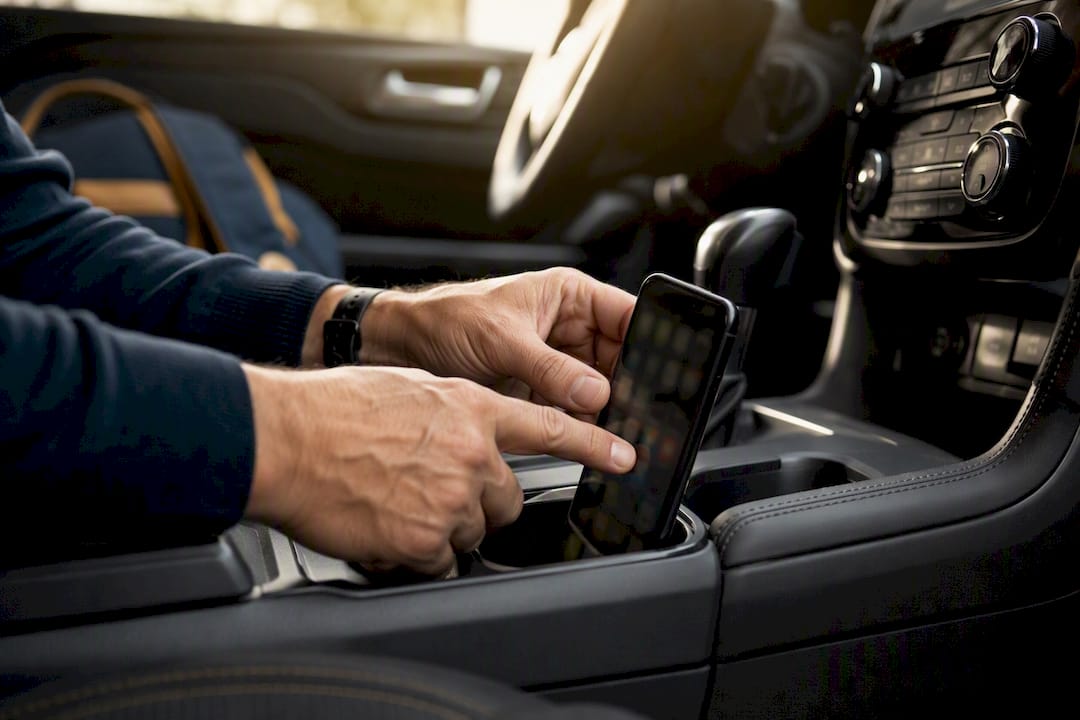
Hands-free calling feels safer. It isn’t nearly as safe as it feels. NTSB warns that hands-free conversations still create dangerous cognitive load, because your brain is processing a conversation instead of the road, even with both hands on the wheel.
Pro Tip: Consumer Reports advises setting up your infotainment system, navigation, and climate shortcuts while parked, then testing them once before you actually need them mid-drive.
Teen Distracted Driving: The S‑M‑A‑R‑T Method for Parents
Michigan Medicine built a five-letter mnemonic that gives parents a repeatable script instead of a one-time lecture: Stay focused, Make preparations, Avoid other tasks, Rehearse responses, Teach and enforce.
Rehearsing responses is the piece most families skip, and it’s the one that matters most. Practicing what to say when a friend asks “just check this real quick” builds the reflex before the moment arrives.
- Model phone-free driving yourself. CDC’s research confirms parents are the biggest influence on teen driving habits, more than any lecture.
- Put a signed safe-driving contract in writing, with clear consequences and rewards attached.
- Use geofencing or blocking apps on a teen’s phone as a backstop, not a substitute for the conversation.
Pro Tip: Run a quick rehearsal in the driveway: have your teen say out loud what they’ll tell a friend who’s texting them “where are you?” This kind of practice under pressure sticks far better than a rule they’ve only heard once.
What Passengers and Callers Can Do
Distraction prevention isn’t a solo job. Passengers and the people who call or text drivers carry real responsibility too.
- Volunteer as the designated texter and handle navigation, music, and messages for the driver.
- Keep kids and pets settled before the car starts moving, not mid-drive.
- If you’re calling or texting someone you know is behind the wheel, wait, or expect a delayed reply.
- If you notice risky behavior as a passenger, say something simple and calm: “Hey, I’ve got that, keep your eyes up.”
CDC guidance is blunt about this: passengers who actively help, rather than just stay quiet, measurably reduce a driver’s distraction load.
Why Distracted Driving Prevention Matters: Laws and Enforcement
The numbers behind this issue are hard to argue with. NHTSA’s 2024 data reports that distracted driving caused thousands of deaths and hundreds of thousands of injuries, and the five-second, football-field example for texting explains why. At highway speed, that’s several hundred feet driven with zero visual input.
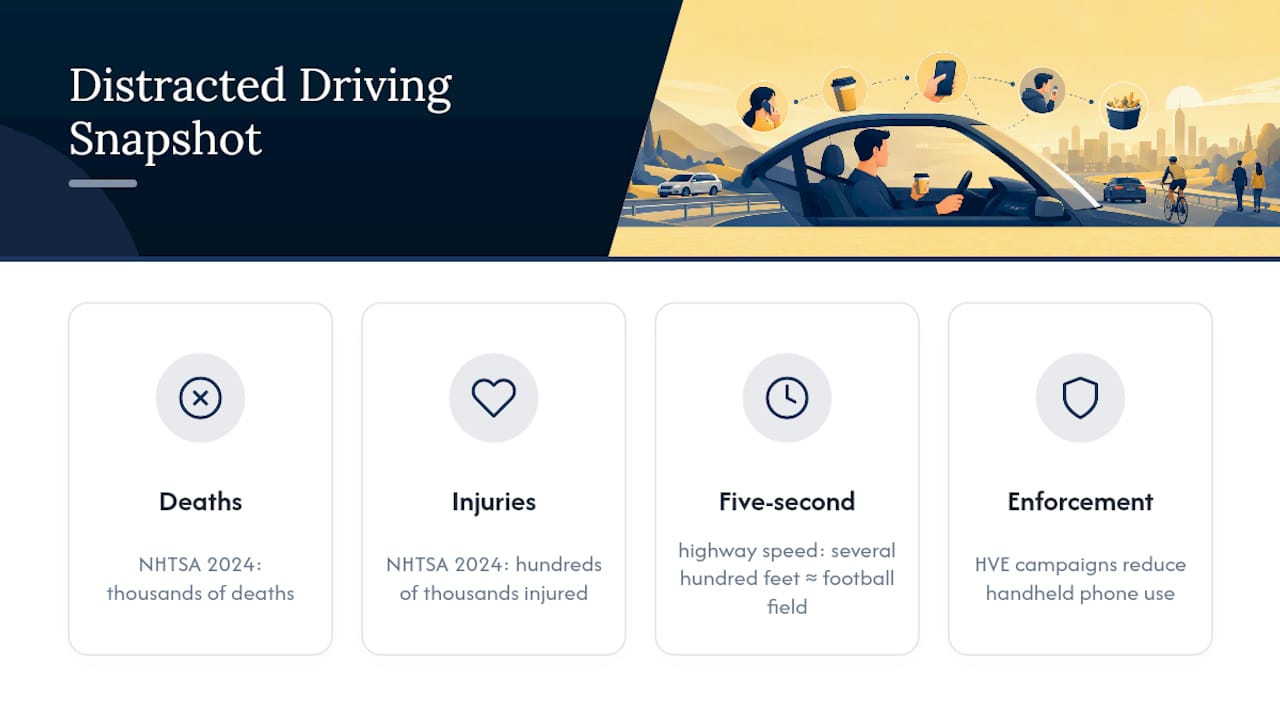
Texting-while-driving bans exist in nearly every state, and many states layer on handheld-device restrictions and stricter rules for novice drivers. Coverage and penalties vary widely by state, so check your local vehicle code rather than assume uniform rules. NHTSA’s enforcement campaigns, built around high-visibility enforcement, or HVE, have shown that concentrated ticketing periods at demonstration sites correspond with measurable drops in handheld phone use while driving. Enforcement alone won’t fix this. Paired with public awareness and family agreements, it moves the needle further than either does alone.
How to Make Safer Driving Habits Actually Stick
Knowing the risks and changing your behavior are two different things, and the gap between them is where most prevention efforts quietly fail. Three tools close that gap.
- Sign the Drive With Care safety pledge. A printed, signed commitment works because it turns an abstract intention into a concrete promise you can point back to.
- Use the parent-teen safe driving contract. Sit down together, fill it out, sign it, and post it somewhere visible, like the fridge or the car’s glove box.
- Run the safety reset rehearsal, a short practice exercise for handling the exact moments that trigger distraction, like a buzzing phone at a red light.
Drivewithcare built these as a nonprofit precisely because pledges backed by community accountability outlast good intentions made alone in the car.
The Gap Between Knowing the Risks and Actually Changing Behavior
Most distracted driving articles hand you a list of statistics and assume the numbers alone will change behavior. They rarely do. Drivers already know texting is dangerous; they do it anyway because the trigger, a buzzing phone at a red light, hits before the safety lecture in their head does.
That’s why the mnemonics and contracts matter more than another repetition of the fatality count. S-M-A-R-T works for teens because it gives them a rehearsed line to say out loud, not just a warning to remember. A signed pledge works for adults for the same reason: it’s a pre-committed decision, made in a calm moment, that overrides the impulsive one made under pressure.

The uncomfortable truth is that hands-free tech, often marketed as the safety-conscious choice, gives drivers permission to feel responsible while still splitting their attention. If prevention efforts lean too hard on gadgets and not enough on rehearsed behavior, they’ll keep missing the moment that actually matters: the ten seconds after the phone buzzes.
Frequently Asked Questions
What is the single most effective way to prevent distracted driving?
Physically stow your phone out of reach before you start driving. Willpower alone rarely beats a buzzing phone sitting in the cup holder.
Does hands-free calling solve distracted driving?
No. NTSB warns that hands-free conversations still create cognitive distraction, since your brain processes the conversation instead of the road.
What does the S‑M‑A‑R‑T method stand for?
Stay focused, Make preparations, Avoid other tasks, Rehearse responses, and Teach and enforce, a framework built by Michigan Medicine for parents coaching teen drivers.
Are texting-while-driving laws the same in every state?
No. Most states ban texting while driving, and many add handheld restrictions or stricter rules for new drivers, but exact coverage and penalties vary by state.
How can passengers help reduce driver distraction?
Act as the designated texter, handle navigation, and speak up calmly if the driver’s attention drifts, rather than staying silent.
Sources
- Distracted Driving Dangers and Statistics | NHTSA
- What You Can Do to Prevent Distracted Driving | Distracted Driving | CDC
- Cell Phone Use While Driving Kills (NTSB safety alert)
- Technology Can Reduce Cell Phone Distracted Driving
- Car Distractions: How to Stay Focused While Driving – Consumer Reports
Recommended
- Resources – Safety Behind the Wheel Foundation
- What to say when driving pressure shows up for the young drivers – Safety Behind the Wheel Foundation
- Promote traffic safety and awareness – Safety Behind the Wheel Foundation
- Safe driving contract between teen driver and parents – Safety Behind the Wheel Foundation

