
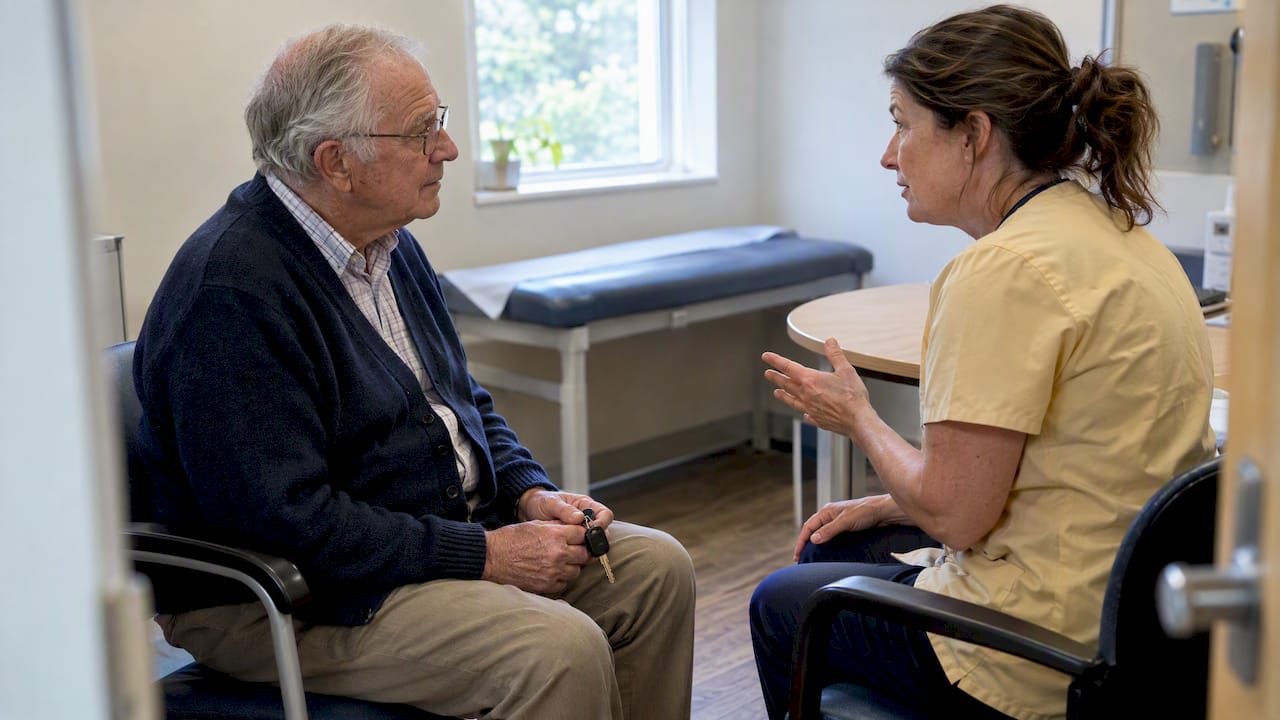
Most older adults can keep driving safely for years, provided they stay on top of a few things: vision and hearing checks, a medication review, and honest attention to how their body responds behind the wheel. If you or someone you love is navigating this, start with three actions this month: book an eye and hearing exam, bring every pill bottle to a pharmacist for a full review, and skip driving at night or in heavy traffic until that review is done. Drive With Care’s community resources can help you find local support.
TL;DR:
- Regular medication, vision, and hearing reviews significantly reduce crash risk by addressing impairments linked to frailty rather than reckless behavior.
- A 12-week strength and flexibility exercise program can improve neck movement and reaction time, leading to safer driving in older adults.
- CarFit adjustments and refresher courses help optimize vehicle fit and safety awareness, lowering the chances of crashes caused by physical limitations or unfamiliar safety features.
- Family conversations should focus on concrete driving issues and safety behaviors rather than age, with early intervention before serious incidents occur.
- Community programs and safety assessments depend heavily on donations and volunteer efforts, emphasizing the importance of local support for older driver safety.
Table of Contents
- What the statistics actually show about older driver risk
- How aging changes the way you drive
- The highest-impact safety steps you can take now
- When to get a professional driving assessment
- Talking with a parent or spouse about driving safety
- How Drive With Care supports older drivers and their families
- What actually moves the needle on older driver safety
- Support older driver safety programs through Drive With Care
- Where these facts come from
- Sources
- FAQ
What the statistics actually show about older driver risk
Per mile driven, fatal crash rates start climbing around ages 70 to 74 and peak for drivers 85 and older, according to the IIHS analysis of older driver fatalities. That rise is not mainly about causing more crashes. It reflects frailty: older bodies absorb crash forces worse, so a collision that a younger driver walks away from can be fatal for someone in their 80s.
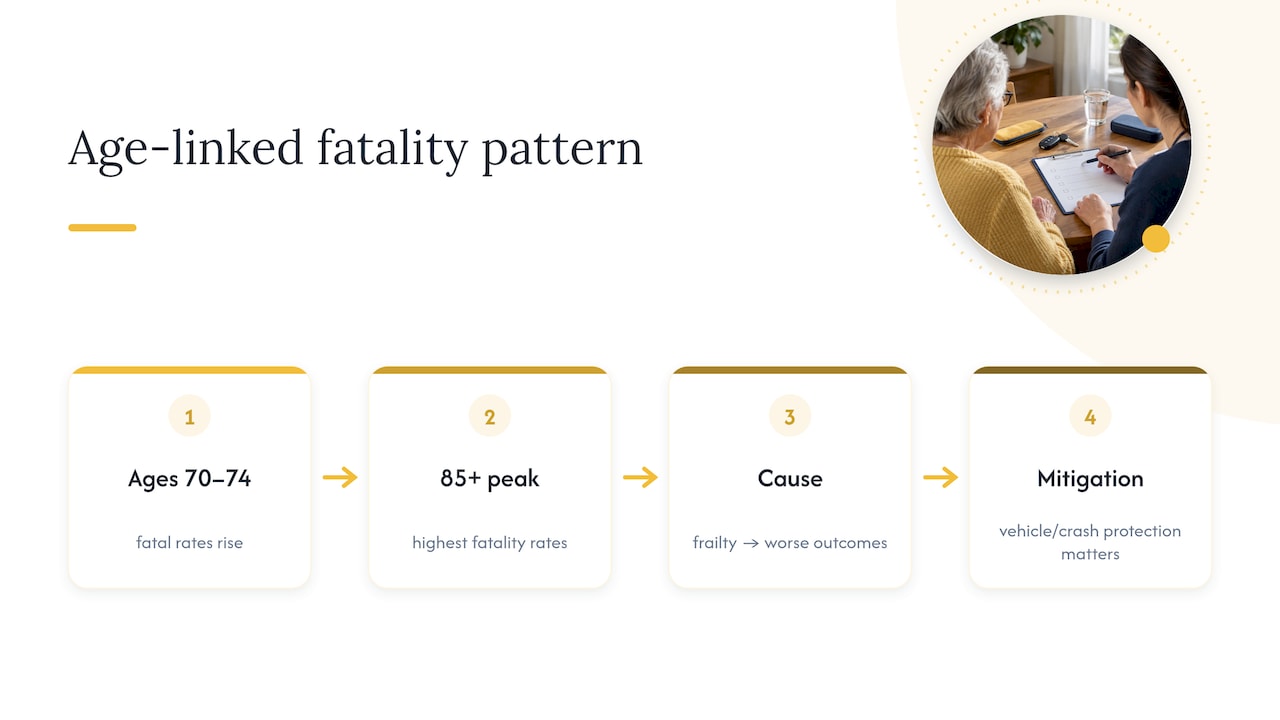
Higher fatality rates among older drivers track with injury susceptibility more than crash-causing behavior, according to IIHS data, which means vehicle choice and crash protection matter as much as driving habits. Many older-driver fatal crashes happen during the day, on weekdays, and involve multiple vehicles rather than single-car crashes caused by recklessness. Per-capita crash involvement among older drivers has trended down over recent decades even as the number of licensed older drivers grows, simply because there are more people in that age group now.
How aging changes the way you drive
Age does not switch off driving skill on a birthday. It erodes specific functions gradually, and spotting the erosion early is what lets you adjust before it becomes a hazard. The NHTSA guidance on aging and driving is built on this premise: decisions about driving ability should never rest on age alone, since vision, physical fitness, and reflexes vary enormously between individuals.
- Vision: glare sensitivity, reduced contrast perception, and weaker night vision make dusk and nighttime driving riskier; an annual eye exam catches most of this early.
- Hearing: missed sirens, horns, or a merging car’s engine noise often signal hearing loss that a yearly hearing check can flag.
- Cognition: slower processing makes judging gaps in traffic, timing left turns, and merging onto highways harder than it used to be.
- Mobility: limited neck rotation, arthritis in the hands or feet, and slower reaction time affect checking blind spots and working the pedals.
- Medications: sedating drugs, interactions, and polypharmacy can impair alertness, which is why a brown-bag medication review, bringing every bottle to a pharmacist or doctor, is one of the most overlooked safety steps available.
The highest-impact safety steps you can take now
Small, specific changes do more for safety than giving up driving altogether, and most of them take less than an hour to put in place.
- Get annual eye and hearing exams and ask your doctor or pharmacist for a full medication review using the brown-bag method, where you bring every prescription, over-the-counter drug, and supplement to one appointment.
- Build a light exercise routine. A 12-week program combining strength and flexibility work improved overall driving ability in a controlled study of older adults, likely because better neck rotation and reaction time translate directly into safer turns and lane changes.
- Adjust your driving habits: stick to daylight hours, avoid rush hour, favor routes with fewer left turns, and leave extra following distance.
- Get a CarFit check, a free 20-minute session that adjusts your seat, mirrors, and pedal position so the vehicle fits your body, improving visibility and control.
- Take a mature-driver refresher course to relearn defensive techniques and understand how newer safety features, like lane-keeping assist and automatic braking, actually work.
- Test alternative transportation before you need it: ride shares, local senior transit, or a volunteer driver program, so switching later feels familiar rather than sudden.
Pro Tip: Schedule your medication review and your CarFit check on the same week. Seeing both results together makes it much easier to decide what, if anything, needs to change.
When to get a professional driving assessment
Two different kinds of evaluation get confused often, and knowing the difference helps you ask for the right one.
- In-car driving skills evaluations test real-world performance: lane control, merging, turns, and reaction to hazards, usually run by a driving rehabilitation specialist.
- Clinical driving assessments test the underlying functions, vision, cognition, reaction time, and physical range of motion, often done by an occupational therapist.
- Common referral triggers include a new diagnosis affecting cognition, a recent fall, a change in medication, or a near-miss a family member witnessed.
- Prepare by keeping your normal routine the day of the test, bringing a complete list of medications, and writing down questions about what the results mean for your license.
- Outcomes range from a clean pass, to a recommendation for adaptive equipment or a refresher course, to restrictions like no highway or no night driving, to a referral for further medical evaluation.
Talking with a parent or spouse about driving safety
Raise the topic early, before a crash forces the conversation, and lead with specific behaviors you have noticed rather than age itself.
- Observe first. Note concrete incidents: a scrape on the mailbox, missed turns, confusion at an intersection, rather than generalizing about getting older.
- Ask them to help plan. Invite your loved one into problem-solving instead of announcing a decision: “What would make you feel safer behind the wheel?”
- Agree on one immediate step, whether that is a vision checkup, a CarFit appointment, or a trial week using a ride service for errands.
Red flags that call for immediate action include getting lost on familiar routes, confusing the gas and brake pedals, or a near-miss reported by someone else in the car. A family communication guide for caregivers offers more detail on framing these conversations without damaging trust, and a shared care-plan tool like KinCarer can help siblings coordinate who handles what.
How Drive With Care supports older drivers and their families
A safety initiative focuses on the human-error side of traffic safety, since error accounts for the overwhelming share of crashes across all ages.
- A safety pledge program has collected numerous commitments to safer driving habits.
- Partnerships with driving schools and local agencies help bring CarFit-style events and safety education closer to home.
- The safety reset rehearsal technique gives drivers a practical way to rehearse high-pressure scenarios before they happen on the road.
- A resources page collects checklists, local event links, and guides for families planning a conversation about driving.
What actually moves the needle on older driver safety
The conventional advice on this topic tends to treat age as the problem and license restriction as the solution. That framing misses what the evidence actually supports: frailty, not recklessness, drives most of the risk increase. Frailty responds to exercise, vehicle fit, and medication management far better than it does to a blanket cutoff age. Families who jump straight to “should you still be driving” often skip the cheaper, faster interventions first: a pharmacist review, a CarFit appointment, a pair of updated glasses.
If you take one thing from this, prioritize the brown-bag medication review before anything else. It is the fastest, cheapest check available, and sedating or interacting drugs are a fixable cause of impaired driving that gets far less attention than vision or cognition. CarFit checks come second: a seat two inches out of position or mirrors set wrong can undo a driver’s otherwise solid skills. Save the harder conversation about giving up the keys for last, after the fixable things have actually been fixed.
— Charles
Support older driver safety programs through Drive With Care
Every brown-bag medication review clinic, CarFit event, and community safety rehearsal Drive With Care runs depends on donations and partnerships, not on drivers paying for services.

Individual gifts through Donate Now range from $10 to $250 and fund direct outreach to older drivers and their families. Organizations and local groups can go further:
- The Safety Supporter Partnership ($250) backs local education events.
- The Community Safety Partner Partnership ($1,500) supports broader outreach in a single community.
- The Road Safety Partner Partnership ($5,000) and the Founding Road Safety Partner ($10,000) fund sustained, multi-site programming.
If you would rather give your time, volunteer with Drive With Care to help organize a local CarFit event or safety pledge drive, or reach out through the safety awareness page to bring a program to your community.
Where these facts come from
- The NHTSA guidance on aging and driving covers vision, medication, and self-regulation strategies for older drivers.
- The IIHS fatality statistics on older drivers break down crash risk by age group.
- The WHO guidance on healthy aging addresses community-level supports for safe mobility.
- A clinical study on exercise and driving performance measured the effect of a 12-week conditioning program.
Sources
- Driving safely while aging gracefully | NHTSA
- Older people | IIHS fatality statistics
- Exercise improves driving ability among older adults (PMC study)
- WHO – Age-friendly cities / healthy ageing guidance
FAQ
What percentage of 85 year olds still drive?
Published national figures on the exact share of 85-year-olds who hold a license are not publicly listed in the sources reviewed here. What is well documented is that fatality rates per mile rise sharply in this age group, according to IIHS data, largely because of greater injury susceptibility rather than a higher crash-causing tendency.
Is it safe for a 90 year old to drive?
Safety at advanced ages depends on individual vision, cognition, reflexes, and physical fitness rather than age alone, according to NHTSA guidance. A clinical or in-car driving assessment is the most reliable way to answer the question for a specific person.
Should an 82 year old be driving?
There is no single age cutoff that determines whether someone should keep driving, since functional ability varies widely among individuals in their 80s. A medication review, updated vision and hearing checks, and a CarFit adjustment are reasonable first steps before deciding anything bigger.
At what age do most seniors give up driving?
There is no single, universally cited age at which most older adults stop driving, since the decision depends on health changes, not a fixed birthday. Families are generally advised to watch for specific warning signs, like getting lost on familiar routes or confusing pedals, rather than waiting for an arbitrary age.

