
If you’re drinking, don’t drive. Plan a sober ride home before you take the first sip, not after. That single decision prevents more harm than almost anything else discussed in this piece, but it works best alongside two other priorities: stopping impaired friends from getting behind the wheel and backing the community tools that catch what personal willpower misses.
At 0.02 g/dL, visual function and multitasking already decline. By 0.08, judgment and reaction time are seriously compromised. On the policy side, Utah’s move to a 0.05 BAC limit cut crash deaths per mile driven by 18% in its first year.
Three things matter most:
- Plan your ride home before you start drinking, not after.
- Intervene early if a friend is too impaired to drive.
- Support community measures like ignition interlocks and checkpoints, which have been shown to help reduce impaired driving.
Key Takeaways
Drunk driving prevention works best when personal planning, community policy, and host responsibility operate together rather than as separate strategies.
| Point | Details |
|---|---|
| Plan before you drink | Line up a sober driver or rideshare before the first drink, not after. |
| Know the BAC thresholds | Impairment starts at 0.02 g/dL; skills are substantially compromised by 0.08 g/dL. |
| Support proven policy | Lower BAC laws like Utah’s cut crash deaths by 18% in one year. |
| Buckle up regardless | Seat belts cut death or serious injury risk by about 50% in a crash. |
| Join Drivewithcare’s pledge | Sign the Safer Roads Now pledge or donate to support education and survivor programs. |
Table of Contents
- Personal Actions That Prevent Impaired Driving
- Community and Policy Strategies That Reduce Drunk-Driving Deaths
- Host Strategies for Parties and Events
- How to Stop a Friend From Driving Impaired
- Drive With Care Programs You Can Join Today
- Screening, Brief Interventions, and Getting People Into Treatment
- Do School and Community Alcohol Education Programs Actually Work?
- Law Enforcement Training and Where Resources Go
- Beyond Interlocks: New Technology for Preventing Impaired Driving
- Does Public Transportation Availability Reduce Drunk Driving?
- How Data Tracking Improves Drunk Driving Prevention
- What the Research Actually Supports
- Get Involved With Drivewithcare’s Prevention Programs
- Sources
Personal Actions That Prevent Impaired Driving
Prevention starts with a decision made before the first drink, not a debate after the fourth. The most reliable move is picking a sober driver or prebooking a rideshare before you leave the house. If you’re hosting yourself, build an overnight option into the plan, a spare room, a couch, anything that removes the temptation to “just drive a few blocks.”
Understanding what alcohol actually does to your driving ability helps make the case for planning ahead. Here’s how impairment builds:
- At 0.02 g/dL (roughly one drink for most adults), visual tracking and the ability to do two things at once already decline.
- At 0.05 g/dL, coordination and steering control weaken noticeably, and reaction time slows.
- At 0.08 g/dL, the legal limit nearly everywhere in the US, short-term memory, speed control, and information processing are all substantially impaired.
None of these thresholds require you to feel drunk. That’s the trap: impairment starts working against you long before your judgment tells you it has.
A seat belt won’t stop a crash caused by another impaired driver, but it dramatically changes what happens if one hits you. Buckling up cuts your risk of dying or being seriously injured by roughly 50%, which makes it the cheapest insurance policy on the road.
Smaller habits add up too: cap yourself at one drink per hour, set a phone reminder to check in on your plan, or just hand your keys to someone else the moment you start drinking so the decision is already made.
Pro Tip: Put your rideshare app’s payment method on autopay before a night out. Removing the “do I have enough for a ride” hesitation removes one of the most common excuses people give for driving anyway.
Community and Policy Strategies That Reduce Drunk-Driving Deaths
Individual choices matter, but they don’t catch everyone, which is why policy tools exist to close the gap. Public-health researchers consistently find that changing the environment through law and enforcement works better than relying on personal willpower alone.
Lower legal limits are one of the clearest wins on record. When Utah dropped its BAC threshold to 0.05, the crash death rate per mile driven fell 18% in the first year, a result that pushed other states to reconsider their own limits.
Ignition interlocks target repeat risk directly. These devices require a breath sample below roughly 0.02 g/dL before the engine will start, and they’re highly effective at preventing repeat offenses for as long as they stay installed. That last part matters: interlocks work best paired with treatment and monitoring, since removing one without follow-up support tends to erode the benefit over time.
A handful of other levers round out the toolkit:
- Sobriety checkpoints and high-visibility enforcement, publicized regularly rather than run quietly, act as a deterrent even for drivers who never encounter one.
- Higher alcohol taxes and limits on outlet density reduce overall consumption in ways that show up in crash statistics.
- Zero-tolerance laws for drivers under 21 close off the riskiest age group’s margin for error entirely.
The strongest evidence points toward combining these approaches rather than picking one. Multi-component strategies that mix policy, enforcement, and community mobilization outperform any single tactic on its own.
Host Strategies for Parties and Events
If you’re the one pouring the drinks, you carry real responsibility for how the night ends. The most effective move happens before anyone arrives: line up rideshare codes, a shuttle, or a designated-driver list and post it somewhere guests will actually see it.

Timing the bar matters more than most hosts realize. Cutting off alcohol service at least two hours before the event ends gives guests time to sober up somewhat and gives you a real window to sort out transportation instead of scrambling at the door.
A few concrete steps make this easier to pull off:
- Advertise the safe-ride plan in the invite, not as an afterthought announced at midnight.
- Stop serving alcohol two hours before close, and switch the bar to coffee and water.
- Keep nonalcoholic drinks visible and appealing, not shoved in a back cooler.
- Offer a small incentive, free food, a raffle entry, for anyone who volunteers as a designated driver.
Pro Tip: Assign one sober person the specific job of watching the door for anyone who looks ready to leave and drive. A general “keep an eye out” instruction rarely works; a named responsibility does.
How to Stop a Friend From Driving Impaired
The moment you decide to intervene, skip the debate about whether they’re “really” drunk, a recommended approach outlined in ADHD And Driving: Safer Systems For Focus. Impairment isn’t up for negotiation, and arguing about it just gives someone more time to get to their car.
- Say it plainly and calmly. “I care about you, and you’re not driving tonight” works better than a lecture.
- Get the keys. Ask directly, or offer to hold them “just for now” if a direct request feels confrontational.
- Line up the ride immediately. Call a rideshare, a cab, or another sober friend before the conversation stalls.
- Offer to drive them yourself if that’s realistic and you’re sober.
- Stay with them until they’re in the car, on the couch, or otherwise no longer a risk.
- Call law enforcement if someone tries to drive anyway and you can’t physically stop them safely.
When intervening with an impaired friend, don’t debate the impairment itself. Explain that you care, then take decisive action, take the keys, arrange a ride, and stay persistent until the person genuinely cannot drive.
This isn’t about winning an argument. It’s about outlasting someone’s stubbornness for the ten minutes it takes to get them home safely, a tactic road safety agencies actively recommend. Know your limits, too: if a situation turns physical or unsafe, step back and call for help rather than escalating it yourself.
Drive With Care Programs You Can Join Today
Prevention works best when it’s visible in a community, not just practiced privately. That’s the thinking behind Safer Roads Now, Drivewithcare’s core initiative built around a simple insight: human error drives up to 96% of traffic incidents, and most of that error is preventable with the right habits and support systems.
The pledge program asks people to commit publicly to safe driving, no phone use, no impaired driving, always a plan for getting home. Thousands have already signed on, and visible pledges tend to shift local social norms by making safe behavior something neighbors can see and copy, not just something everyone privately agrees is a good idea.
Ways to get involved:
- Sign the pledge and share it with your family or driving-age teens.
- Volunteer as a community safety ambassador through local partnerships with driving schools.
- Donate to support education and survivor programs.
- Explore Drivewithcare’s safety awareness resources for materials you can use in your own community.
For deeper reading, the CDC’s impaired driving prevention guidance and NHTSA’s Drunk Driving statistics page are two of the most reliable sources available.
| Resource | What it offers |
|---|---|
| Safer Roads Now pledge | Public commitment tool that shifts local social norms around safe driving. |
| Donate Now | Funds education, survivor support, and neurological research programs. |
| CDC and NHTSA guidance | Government-backed data and prevention strategy summaries. |
Screening, Brief Interventions, and Getting People Into Treatment
Not everyone who drives impaired has a diagnosable alcohol use disorder, and that distinction matters for prevention. Screening and brief intervention programs exist to catch risky drinking patterns before they turn into a DUI arrest or a crash.
These programs work by asking a short series of questions, often in an ER, a primary care visit, or even a university health center, to identify someone drinking at a level that raises their risk. Screening and brief interventions are effective at reaching people outside a clinical addiction diagnosis, which is exactly the group most likely to end up driving after “just a few drinks” without realizing how impaired they are.
The intervention itself is usually brief: a conversation, some feedback on drinking patterns, and a referral if the person’s answers suggest a bigger problem. It’s low-cost, non-punitive, and it reaches people long before law enforcement would ever get involved.
The setting flexibility is what makes this approach useful at scale. A screening conversation in a doctor’s office costs a few minutes and catches people who would never seek out addiction treatment on their own. Community clinics, college health centers, and even workplace wellness programs can run versions of the same model.
For someone already flagged as a repeat offender, treatment referral paired with monitoring, sometimes alongside an ignition interlock, produces better long-term outcomes than punishment alone. The goal isn’t just to stop one drive; it’s to change the pattern that leads to the next one.
Do School and Community Alcohol Education Programs Actually Work?
The honest answer is: it depends heavily on the design. Programs that rely on scare tactics or one-off assembly speeches tend to produce short-term awareness that fades within weeks. Programs woven into a broader, sustained effort perform far better.
The strongest evidence supports combining education with policy and enforcement rather than treating classroom lessons as a standalone fix. Multi-component interventions that mix education, community mobilization, and policy consistently outperform education delivered in isolation. A single lecture about the dangers of drunk driving rarely changes behavior on its own, but that same lesson backed by a visible pledge campaign, active enforcement, and peer-driven social pressure tends to stick.
Age matters too. Programs aimed at teen drivers work best when they address the specific risk factors young drivers face, including the well-documented tendency for passengers to raise a teen driver’s crash risk independent of alcohol. Family driving agreements that spell out consequences and expectations in advance give teens a concrete reference point instead of a vague warning.
Community-level programs that succeed tend to share a few traits: they’re recurring rather than one-time, they involve local voices instead of outside experts parachuting in, and they pair the message with a real action, a pledge, a ride-share discount code, a checkpoint schedule, something the audience can actually do with the information.
Law Enforcement Training and Where Resources Go
Enforcement only deters drunk driving if drivers believe they’ll actually encounter it. That’s a training and resource-allocation problem as much as a legal one.
Officers trained in standardized field sobriety testing catch impairment more reliably and consistently than those relying on informal judgment calls. That consistency matters in court, where poorly documented stops get challenged and can undercut public confidence in enforcement altogether.
Resource allocation shapes outcomes just as much as training does. Checkpoints and patrols concentrated during known high-risk windows, holiday weekends, late-night hours, event nights, catch more impaired drivers per hour of enforcement than evenly spread patrols. But the deterrent effect depends on visibility: checkpoints that never get publicized lose most of their preventive value, since the psychological deterrent comes from drivers expecting to encounter one, not just from the occasional arrest.
Departments that route resources toward high-visibility, well-publicized enforcement alongside routine patrols tend to see better results than those that treat DUI enforcement as an occasional priority. Sustained funding for training and equipment, breathalyzers, dashcams, officer certification, also determines how consistently a jurisdiction can run these programs year over year rather than in short bursts tied to grant cycles.
Beyond Interlocks: New Technology for Preventing Impaired Driving
Ignition interlocks remain the most established technology, but they’re no longer the only option in development. In-car alcohol detection systems, some using breath sensors built into the vehicle itself, others using touch-based sensors in the steering wheel or gear shift, are being tested as standard equipment rather than court-ordered add-ons.
The appeal is obvious: instead of installing an interlock after a conviction, a built-in sensor could flag impairment before a first offense ever happens. These systems are still working through reliability and cost hurdles before wide adoption, but the direction is clear. Passive sensing, technology that checks a driver without requiring a deliberate breath sample, is the likely next step, since it removes the friction that makes some drivers try to bypass a traditional interlock.
Smartphone apps that estimate BAC based on self-reported drinks and time are popular but far less reliable than an actual sensor. They’re useful as a rough gut check, not as a green light to drive. Rideshare apps themselves function as a kind of technology intervention too, lowering the cost and friction of choosing a sober ride to nearly zero.
The lesson from interlocks applies here as well: technology works best paired with follow-up, not as a standalone fix. A car that won’t start doesn’t address why someone was drinking and driving in the first place. Pairing new detection tech with the same screening and treatment pathways used for interlocks will matter as these systems scale up.
Does Public Transportation Availability Reduce Drunk Driving?
Access to a bus, train, or late-night transit option removes one of the biggest excuses for driving impaired: “I had no other way home.” Cities with reliable late-night transit consistently see this option used as a genuine alternative on high-risk nights, not just a theoretical one.
The gap shows up clearly in areas without it. Rural and suburban communities with limited or no public transit push people toward driving by default, since a rideshare might take 40 minutes to arrive or cost more than a round of drinks. That access gap is a policy lever, not just a personal inconvenience, and it’s one reason drunk driving rates skew higher in areas with sparse transit infrastructure.
Expanded late-night service, extended train and bus hours on weekends, dedicated shuttle routes near entertainment districts, functions as a prevention tool even though transit agencies rarely frame it that way. It’s infrastructure doing the work that a designated driver or a rideshare app does on an individual level, just at a scale that reaches people who can’t afford either.
Communities pushing for prevention gains often overlook this lever entirely, focusing on enforcement and education while ignoring the basic logistics of how someone gets home. Advocating for extended transit hours around nightlife districts is a concrete, achievable ask for local advocacy groups, and it’s one of the few prevention measures that helps every rider, not just the ones who plan ahead.
How Data Tracking Improves Drunk Driving Prevention
None of these strategies work in a vacuum, and none of them stay effective without measurement. Crash data, arrest records, and interlock usage logs are what tell policymakers whether a given law or program is actually reducing harm or just looking good on paper.
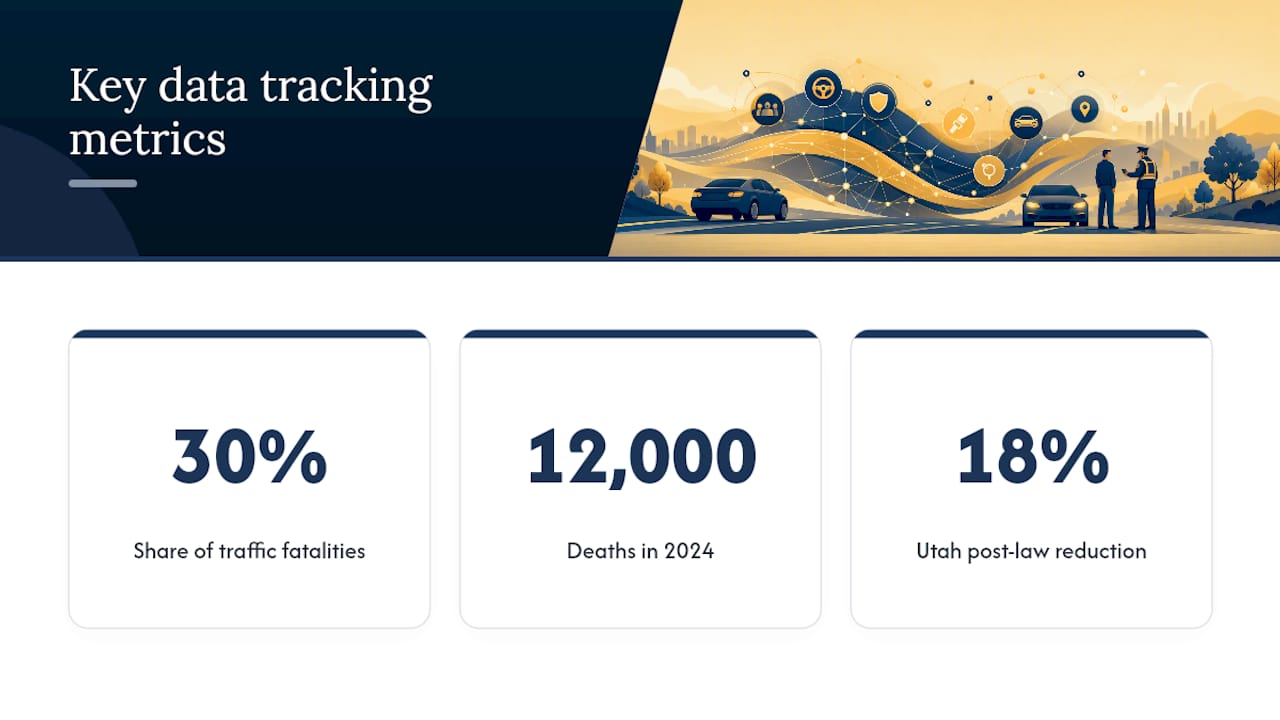
NHTSA’s national crash statistics show that roughly 30% of all traffic fatalities involve a drunk driver, with nearly 12,000 deaths recorded in 2024 alone. That single data point is what makes prevention urgent, but it’s the year-over-year tracking, not the one-time snapshot, that reveals whether a specific policy is working.
States that track BAC laws, interlock installations, and checkpoint frequency against local crash trends can spot what’s working faster than states relying on national averages alone. Utah’s 18% reduction after lowering its BAC limit only became a usable data point because researchers tracked crash rates closely enough, before and after, to isolate the law’s effect from other factors.
Local advocacy groups can push for the same rigor at a smaller scale: asking city councils to publish checkpoint schedules and outcomes, or asking school districts to track participation in education programs against local incident rates. Data without action changes nothing, but action without data is just guessing, and guessing is exactly what got drunk driving rates stuck for decades before agencies started measuring seriously.
What the Research Actually Supports
Most drunk driving campaigns lean hard on individual willpower: don’t drink and drive, make good choices, be responsible. That framing isn’t wrong, but it’s incomplete, and treating it as the whole solution is where a lot of well-intentioned prevention work falls short.
The evidence points somewhere less comfortable for anyone who wants a simple answer. Utah’s 18% drop after lowering its BAC limit didn’t happen because people suddenly developed better judgment. It happened because the environment changed. Interlocks work the same way: they don’t require someone to feel motivated at 11 p.m. on a Friday, they just remove the option entirely.
That’s the gap I’d push readers to close first. Personal planning, a designated driver, a rideshare app, a seat belt, still matters enormously, and it’s the fastest thing you can control tonight. But if your only prevention strategy is hoping people make better choices, you’re betting against a substantial body of evidence showing that environment and policy do more of the work. Support the boring stuff: checkpoints, interlocks, transit funding, pledge programs. It’s less satisfying than a personal resolution, but it’s what actually moves the death count.
— Charles
Get Involved With Drivewithcare’s Prevention Programs
Reading about prevention strategies is a start; putting one into practice locally is what actually changes outcomes. Drivewithcare exists for exactly that gap between knowing what works and having a way to act on it. Through the Safer Roads Now initiative, you can sign a personal driving pledge, connect with local safety ambassadors, or bring a family driving agreement into your own household instead of leaving prevention as a vague intention.
If you’ve read this far, you already understand the stakes better than most. The next step is small: donate now to fund the education programs, survivor support, and research this article draws on, or explore volunteer opportunities if you’d rather give time instead of money. Either one turns what you just read into something a community can actually use.
Sources
- What Works: Strategies to Prevent Alcohol-Impaired Driving | Impaired Driving | CDC
- Drive Sober or Get Pulled Over | NHTSA
- Drunk Driving | Statistics and Resources | NHTSA
Recommended
- Promote traffic safety and awareness – Safety Behind the Wheel Foundation
- Why friends in the car can raise a teen driver’s crash risk – Safety Behind the Wheel Foundation
- Safe driving contract between teen driver and parents – Safety Behind the Wheel Foundation
- Resources – Safety Behind the Wheel Foundation

