
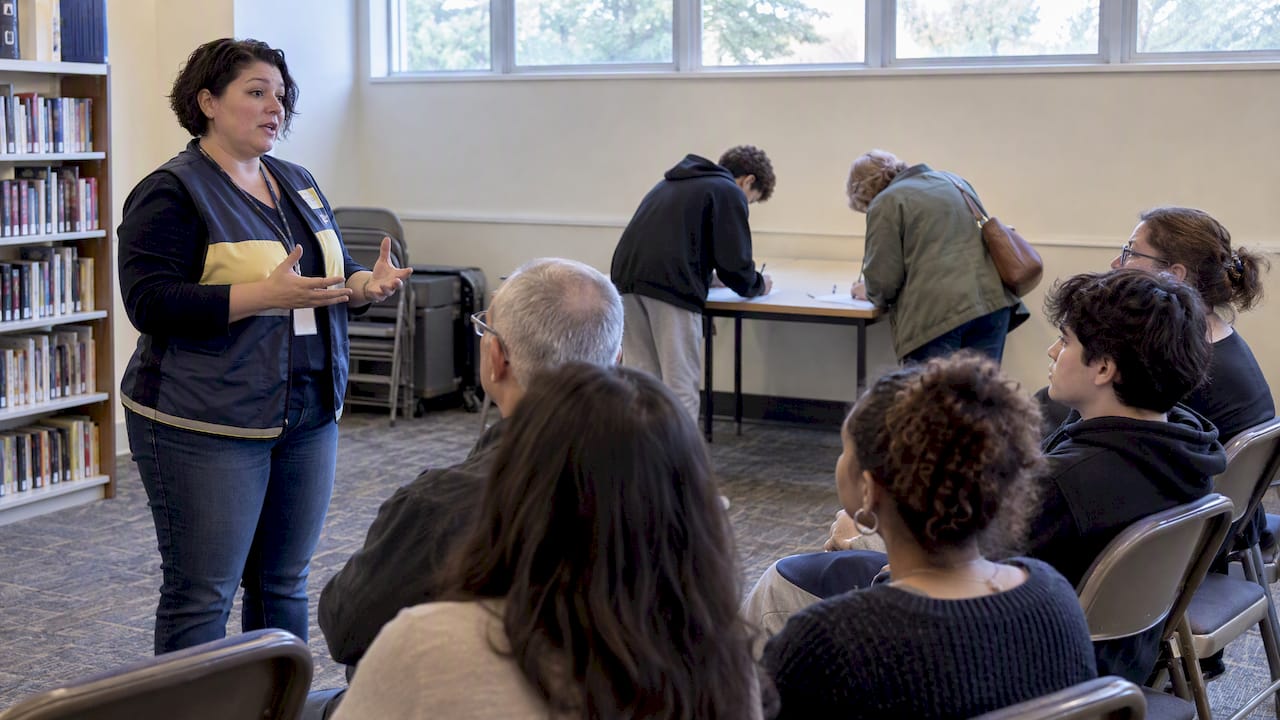
A safe driving workshop in our model is a community event that combines road safety education with survivor testimony and a public behavior-change pledge, built to leave attendees with new awareness, a concrete commitment, and a connection to support. We design these sessions for families, teen drivers, crash survivors, and community partners who want more than a lecture: a shared experience that changes what people do behind the wheel.
TL;DR:
- Community-led workshops must include local crash data, survivor testimony, interactive activities, a public pledge, and resource demonstrations to foster lasting behavior change.
- Follow-up surveys and pledge tracking at one week, one month, and three months are essential to measure whether attendees maintain safer driving habits over time.
- Peer-led education, specific public commitments, and ongoing reminders significantly improve the likelihood of sustained behavioral improvement.
- Workshops focus on practical principles like seatbelt use, adjusted speed, and distraction avoidance, emphasizing consistent habits over fear-based messaging.
- Proper understanding and use of in-car safety features, along with knowledge of local legal responsibilities, are key components to reduce crash risk.
Table of Contents
- What Counts as a Safe Driving Workshop, and What Doesn’t
- Who Gets the Most Out of a Workshop
- The Modular Blueprint We Recommend for Hosts
- Planning Checklist: From Idea to Delivered Event
- Tactics That Make the Message Stick
- Measuring Whether the Workshop Actually Changed Behavior
- How Our Safer Roads Now Model Supports Hosts
- Core Safe Driving Principles Worth Repeating
- What Actually Causes Most Road Accidents
- Defensive Driving Techniques Worth Practicing
- Understanding the Safety Features Already in Your Car
- Legal Responsibilities Every Driver Should Understand
- Spotting Hazards Before They Become Emergencies
- Why Fear Alone Never Changes Driving Habits
- Bring a Safe Driving Workshop to Your Community
- FAQ
- Sources
What Counts as a Safe Driving Workshop, and What Doesn’t
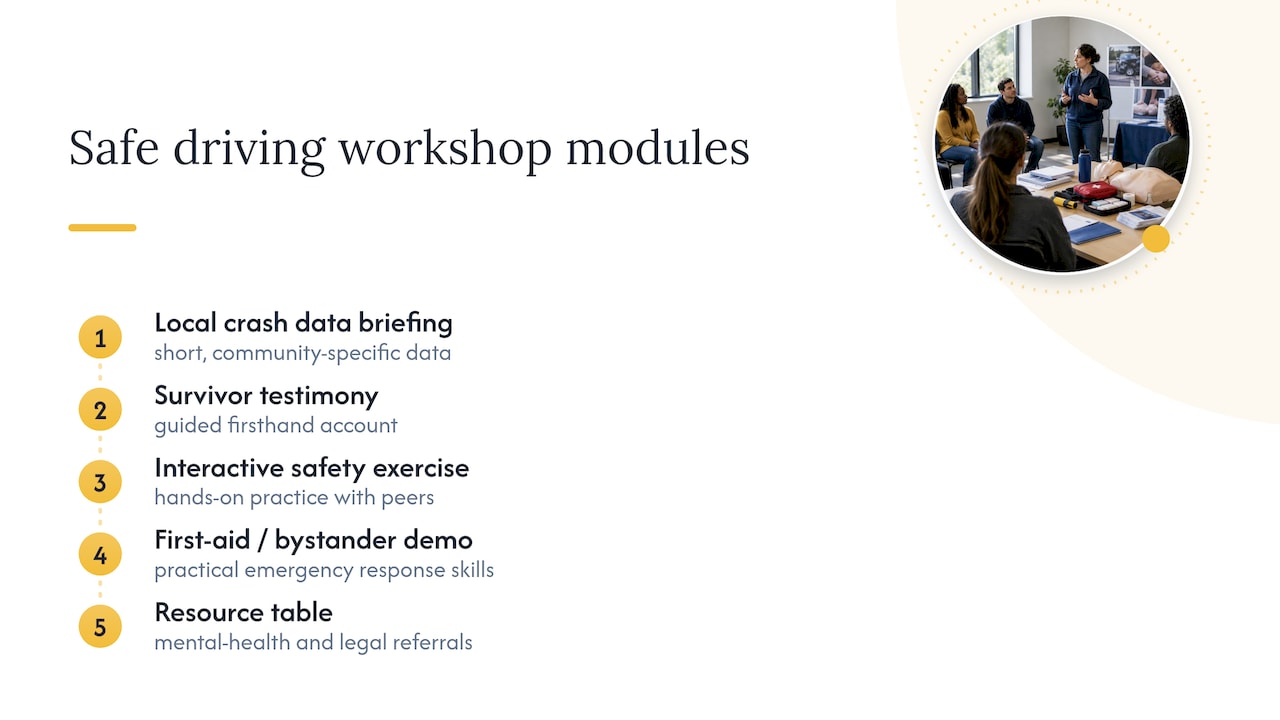
Our safe driving workshops are community-led sessions that pair local crash data, a survivor’s firsthand account, hands-on safety practice, and a pledge participants sign in front of their peers. The core modules usually include a short data briefing, guided testimony, an interactive exercise, a first-aid or bystander-response demo, and a resource table connecting attendees to mental health and legal support.
This is not a court-ordered or insurance-mandated defensive driving class, and we never frame it that way. There is no certificate for ticket dismissal, no insurance discount, and no legal credit for completion. The goal is awareness and behavior change inside a community, not compliance with a court or insurer. Families, teens, survivors, and local organizations come together for a few hours; what they leave with is a pledge, a referral list, and often a first-aid skill they did not have before walking in.
Who Gets the Most Out of a Workshop
Each audience walks away with something different. Families and teen drivers get practical tools for pushing back on driving pressure, along with pledge language and teen-parent driving contracts that turn a conversation into a written commitment. Survivors get a peer environment and a direct line to emotional and psychological support resources, since crash recovery is rarely just physical.
- Community members and volunteers gain hands-on first-aid exposure and a role in local resilience efforts.
- Donors and partners get a measurable channel for impact: pledge counts, attendance, and follow-up data tied to a specific event.
- Teen drivers get peer-tested language for resisting pressure to speed, text, or skip a seatbelt.
Everyone leaves with a next step, not just information.
The Modular Blueprint We Recommend for Hosts
A workshop runs best as a sequence, not a grab bag of activities. We suggest five modules in this order:
- Local data briefing (10 minutes): a short, specific look at crash patterns in the host community to make the risk feel real rather than abstract.
- Survivor testimony (20 to 30 minutes): a firsthand account delivered under WHO post-crash response guidance, which recommends integrating medical, psychological, legal, and social support for anyone sharing their story publicly.
- Interactive peer activity: role-play, scenario cards, or a short simulation that lets attendees practice a response rather than just hear about it.
- Public pledge: a witnessed, specific commitment, such as seatbelt use or a no-texting promise, signed in the room.
- First-aid and resource demo: a brief bystander-response walkthrough paired with a printed or digital referral table for mental health, legal aid, and survivor support.
Trauma-informed facilitation matters at every stage where a survivor is speaking. That means a pre-brief with the speaker, a built-in opt-out, on-site mental health support, and an immediate debrief after the talk, consistent with WHO’s framework for post-crash response.
Pro Tip: Keep testimony to under 30 minutes and follow it immediately with a facilitated discussion rather than letting the room sit in silence; reflection, not shock, is what sticks.
Planning Checklist: From Idea to Delivered Event
Before any outreach, write down what success looks like: a pledge rate, an attendance target, or a specific knowledge gain you plan to measure afterward. Vague goals produce vague events.
- Recruit partners early, including a first-aid trainer, a mental health provider, local emergency services, and a school or youth group if teens are part of the audience.
- Build a survivor consent protocol before contacting any speaker: written consent, an opt-out clause, and a named mental health contact on-site.
- Confirm venue accessibility and a basic supply list: seating, a sound system, pledge cards, and printed resource sheets.
- Set a staffing plan so no single volunteer is responsible for both logistics and emotional support during the event.
- Draft a promotion and registration plan, including a parental consent form if minors will attend.
Budgets for a first event can stay modest. A local venue, printed pledge cards, and a volunteer first-aid demonstrator cost far less than a formal program, and a partnership like our Community Safety Partner Partnership can offset the rest. First-aid training providers such as Prime First Aid and Training offer course formats that community hosts can adapt for a short bystander-response segment. Groups organizing youth travel or school-based events can also draw on planning frameworks like the one from Group Travel Network for risk management basics.
Tactics That Make the Message Stick
Fear alone rarely changes behavior for long. What works better is a mix of peer influence, guided reflection, and a commitment people make in public.
- Train local youth as facilitators. Peer-led road safety education has improved knowledge scores among adolescents in pre- and post-studies, though attitude and behavior shifts usually need reinforcement over time.
- Pair testimony with structured reflection, not a standalone shock moment; a guided discussion after a survivor’s story helps attendees process what they heard instead of just reacting to it.
- Make the pledge specific and public. A vague promise to “drive safely” does little; a pledge to always buckle up or never text while driving, signed in front of others, gives people something concrete to track.
- Follow up with short digital reminders or a community challenge in the weeks after the event to keep the pledge from fading from memory.
Behavioral science research on seatbelt campaigns finds that public pledges, positive framing, and social norms messaging increase uptake more reliably than fear-based messaging alone, which supports building the pledge module around specific, witnessed commitments rather than general warnings.
Measuring Whether the Workshop Actually Changed Behavior
A short pre- and post-survey gives you the clearest signal at the lowest cost. Ask about knowledge of local crash risks, intent to change a specific behavior, and confidence in responding to a crash scene; a handful of questions is enough for a community event.
- Track pledge signatures as a behavioral proxy, since a specific public commitment is easier to measure than a vague attitude shift.
- Check in at one week, one month, and three months, asking a short version of the same intent questions each time to see whether the commitment held.
- Collect qualitative feedback from survivors and partners after each event to adjust testimony length, discussion format, or follow-up timing.
- Compare knowledge-score changes against the pattern seen in peer-led education studies, where gains often appear right after the session but need reinforcement to last.
This cadence costs little more than a few email check-ins or text reminders, and it turns a one-time event into a dataset you can use to improve the next one.
How Our Safer Roads Now Model Supports Hosts
Our Safer Roads Now initiative is built around the idea that survivor stories, paired with public pledges and local data, move people further than statistics alone. Since human error accounts for the overwhelming majority of road incidents, we focus workshop design on the specific choices drivers make every day: buckling up, putting the phone away, slowing down in a school zone.
Hosts working with us can draw on prepared testimony coordination, pledge toolkits, and printed or digital resource materials through our resource hub, rather than building a program from nothing. We also maintain guidance on handling driving pressure for young drivers, which hosts can fold directly into a teen-focused session. Our pledge program has collected thousands of individual commitments to date, and we treat each one as a data point worth tracking, not just a signature.
Core Safe Driving Principles Worth Repeating
A handful of habits account for most of the difference between a safe trip and a dangerous one. Seatbelt use remains the single most effective protection in a crash, yet it is also the habit most often skipped on short, familiar trips. Keeping a consistent following distance, generally three to four seconds behind the car ahead, gives a driver time to react instead of reacting too late.
Speed adjusted to conditions matters more than speed limits painted on a sign; a posted limit assumes dry pavement and daylight, not rain or fog. Eliminating phone use entirely while driving, rather than relying on hands-free settings, removes the mental distraction that causes most phone-related crashes, since the risk comes from attention, not hand position.
Fatigue deserves the same respect as impairment. A tired driver has slower reaction times and poorer judgment, and the fix is simple: pull over and rest rather than pushing through. These principles are not complicated, but repetition is what makes them automatic, which is exactly why a workshop built around practice and public commitment works better than a one-time pamphlet.
What Actually Causes Most Road Accidents
Distraction, speeding, and impaired driving are the three causes that show up again and again in crash investigations, and each has a distinct fix. Distraction includes phones, but also eating, adjusting a GPS, or reaching for something in the back seat; the common thread is attention pulled away from the road for even a few seconds.
Speeding reduces the time a driver has to notice a hazard and the distance needed to stop once they do, a compounding problem rather than a single risk. Impairment from alcohol, drugs, or exhaustion slows reaction time and distorts judgment about risk, which is why workshops pair data on local crash causes with a direct conversation about these specific behaviors rather than general safety talk.
Weather and road conditions contribute as well, but they tend to combine with one of the three behaviors above rather than cause crashes alone; a driver going the speed limit in heavy rain is still speeding for the conditions. Addressing the behavior, not just the condition, is where a workshop’s pledge module earns its place.
Defensive Driving Techniques Worth Practicing
Defensive driving means assuming other drivers will make mistakes and leaving yourself room to respond. Scanning intersections before entering them, even on a green light, catches the driver who runs a red. Checking mirrors and blind spots before every lane change, not just the ones that feel necessary, catches the vehicle that drifted into view without you noticing.
Keeping a consistent space cushion around your car, not just behind the car ahead, gives you an escape route if a hazard appears from any direction. Covering the brake in high-risk zones, school areas, parking lots, and intersections, shaves critical fractions of a second off reaction time.
Anticipating the actions of pedestrians and cyclists, especially at dusk or dawn when visibility drops, prevents the kind of close call that turns into a crash. None of these techniques require special training, only consistent practice, which is why a workshop’s interactive module matters as much as its lecture portion.
Understanding the Safety Features Already in Your Car
Modern vehicles carry safety systems that only work when drivers understand and use them correctly. Anti-lock brakes let a driver steer while braking hard, but only if the driver keeps steady pressure on the pedal instead of pumping it, an old habit from before ABS existed. Electronic stability control helps correct a skid automatically, though it cannot compensate for excessive speed into a turn.
Airbags are designed to work with a seatbelt, not instead of one; without a belt, an airbag can cause injury rather than prevent it. Blind-spot monitoring and lane-departure warnings reduce risk, but they are assistance, not replacements for checking mirrors and staying attentive.
Child safety seats and boosters only protect as intended when installed and used according to the seat’s own weight and height guidelines, which vary by model, so checking the manual matters more than following general advice. Knowing what a car’s systems actually do, and what they do not do, closes a gap that too many drivers never think about until a near-miss.
Legal Responsibilities Every Driver Should Understand
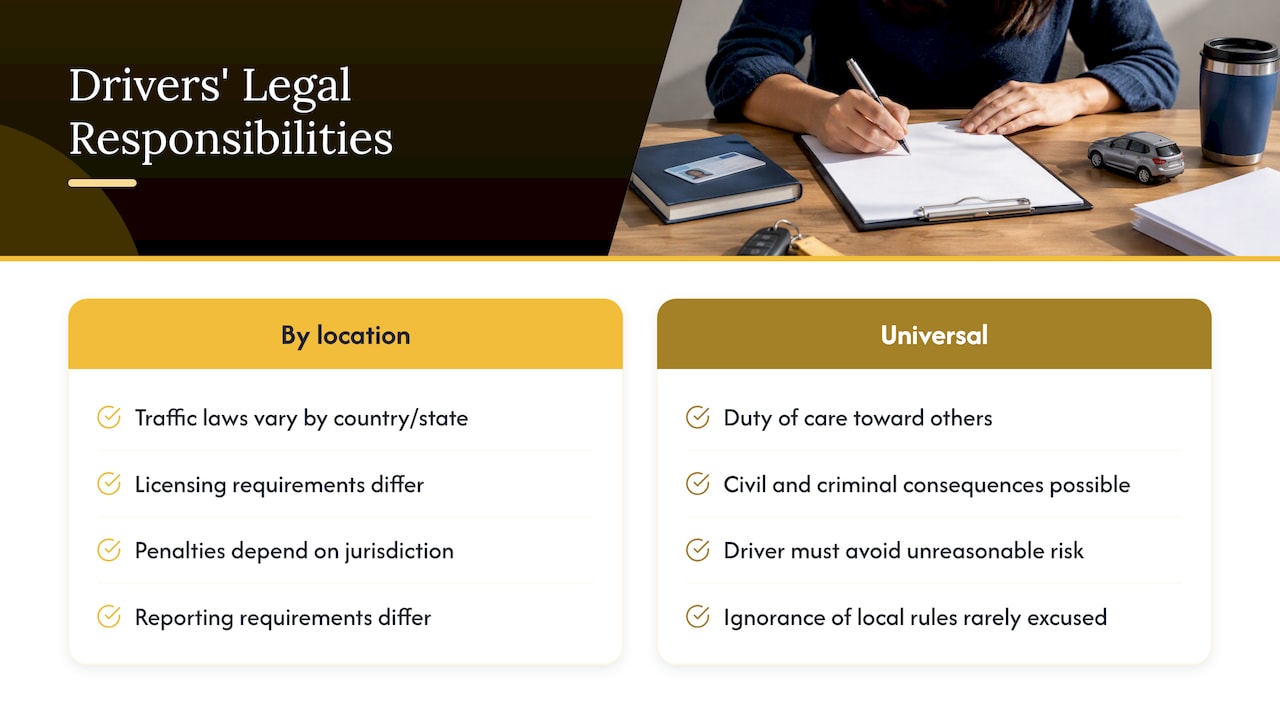
Every licensed driver carries a legal duty of care toward other road users, and failing that duty can carry both civil and criminal consequences depending on the outcome of a crash. Traffic laws, licensing requirements, and penalties vary significantly between countries and even between states or provinces within the same country, so a driver’s specific obligations depend on where they are driving, not a single global standard.
Reporting requirements after a crash, insurance obligations, and liability rules also differ by jurisdiction, which is why we point workshop attendees toward their own local traffic authority or a legal professional for specifics rather than offering a one-size answer. What stays consistent everywhere is the basic principle: a driver is responsible for operating a vehicle in a way that does not put others at unreasonable risk, and ignorance of a local rule rarely excuses a violation.
Workshops are not the place to resolve legal questions, but they are a useful place to raise awareness that responsibilities exist beyond the moment of a crash, including for survivors navigating insurance claims or legal proceedings afterward.
Spotting Hazards Before They Become Emergencies
Risk assessment on the road is mostly about noticing patterns early: a ball rolling into the street usually means a child is right behind it, and a car weaving slightly in its lane might signal a distracted or impaired driver nearby. Scanning ahead, not just at the car directly in front, gives a driver time to adjust before a hazard becomes unavoidable.
Weather changes risk quickly, and a driver who adjusts speed and following distance as soon as rain starts, rather than after the road feels slippery, has already cut their risk. Intersections carry disproportionate danger because they combine multiple vehicles, pedestrians, and decision points at once, which is why a brief pause and visual check, even with the right of way, prevents many crashes.
Night driving and low-visibility conditions call for reduced speed and increased following distance, since reaction time does not improve just because the hazard is harder to see.
Why Fear Alone Never Changes Driving Habits
The conventional wisdom about road safety campaigns leans hard on shock: graphic images, worst-case statistics, scared-straight assemblies. It works for about as long as the memory of the slideshow lasts, then fades. What actually holds up over months is a specific, public commitment paired with a person’s own story, told by someone the audience can see themselves in.
We think the field has overinvested in one-time fear appeals and underinvested in follow-up. A workshop that ends after the pledge card is signed has done half the job. The harder, more valuable work is the three-month check-in, the text reminder, the second conversation with a teen driver who signed a contract and then forgot about it within a week.
If we had to tell an organizer to prioritize one thing, it would not be the testimony, powerful as it is. It would be the follow-up schedule. A community that tracks its pledges and circles back treats safety as an ongoing practice rather than a single afternoon, and that distinction is where lasting change actually happens.
— Charles
Bring a Safe Driving Workshop to Your Community
We built our workshops to run on local partnership, not a one-size program shipped in from outside. If you want to host an event, a modest Donate Now contribution of $10 to $250 helps cover materials and speaker coordination, and a Safety Supporter Partnership at $250 one-off is a solid starting point for a small sponsor.
- Request workshop support or materials through our resource hub.
- Sign up to volunteer through our volunteer page.
- Invite your community to make a public commitment at our Safety Pledge.
FAQ
What makes a safe driving workshop different from a defensive driving course?
A safe driving workshop in our model is a community event built around survivor testimony, local data, and a public pledge, aimed at awareness and lasting behavior change. It is not a court-ordered or insurance-related class, and it carries no certificate for ticket dismissal or premium discounts.
How much does it cost to become a workshop partner?
Partnership pricing starts at 250 USD one-off for a Safety Supporter Partnership, with a Community Safety Partner Partnership at 1500 USD one-off and a Road Safety Partner Partnership at 5000 USD one-off. A Founding Road Safety Partner role is available at 10000 USD one-off for organizations seeking the deepest level of involvement.
Does sharing a survivor’s story actually change driving behavior?
Guided survivor testimony paired with structured reflection tends to work better than shock alone, especially when it leads into a specific, public pledge. Peer-led education studies show measurable knowledge gains after this kind of session, though lasting behavior change usually needs follow-up reinforcement over weeks or months.
What first-aid skills should a community workshop include?
A short bystander-response demo covering the basic primary survey, checking for danger, response, airway, breathing, and circulation, gives attendees a practical skill they can use immediately. Post-crash toolkit guidance recommends training lay responders in these steps as part of broader community preparedness.
How do organizers know if a workshop actually worked?
Tracking pledge signatures alongside a short pre- and post-survey on knowledge and intent gives a low-cost way to measure impact. Following up at one week, one month, and three months after the event shows whether the commitment held rather than faded once the session ended.
Sources
- Post-crash response: supporting those affected by road traffic crashes (WHO)
- Effectiveness of Peer-Led Education on Knowledge and Attitude among Adolescents regarding Road Safety (PMC)
- Post-crash emergency response toolkit (Global Roads Safety Facility / EBRD)

