

Brain fog after a concussion is slowed thinking, trouble concentrating, and short-term memory lapses caused by disrupted neural signaling, inflammation, and blood-flow or vestibular changes in the days and weeks after injury. The immediate steps are brief relative rest for about 24 to 48 hours, then light, symptom-limited aerobic activity, careful symptom tracking, and a clinician visit if symptoms are severe or do not ease on that timeline.
TL;DR:
- Most people improve within 10 to 14 days, but symptoms lasting beyond about 30 days warrant reassessment and structured rehabilitation rather than continued waiting.
- Record symptom timing, preceding activities, and what worsens or eases the fog; associated dizziness, vision, sleep, or mood changes can guide treatment.
- When dizziness, neck pain, or headache persists beyond 10 days, CDC guidance supports cervicovestibular rehabilitation rather than relying on rest alone.
- Seek urgent care for worsening headache, repeated vomiting, new weakness or numbness, slurred speech, seizure, or declining alertness rather than waiting for a scheduled appointment.
- Symptomatic students who resumed full academic demands were 19% to 21% more likely to recover beyond 28 days than peers who delayed full return.
Table of Contents
- How brain fog happens after a concussion
- What brain fog feels like and how to track it
- How long brain fog lasts and what slows recovery
- What a proper concussion assessment includes
- Treatments that actually help brain fog
- Returning to school, work, and driving safely
- Drive With Care: supporting survivors through recovery
- Anxiety, depression, and PTSD after a concussion
- How medications and substances affect post-concussion fog
- Ruling out other causes of mental fog
- A grounded take on recovering from brain fog
- Find support through Drive With Care
- FAQ
- Sources
How brain fog happens after a concussion
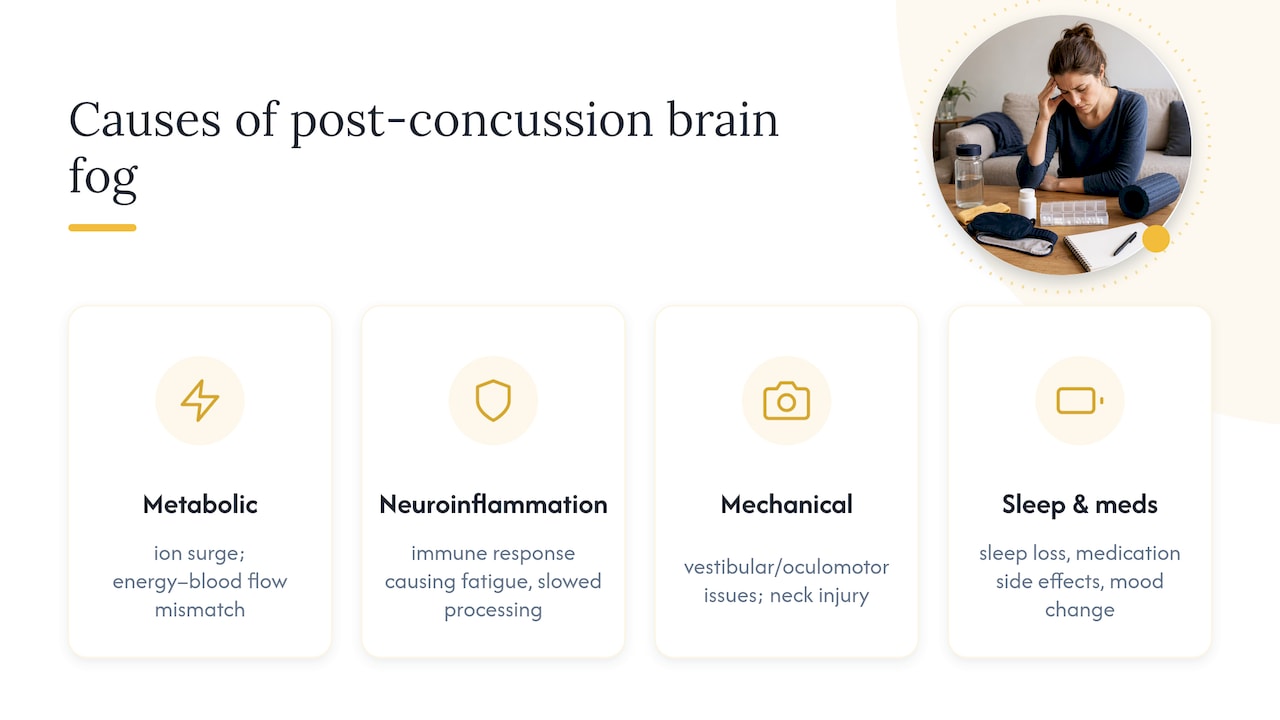
A concussion sets off a cascade that has nothing to do with visible bruising or bleeding. Within seconds of impact, brain cells experience a surge of ions across their membranes, a spike in energy demand, and a temporary mismatch between how much blood flow the brain needs and how much it gets. That metabolic strain can leave networks involved in attention and working memory running under capacity for days or weeks, which is why concentrating on a page of text or following a fast conversation suddenly feels like wading through mud.
Neuroinflammation adds another layer. The brain’s immune response to injury, while necessary for repair, can itself produce fatigue, slowed processing, and a sense of mental heaviness while it runs its course. Changes in cerebral blood flow compound this: regions that depend on steady circulation for quick signaling may get less of it right after injury, which shows up as the “can’t think straight” feeling many people describe.
Mechanical and sensory contributors matter just as much as the metabolic ones. The vestibular system, which governs balance and the coordination between eye movement and head movement, is frequently disrupted after a concussion, and oculomotor problems (difficulty tracking text or switching focus between near and far objects) can masquerade as memory or attention trouble when the real issue is visual-spatial processing. Neck injury from the same impact that caused the concussion often produces headache and dizziness that compound cognitive symptoms. Sleep disruption, whether from pain, anxiety, or a disturbed circadian rhythm, degrades attention and memory consolidation on its own. Medication side effects and mood changes layer on top of all of this.
This is why brain fog rarely shows up alone. Cognitive symptoms cluster with somatic ones (headache, dizziness, light sensitivity) and emotional ones (irritability, anxiety, low mood), and treating any one cluster in isolation often leaves the others untouched. Understanding how a concussion can affect the brain at a mechanical level helps explain why a symptom-by-symptom approach, rather than a single blanket fix, tends to work better.
What brain fog feels like and how to track it
The core cognitive symptoms of post-concussion brain fog are fairly consistent across patients, even though the severity varies widely.
- Slowed processing: simple tasks like reading an email or following directions take noticeably longer than before.
- Concentration problems: attention drifts within minutes, especially in noisy or visually busy environments.
- Short-term memory lapses: forgetting where you put something, or losing the thread of a conversation seconds after hearing it.
- Mental fatigue: a draining, “used up” feeling after cognitive effort that rest does not immediately fix.
Alongside these, watch for headache, sensitivity to light or noise, dizziness, blurred or double vision, disrupted sleep, and shifts in mood like irritability or flatness. These associated symptoms often rise and fall together with the cognitive ones, which is a useful clue for your clinician.
Keeping a simple daily log helps more than most people expect. Note what time symptoms appeared, what you were doing beforehand (screen time, physical exertion, a crowded room), and what made symptoms better or worse. Clinicians often use structured symptom scales to quantify this over time, which turns a vague “I feel foggy” into trackable data that guides treatment decisions. Research tracking brain fog severity in TBI patients found it correlates with depressive symptoms and weaker performance on memory and executive function testing, which is one reason screening for brain fog specifically, not just headache or dizziness, is worth doing early.
How long brain fog lasts and what slows recovery
Most people start improving within days, and many return to their baseline within about 10 to 14 days. But cognitive symptoms can linger for weeks or even months in a smaller group of patients, and that gap between the typical timeline and the outlier timeline is where most of the anxiety around concussion recovery lives.
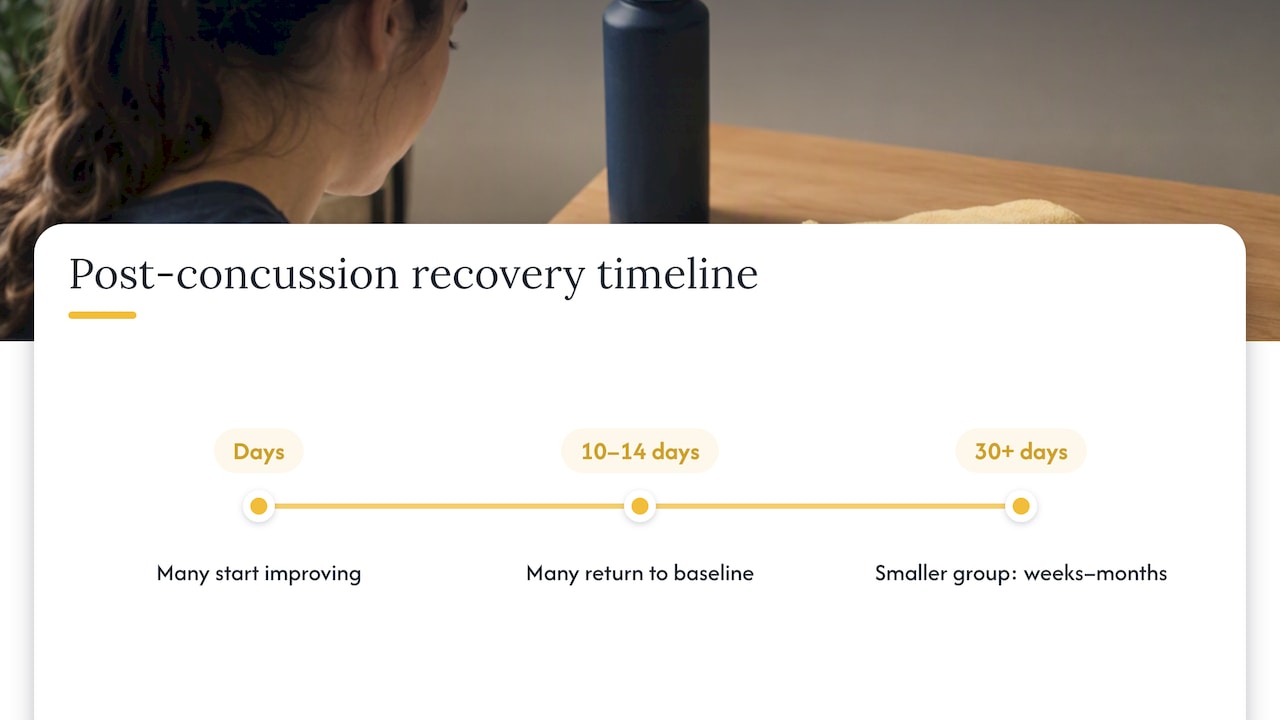
Clinical guidance generally treats symptoms persisting beyond roughly 30 days as warranting reassessment and a more structured rehabilitation plan rather than continued watchful waiting, since VA/DoD guidance on mild traumatic brain injury frames persistent symptoms as a signal to move toward a multidisciplinary, symptom-driven approach rather than a diagnosis of permanent damage.
Several factors reliably predict a longer road: a history of prior concussions, a personal or family history of migraine, pre-existing anxiety or depression, poor sleep quality going into the injury, and, importantly, returning to high-exertion cognitive or physical activity before symptoms have settled. Patients who push back into demanding schoolwork, intense screen use, or strenuous exercise too soon tend to see symptoms spike and recovery stretch out. None of these risk factors mean recovery will fail. They mean pacing matters more for you than it might for someone without those factors, and your clinician should factor them into how aggressively (or cautiously) you ramp back up.
What a proper concussion assessment includes
Concussion is diagnosed clinically, through history and symptom examination, not through a scan. Routine neuroimaging and blood biomarkers usually add little once the acute emergency period has passed, because standard CT and MRI typically look normal in concussion even when symptoms are real and significant.
VA/DoD clinical guidance also advises against routine neuropsychological or computerized cognitive testing in the first 30 days after injury, since early results are often misleading and can cause unnecessary alarm. Instead, a short trial of clinician-directed cognitive rehabilitation, rather than self-administered brain-training software, is the recommended approach for people whose attention, memory, or executive function problems persist past that window, according to a review of postconcussive syndrome management.
When symptoms persist, referral to a specialist is often the most useful next step rather than more waiting:
- Vestibular and oculomotor therapy for dizziness, imbalance, or visual tracking problems.
- Physical therapy for neck pain or cervicogenic headache contributing to cognitive symptoms.
- Sleep medicine when insomnia or disrupted sleep is dragging out fatigue and fog.
- Behavioral health for anxiety, depression, or stress reactions tied to the injury.
- Occupational therapy or speech-language pathology for structured cognitive rehabilitation.
Certain signs mean you should seek urgent evaluation rather than wait for a routine follow-up: worsening headache, repeated vomiting, any new weakness or numbness, slurred speech, a seizure, or declining alertness. A concussion and TBI red flag checklist can help you recognize these quickly after an accident.
Treatments that actually help brain fog
The treatment plan that holds up best in current guidance is staged, symptom-driven, and built around the idea that moderate activity, not total rest, speeds recovery.
- Start with brief relative rest. Limit demanding cognitive and physical activity for about 24 to 48 hours after injury, but avoid prolonged, strict inactivity.
- Begin light aerobic exercise early. CDC guidance supports starting subsymptom aerobic activity as soon as two days post-injury, as long as the intensity stays below the point where it triggers symptoms.
- Add cervicovestibular rehabilitation if symptoms persist beyond 10 days, particularly when dizziness, neck pain, or headache are prominent, per the same CDC guidance.
- Pursue a short, clinician-directed trial of cognitive rehabilitation for attention, memory, or executive function problems that outlast the first month, rather than relying on generic brain-training apps.
- Treat mood and sleep issues directly through behavioral health support and sleep hygiene changes, since both intensify perceived brain fog independent of the injury itself.
Self-management fills the gaps between appointments. Keep a consistent sleep schedule, break cognitive tasks into shorter blocks with real rest breaks between them, and lean on compensatory tools like phone timers, calendar reminders, and written checklists instead of trying to hold everything in memory while your processing speed is still recovering.
Some gentle adjuncts are reasonable to add: light mindfulness practice and gentle yoga have a plausible role in reducing stress-driven symptom amplification, though they are supports rather than cures. Steer clear of unproven interventions marketed as concussion treatments, such as hyperbaric oxygen therapy, which lacks the evidence base to justify its cost or time commitment for typical cases. For people whose cervicogenic headaches or neck pain are a major driver of fog, targeted physical therapy such as the options described by Shephard Health addresses a contributor that general rest will not resolve on its own.
Pro Tip: Use the symptom-exacerbation threshold, not a fixed time limit, to pace activity: stop or scale back when symptoms spike, not according to a clock.
Clinicians track progress by watching how quickly symptoms return during graded activity and how long they take to settle afterward. A clear trend toward less exacerbation and faster recovery signals you are ready to progress; a plateau or regression is the cue to slow down and reassess, sometimes with the specialist referrals described above.
Returning to school, work, and driving safely
The guiding rule for every return-to-activity decision is the same: progress is based on symptoms, not the calendar. If an activity triggers a meaningful symptom spike, you back off slightly and try again later rather than pushing through.
For school or work, that usually means staged reintegration: half days before full days, shorter blocks of screen time before unrestricted use, and quiet or low-stimulation rooms for testing or focused work before returning to open, busy spaces. Reasonable accommodations, such as extended deadlines, reduced screen exposure, and breaking large assignments into smaller chunks, buy the brain time to catch up without falling behind academically or professionally.
Cohort data from Ivy League and Big Ten athletic programs found that students who returned to full academic exertion while still symptomatic were about 19 to 21% more likely to have a prolonged recovery past 28 days compared with those who waited until symptoms resolved before resuming full cognitive load. That is a meaningful argument for staging the return even when you feel well enough to push through.
Driving deserves its own caution. If attention, reaction time, or visual processing still feel impaired, delay driving and talk to your clinician before resuming it, since driving combines several of the exact cognitive functions concussion disrupts. A structured approach, such as the five-stage plan to resume driving after injury, gives a more reliable path back to the wheel than guessing based on how you feel on a given day.
Drive With Care: supporting survivors through recovery
This article is written by Charles for Drive With Care, drawing on current clinical guidance and concussion research to help readers make sense of a confusing recovery process. We work to reduce traffic-related injury and death through education, survivor support, and community partnerships, and brain injury recovery sits squarely inside that mission.
Clinical care treats the injury. Resources exist to support the person going through it, including survivor and caregiver guidance on neuroplasticity after brain injury, return-to-driving frameworks, and community programs that connect people recovering from concussion with others who understand what the fog actually feels like day to day.
Anxiety, depression, and PTSD after a concussion
Psychological symptoms are not a side effect of brain fog. They are often woven into it. Anxiety about whether symptoms will ever fully resolve can itself worsen concentration and sleep, creating a loop where worry amplifies the very fog it is reacting to. Depression following a concussion, particularly in cases involving a stressful or frightening accident, correlates with worse brain fog severity and weaker objective memory and executive function performance, according to research on brain fog in TBI patients.
Some people, especially after a traumatic crash, develop symptoms consistent with post-traumatic stress, including intrusive memories, avoidance of driving or similar situations, and hyperarousal that fragments attention and sleep. These symptoms deserve direct treatment rather than being lumped in with “normal” concussion recovery.
Behavioral health referral is appropriate whenever mood symptoms are significant or persistent, not just when they become severe. Effective approaches include structured talk therapy, treatment for underlying anxiety or depression, and, for some patients, short-term medication management. Addressing the psychological piece often improves the cognitive piece as well, since untreated anxiety and depression both independently degrade attention and memory. For readers supporting someone through this, our page on long-term emotional and psychological changes after severe concussion covers what that experience can look like for families.
How medications and substances affect post-concussion fog
What you take while recovering matters as much as what injury you are recovering from. Sedating medications such as certain pain relievers, sleep aids, and some antihistamines can intensify the slowed thinking and fatigue that already come with concussion, making it hard to tell how much fog is the injury and how much is the medication layered on top of it.
Alcohol slows recovery in a similar way: it disrupts the sleep architecture your brain needs for repair and can worsen dizziness, headache, and cognitive slowing on its own. Cannabis and other recreational substances carry similar concerns, particularly around memory and attention, even though research on their specific effect on concussion recovery is still limited. The safest approach during active recovery is minimizing or avoiding substances that independently impair cognition or sleep until symptoms have settled.
If you are on medication for a chronic condition, mention your concussion to the prescriber rather than adjusting doses on your own, since some combinations can intensify fog unexpectedly. A medication review with your clinician, especially if you started something new around the time symptoms worsened, is a reasonable step whenever recovery seems to be stalling for no clear reason.
Ruling out other causes of mental fog
Not every bout of fog after a head injury is still “the concussion.” Migraine is one of the most common mimics: migraine attacks, with or without headache, can produce the same slowed thinking, light sensitivity, and concentration trouble, and a history of migraine is itself a risk factor for prolonged post-concussion symptoms. Distinguishing the two matters because migraine-specific treatment can resolve fog that general concussion rest will not touch.
Sleep disorders are another frequent overlap. Undiagnosed sleep apnea, insomnia, or a disrupted circadian rhythm can produce daytime fog that looks identical to post-concussion cognitive symptoms, and either can worsen the other. A clinician evaluating persistent fog should ask about snoring, daytime sleepiness, and sleep timing, not just injury history.
Other considerations include medication side effects, anxiety or depression presenting primarily as cognitive complaints, thyroid or other metabolic issues unrelated to the injury, and vestibular or visual-spatial problems that mimic memory trouble rather than being a true memory deficit. When fog does not track with the expected concussion recovery curve, or when it appears disconnected from the injury’s other symptoms, it is worth asking your clinician whether something else is contributing.
A grounded take on recovering from brain fog
The fear underneath most brain fog questions is simple: will this ever go away? Clinical guidance is genuinely reassuring here. Most people recover fully, and clinicians are advised to stay optimistic with patients while avoiding promises of a symptom-free timeline, since CDC guidance frames full recovery as the expected outcome, not the exception.
What actually moves the needle is less dramatic than people expect: consistent symptom tracking, pacing instead of pushing, and treating the specific contributor (vestibular, mood, sleep) rather than waiting for generic rest to fix everything. Small, steady progress, supported by people who understand what you are navigating, tends to beat any single breakthrough.
— Charles
Find support through Drive With Care
Medical treatment addresses the injury itself, but recovery is rarely just a clinical process. We built our survivor resources because the emotional weight of a concussion, the fear, the frustration, the isolation of feeling foggy when everyone around you expects you to be “back to normal,” deserves support in its own right.

Emotional and psychological support resources connect survivors and families with practical guidance alongside clinical care, never in place of it. Supporters can explore ways to help continue this work, including making a one-time donation.
This article is general information, not a substitute for advice from a qualified doctor. Consult a qualified healthcare professional about your own circumstances before acting on anything here.
FAQ
How long can brain fog last after a mild concussion?
Most people see brain fog improve within days to about two weeks, though cognitive symptoms can persist for several weeks to a few months in a smaller group of patients. Factors like prior concussions, migraine history, and returning to demanding activity too soon tend to stretch that timeline.
How long does it take for a concussion to heal?
Many people return to their baseline within roughly 10 to 14 days, with full recovery being the typical outcome overall. Clinical guidance treats symptoms lasting beyond about 30 days as a signal to pursue more structured, multidisciplinary evaluation rather than a sign that recovery has failed.
How do you fix brain fog from a concussion?
Brief relative rest for the first 24 to 48 hours, followed by light, symptom-limited aerobic exercise, is the starting point supported by CDC guidance. Persistent cases often benefit from targeted therapies such as vestibular rehabilitation, clinician-directed cognitive rehabilitation, or behavioral health support depending on which symptoms are driving the fog.
Does the brain ever fully recover from a concussion?
Full recovery is the typical outcome for most people after a concussion, according to clinical guidance, though clinicians avoid guaranteeing a specific symptom-free timeline for every patient. A smaller subset experiences longer-lasting symptoms that generally respond well to staged, symptom-driven rehabilitation.
Sources
- CDC: Recovery from concussion
- VA/DoD Clinical Practice Guideline (mTBI) — provider guidance
- Severity and correlates of brain fog in people with traumatic brain injury (2022)

