
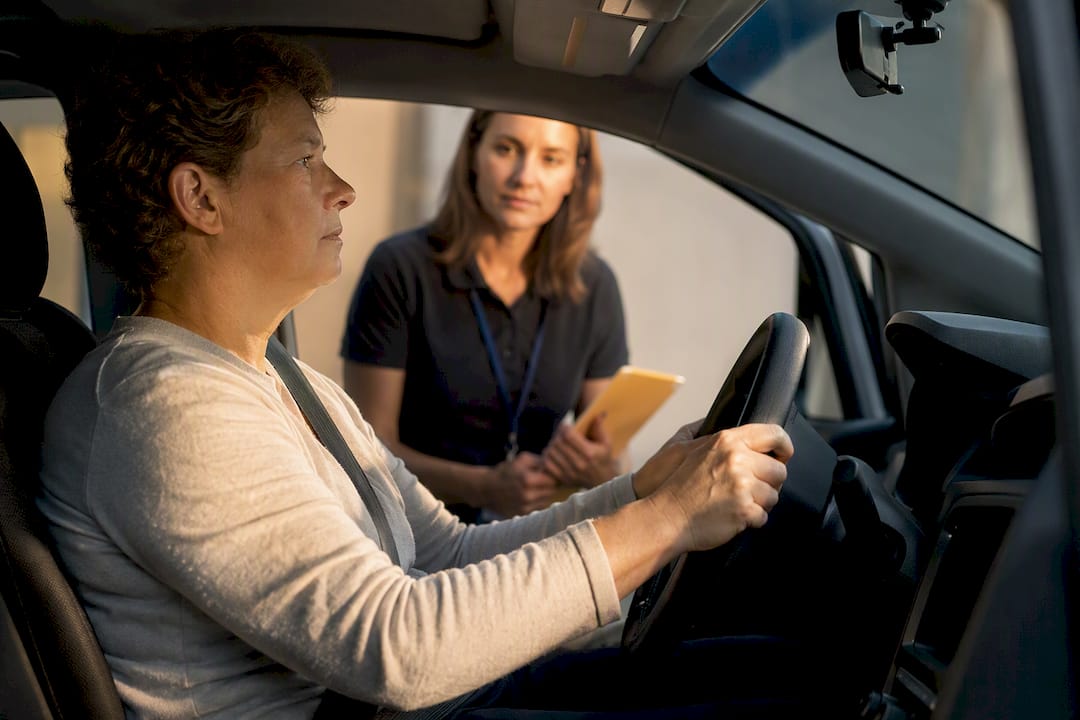
Most people with minor injuries, a healed sprain, a soft cast on a non-dominant limb, or short-term pain can drive cautiously once their treating clinician agrees they can control the vehicle safely. Stop driving and seek assessment immediately if you have any neurological symptoms, a seizure risk, a limb in a rigid cast affecting steering or pedals, or if you are on sedating medication. You have a legal duty to confirm your own fitness to drive, and some conditions require notifying your licensing authority before you get back on the road.
TL;DR:
- Recovery timelines vary significantly depending on the injury, with stroke patients often needing around four weeks before returning to driving and longer for traumatic brain injuries.
- Clinicians involved in clearance include your GP, neurologist, occupational therapist, and driving rehabilitation specialist, each performing different assessments and tests.
- Wearing a cast or brace can reduce steering accuracy, slow reaction times, and impact insurance coverage, especially if not properly documented or tested beforehand.
- Adaptive equipment like hand controls or left-foot accelerators requires dedicated training, which can range from a few lessons to over ten, before solo driving resumes.
- Medications such as opioids or benzodiazepines impair reaction times, and fatigue from pain management can silently increase crash risk, so driving should only happen when fully alert.
Table of Contents
- What licensing rules and insurance require before you drive again
- Which clinicians and tests decide if you’re ready to drive
- How specific injuries change your ability to steer and brake
- Adaptive equipment and how retraining actually works
- How medication and fatigue quietly raise your crash risk
- A five-stage plan for getting back to full driving
- Where Drive With Care fits into your recovery
- Rebuilding confidence without rushing the road
- How to support safer roads and recovery for others
- Sources
- FAQ
What licensing rules and insurance require before you drive again
The responsibility for deciding whether you are fit to drive sits with you, not your doctor and not your insurer. In the United Kingdom, drivers are legally required to notify the licensing authority if a condition is likely to affect their driving for more than three months, and failing to do so can bring a fine of up to £1,000. Other countries run similar systems under different names and different thresholds, so check your own jurisdiction’s licensing body rather than assuming the UK rule applies to you.
Wait times after specific events vary by condition and by driver category:
- Many regions follow guidance recommending a minimum non-driving period of around four weeks after a stroke for private drivers, with stricter waits closer to three months for commercial drivers.
- After a traumatic brain injury involving seizures, some regions require a seizure-free period of around six months before driving resumes, though the exact interval depends on local law.
- Heavy sedation, active seizure risk, or a rigid cast on a limb needed for steering or braking are common immediate stop signs regardless of jurisdiction.
Before you get back in the car, call your insurer. Driving with a cast, brace, or adaptive equipment can affect your coverage if the policy was never updated to reflect it, and a claim denial after a crash is a far worse outcome than a short phone call now.
Which clinicians and tests decide if you’re ready to drive
Getting cleared to drive again usually involves more than one person, and knowing who does what saves time.
- Your GP or treating physician makes the first call on whether your injury or condition is stable enough to consider driving at all.
- A neurologist gets involved for stroke, traumatic brain injury, or seizure history, since these carry the strictest wait periods and red-flag criteria.
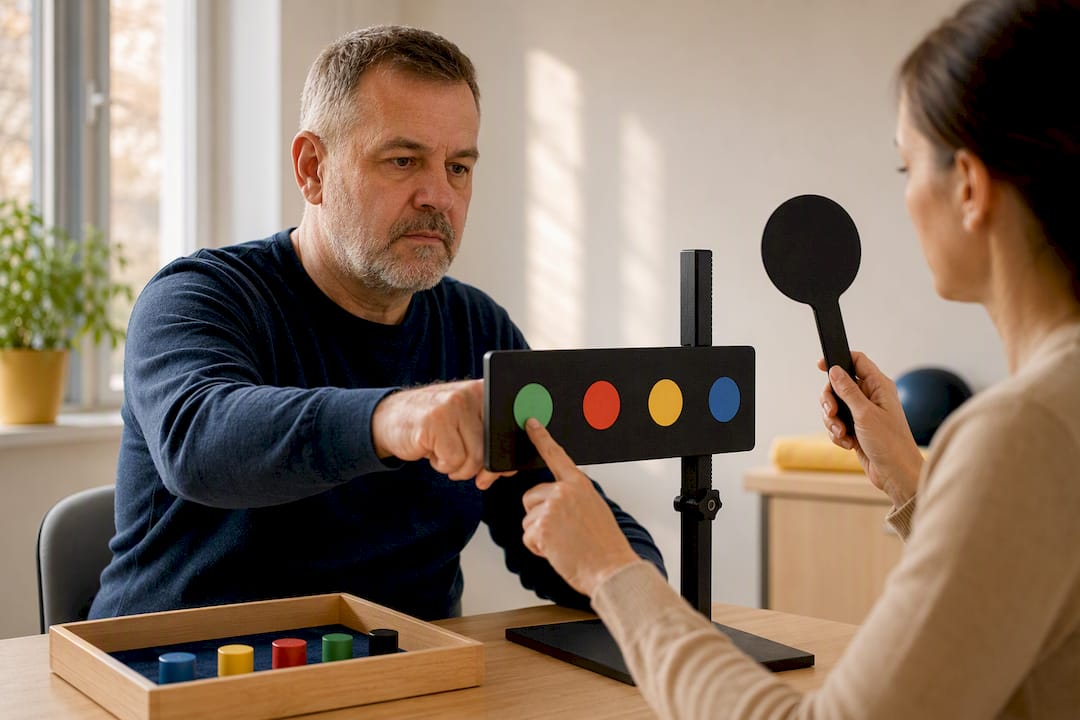
- An occupational therapist runs off-road screening: vision checks, the Trail Making Test B for divided attention, reaction-time tools like Compass, and functional assessments of grip, range of motion, and pedal control.
- A certified driving rehabilitation specialist conducts the on-road evaluation, often in a dual-control vehicle, and can recommend adaptive equipment or a conditional license if you pass with restrictions.
A failed off-road screen does not mean driving is permanently off the table. It usually means more rehabilitation, a repeat screen later, or a shift toward adaptive equipment before trying an on-road test. The clinical review on driving after stroke notes there is no single universal test battery, which is why the process is staged rather than a one-time pass or fail. On-road assessments look at real intersections, merging, and unexpected hazards, and some drivers return with a conditional license limiting them to daytime or local routes.
Pro Tip: Book the occupational therapy screening before you assume you need a full driving rehabilitation program. Many people only need the shorter off-road check to get cleared.
How specific injuries change your ability to steer and brake
The type of injury changes both the risk and the fix, and the evidence differs by body region.
- Upper limb casts and splints: Controlled studies show that upper-extremity immobilization measurably reduces steering accuracy, and spinner knobs, often assumed to compensate, only helped in limited, easier tasks and did not reliably restore accuracy across the board.
- Lower-limb casts and ankle braces: Rigid immobilization below the knee changes how quickly your foot moves between the accelerator and brake, and clinical guidance generally advises against driving in a plaster cast, both for safety and because it can affect your insurance.
- Stroke and traumatic brain injury: Visual field loss, slowed processing speed, neglect, and reduced motor control on one side are the deficits assessors look for. Seizure risk, severe neglect, and unresolved double vision are red flags that typically block clearance until they resolve.
- Spinal cord injury and amputation: These generally require adaptive controls, hand controls or a left-foot accelerator, for example, plus supervised retraining before any solo driving.
Some ankle braces have been shown in driving simulator research to lengthen stopping distance at highway speeds, a reminder that a brace that feels stable while walking can still slow your foot’s movement to the brake pedal. If you drive in a brace, treat that slower reaction time as real until you have tested it under supervision.
Adaptive equipment and how retraining actually works
Adaptive equipment closes the gap between what your body can do now and what driving demands, but it is not a plug-and-play fix.
- Hand controls replace foot pedals with lever-operated braking and acceleration, useful after lower-limb injury or amputation and typically requiring dedicated lessons before independent use.
- Left-foot accelerators let drivers with right-leg impairment keep both pedal functions under foot control, again with a training requirement rather than immediate use.
- Simulators and dual-control vehicles let a driving rehabilitation specialist observe your reactions in a controlled setting before risking a real road.
How many lessons you need depends entirely on the injury and the equipment. Session counts for learning adaptive controls range from just a couple of refresher lessons to ten or more, so there is no fixed timeline to expect. Spinner knobs and similar aids can feel helpful, but the steering-accuracy research above found their objective benefit was inconsistent outside of easy tasks, which is why formal training matters more than the gadget itself.
Pro Tip: Ask your driving rehabilitation specialist for a written summary of what you passed and what you still need. That record matters for insurers and licensing bodies later.
How medication and fatigue quietly raise your crash risk
Pain and its treatment are often bigger threats to safe driving than the injury itself.
- Opioids, benzodiazepines, and some anticonvulsants slow reaction time and impair judgment, so talk to your prescriber or pharmacist about whether your current dose is compatible with driving.
- Poor sleep and physical fatigue from healing and pain management reduce attention span, so avoid driving when tired and skip long or complex routes until you feel consistently alert.
- Combined effects matter: a medication that seems fine alone can compound with fatigue or pain to slow you down more than either would separately.
If you are transitioning off a sedating medication, ask your clinician for a brief note confirming your current status. It costs nothing to carry and can matter if a question ever comes up about your fitness at the time you were driving.
A five-stage plan for getting back to full driving
Rushing this process is where most avoidable setbacks happen. A staged return gives you evidence, not guesswork, at each step.
- Home self-check: Test grip strength, range of motion, and reaction time informally, and note any pain or medication effects. Stop immediately if you notice numbness, weakness, or vision changes.
- Clinician evaluation and off-road screening: Get the formal vision, cognition, and motor tests described earlier before touching a car.
- Supervised on-road lessons or simulator practice: Work with a driving rehabilitation specialist in a dual-control vehicle or simulator first.
- Restricted solo driving: Start with daytime, short, familiar routes, and keep a simple log of how each trip felt.
- Full return: Resume unrestricted driving only after documented safe performance and clinician sign-off.
| Stage | Focus | Who’s involved |
|---|---|---|
| 1. Self-check | Mobility, pain, medication effects | You and your household |
| 2. Clinical screening | Vision, cognition, motor skills | GP, occupational therapist |
| 3. Supervised practice | On-road or simulator retraining | Driving rehabilitation specialist |
| 4. Restricted driving | Short daytime routes, logging | You, with clinician check-ins |
| 5. Full return | Unrestricted driving | Clinician sign-off |
Where Drive With Care fits into your recovery
Drive With Care runs its work through the Safer Roads Now initiative, built around the reality that human error contributes to the overwhelming majority of road incidents, and that recovery after an injury deserves the same attention as prevention. The organization pairs survivor stories with practical guidance so recovering drivers are not navigating this alone.
Resources relevant to this stage of recovery include:
- A guide to driving again after a serious accident, covering legal responsibility and recovery steps in depth.
- A concussion and TBI red flag checklist to help you spot signs that mean you should not be driving yet.
- Guidance on memory loss after a severe concussion for families supporting a recovering driver.
- Broader resources on legal duties and medical advice after injury.
Support for this work, and for the survivors it serves, comes through donations and partnerships listed on the organization’s site.
Rebuilding confidence without rushing the road
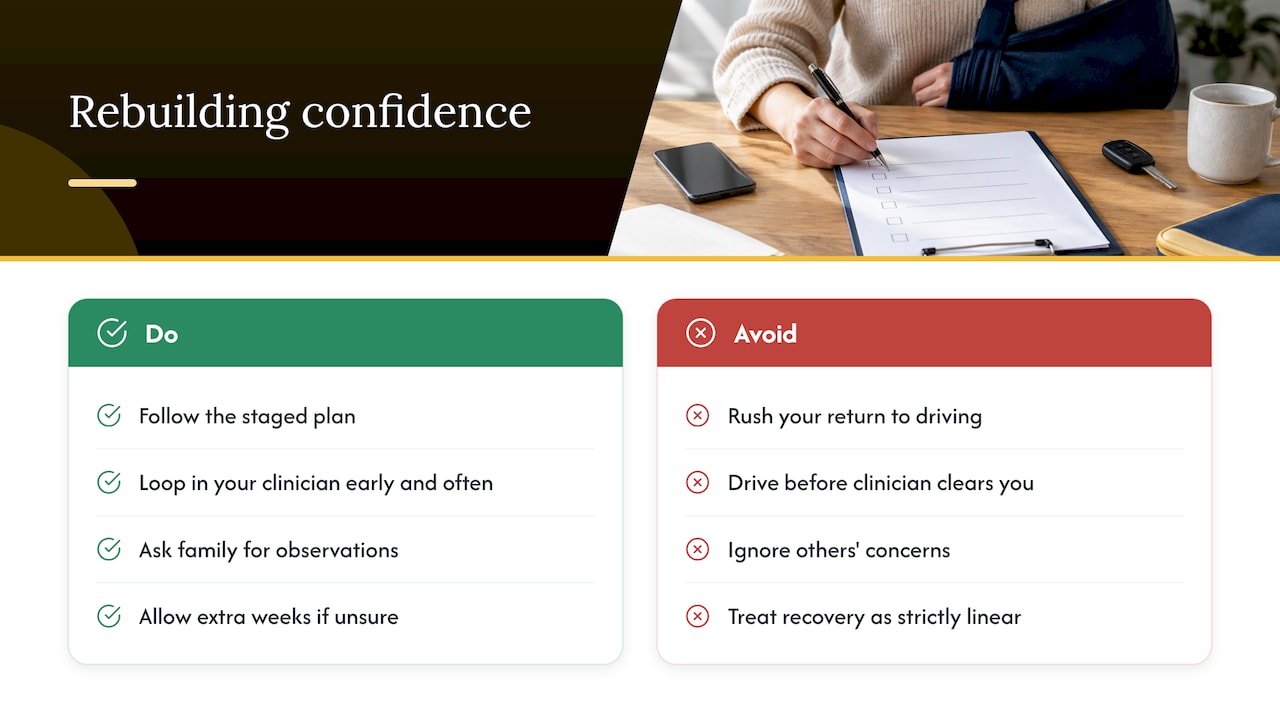
Driving means independence, and losing it, even temporarily, can feel like losing a part of your daily life. That loss is real, and it is also exactly why rushing the return matters so much: a setback caused by driving too soon costs you more time and confidence than a few extra weeks of careful staging ever would.
The staged plan in this article exists because recovery is rarely linear. Loop in your clinician and your family at each stage, not just at the end, and let them tell you what they are noticing that you might not see in yourself.
— Charles
How to support safer roads and recovery for others
The organization funds its survivor support, educational programs, and driving rehabilitation partnerships entirely through donations and sponsorships, since none of these resources are sold to the people who use them.

If this guide helped you think through your own return to driving, consider supporting the work that makes it available to others. A gift through Donate Now funds survivor resources and safety education directly, and organizations looking for a deeper commitment can explore the Safety Supporter Partnership or the Community Safety Partner Partnership for ongoing sponsorship options.
This article is general information, not a substitute for advice from a qualified doctor. Consult a qualified healthcare professional about your own circumstances before acting on anything here.
Sources
- Gov
- Austroads: Assessing fitness to drive — neurological conditions
- Neuropsychological aspects of driving after stroke — NCBI Bookshelf
- Effects of upper extremity immobilization and use of a spinner knob on vehicle steering — PMC
FAQ
Am I legally allowed to drive with a broken arm?
It depends on which arm, the type of cast, and whether you can safely control the steering wheel and gear controls. Rigid casts, especially on the dominant arm, often interfere with steering accuracy, so check with your treating clinician before driving and confirm with your insurer that a cast does not affect your cover.
How long can I still drive my car after an accident?
There is no fixed universal waiting period, since it depends entirely on your injuries and any neurological symptoms. If you have no injury requiring immobilization, sedation, or neurological evaluation, you may be able to drive immediately, but any condition expected to last more than three months may require notifying your licensing authority.
Can I drive with a sprained ankle?
A mild sprain that does not limit your ability to move quickly between the accelerator and brake may not stop you from driving, but a brace or heavy swelling can slow that movement and increase stopping distance. Test your reaction time in a stationary, parked vehicle first, and avoid driving if pressing the brake feels delayed or painful.
Can you legally drive with a splint on your hand?
A hand splint can reduce your grip and steering control, particularly on sharp turns or emergency maneuvers, and clinical guidance generally advises caution or avoiding driving until the splint is removed or you are cleared. If driving is unavoidable, confirm with your clinician that the splint does not compromise your control of the wheel.

