

An effective workplace safe driving program combines four elements: a written policy, driver screening and training, vehicle maintenance, and ongoing monitoring. Start tracking two leading indicators immediately: policy signoff rates and training completion rates. This guide walks through a compact implementation sequence, the components each part requires, and a checklist you can hand to a manager this week.
TL;DR:
- Tracking policy signoff and training completion rates from the start helps identify drivers at risk before incidents occur.
- Regular vehicle inspections and scheduled maintenance are essential to catch issues early and prevent crashes related to vehicle malfunction.
- Combining multiple training formats, such as classroom, online, and in-vehicle coaching, improves engagement and safety outcomes.
- Maintaining detailed records of driver agreements, MVR checks, and training verifies compliance during audits and after incidents.
- Addressing fatigue and medication effects through explicit policies reduces hidden risks that traditional screening methods cannot detect.
Table of Contents
- Core components: what to include in a workplace safe driving program
- A compact step-by-step program to implement quickly
- Training options and delivery: classroom, online, in-vehicle, and coaching
- Policies and driver agreements: wording, signature, and enforcement essentials
- Vehicles and maintenance: selecting safe vehicles and running preventive maintenance
- Monitoring, metrics and leading indicators to track program health
- Implementation checklist, timeline and expected costs (scalable options)
- Drive With Care perspective: how Safer Roads Now and survivor-driven materials improve adoption
- Emergency response procedures for incidents on the road
- Legal and regulatory compliance specific to workplace driving programs
- Employee health and wellness considerations affecting safe driving
- Practical pitfalls and common mistakes safety managers make
- How Drive With Care can help: partnership, pledge campaigns, and resources
- Sources
- FAQ
Core components: what to include in a workplace safe driving program
Every complete program rests on five parts, and skipping any one of them leaves a gap that eventually shows up as a claim. OSHA’s guidance for employers frames leadership commitment and written policy as the foundation, with enforcement and scheduling design carrying as much weight as training itself.
- Written policy: covers seat belt use, distracted driving (phone and texting bans), impaired and drowsy driving, and a clear procedure for reporting crashes or near misses.
- MVR screening: pull motor vehicle records before hire, then annually or semiannually, with defined cutoffs for moving violations, DUIs, and license status changes.
- Initial and refresher training: defensive driving fundamentals, backing and parking maneuvers, and vehicle-specific modules for anyone operating a van, truck, or specialized equipment.
- Crash reporting and corrective training: a standard incident report form, a review process, and mandatory retraining triggered by any at-fault event.
- Vehicle maintenance and inspection: scheduled preventive maintenance plus driver-completed pre-trip and post-trip checks.
The NIOSH/CDC motor vehicle safety program guide recommends refresher training every 2 to 3 years and annual vehicle inspections as the baseline cadence, with faster retraining after any incident. Treating any one of these five parts as optional, especially maintenance or screening, tends to be where programs quietly fail.
A compact step-by-step program to implement quickly
Building the program in phases keeps it manageable and gives you natural checkpoints for reporting progress to leadership.
- Get leadership signoff and scope the risk. Identify who drives for work, how often, and in what vehicles.
- Draft and finalize written policies and driver agreements. Cover seat belts, phone use, impairment, and reporting.
- Run baseline MVR checks on every driver. Set clear cutoffs before you start, not after a bad record surfaces.
- Roll out initial training. Prioritize higher-risk drivers first, such as new hires and those with the most road time.
- Schedule vehicle checks and maintenance. Build pre-trip inspections into the daily routine, not an afterthought.
- Launch monitoring, coaching, and incentives. Track leading indicators from day one rather than waiting for a crash to react.
- Review results and refine the program. Revisit policy language, training content, and cutoffs at least annually.
Pro Tip: Assign a single owner for each phase before you start; a program with five people “responsible” for training usually has none.
Phases 1 and 2 typically take a few weeks; phases 3 through 5 can run in parallel once policies are signed. The NIOSH/CDC guide frames this as a repeatable cycle, not a one-time rollout, which matters when new drivers join or vehicle types change.
Training options and delivery: classroom, online, in-vehicle, and coaching
Different formats suit different risk levels and budgets, and most mature programs blend more than one.
- Instructor-led classroom training works best for onboarding groups and covers policy, hazard recognition, and company-specific procedures in depth.
- Online modules are cost-effective for refreshers and scale well across distributed teams; the NSC’s defensive driving courses offer self-study and web-based formats for exactly this purpose.
- In-vehicle coaching gives the most direct feedback on actual driving behavior but costs more per driver and needs a trained observer or telematics data to run well.
- Vehicle-specific modules (box trucks, passenger vans, towing) should supplement general defensive driving rather than replace it.
Refresher training every 2 to 3 years is the general benchmark, but any at-fault crash or serious near miss should trigger immediate retraining rather than waiting for the scheduled cycle.
Policies and driver agreements: wording, signature, and enforcement essentials
A policy only protects the organization if drivers have actually read, signed, and understood it, and if records prove that.
- Policy elements to include: seat belt requirement, phone and distraction rules, zero-tolerance impairment language, and a defined reporting timeline for any incident.
- Driver agreement checklist: signed acknowledgment, MVR consent, and a record retention period that matches your insurer’s and legal counsel’s recommendations.
- Progressive discipline: a points-based system tied to violation severity, with corrective training as the first response rather than immediate termination.
- Incentive programs: recognition for clean MVR periods, completed training milestones, or safe-driving streaks tend to outperform purely punitive systems.
Store signed agreements alongside training records so an auditor or insurer can verify compliance in minutes, not days.
Vehicles and maintenance: selecting safe vehicles and running preventive maintenance
Vehicle choice and upkeep matter as much as driver behavior in reducing crash severity.
- Prioritize vehicles with strong crash-test ratings and active safety features such as automatic emergency braking and blind-spot warning.
- Set preventive maintenance intervals by mileage and time, not just when something breaks.
- Require pre-trip and post-trip checks: tires, lights, brakes, and fluid levels take minutes and catch problems early.
- Document every maintenance event and extend the same rules to personal vehicles used for work travel, including proof of insurance and a basic condition check.
Monitoring, metrics and leading indicators to track program health
Crash counts tell you what already went wrong. Leading indicators tell you where the next one is likely to happen.
- Training completion rate by cohort, tracked monthly.
- Policy signoff rate for new hires and after any policy update.
- Vehicle inspection compliance as a percentage of required checks completed.
- Coaching sessions per 1,000 miles driven, if telematics data is available.
Carrier-level studies found reductions in recorded risky driving event rates of 37% and 52% when event monitoring programs were paired with structured coaching rather than used purely for discipline. Set a monthly review cadence for the dashboard and a quarterly escalation point for any metric trending the wrong way. If you introduce video or telematics monitoring, publish a clear privacy policy covering what is recorded, who reviews it, and how long footage is retained.
Implementation checklist, timeline and expected costs (scalable options)
A phased timeline keeps the rollout realistic and gives every stakeholder a clear deadline.
- Days 1 to 30: leadership signoff, risk scoping, and policy drafting, owned by safety and HR leadership.
- Days 31 to 90: MVR checks, driver agreement signatures, and initial training rollout, owned by HR and a training lead.
- Days 91 to 180: vehicle inspection scheduling, monitoring dashboard setup, and first program review, owned by fleet or operations management.
Cost scales with ambition: an internal trainer paired with a basic learning management system is the lowest-cost route, purchased online course licenses sit in the middle, and telematics paired with dedicated coaching staff represents the highest investment. Engage HR, fleet or facilities, and frontline supervisors early since each owns a different phase.
Drive With Care perspective: how Safer Roads Now and survivor-driven materials improve adoption
Policy documents change behavior slowly. Survivor stories and public pledges tend to move faster because they make the stakes personal rather than procedural. Drive With Care’s Safer Roads Now initiative pairs a driving safety pledge with survivor narratives, which safety managers can fold into training kickoffs to boost engagement beyond what a slide deck achieves alone. Organizations can explore Safety Supporter and Community Safety Partner partnerships to bring these tools into a rollout.
Emergency response procedures for incidents on the road
Every driver needs a simple, memorized sequence for what to do immediately after a crash or breakdown, because hesitation in the first few minutes is where small incidents become bigger ones. The sequence should cover four things: safety, notification, documentation, and support.
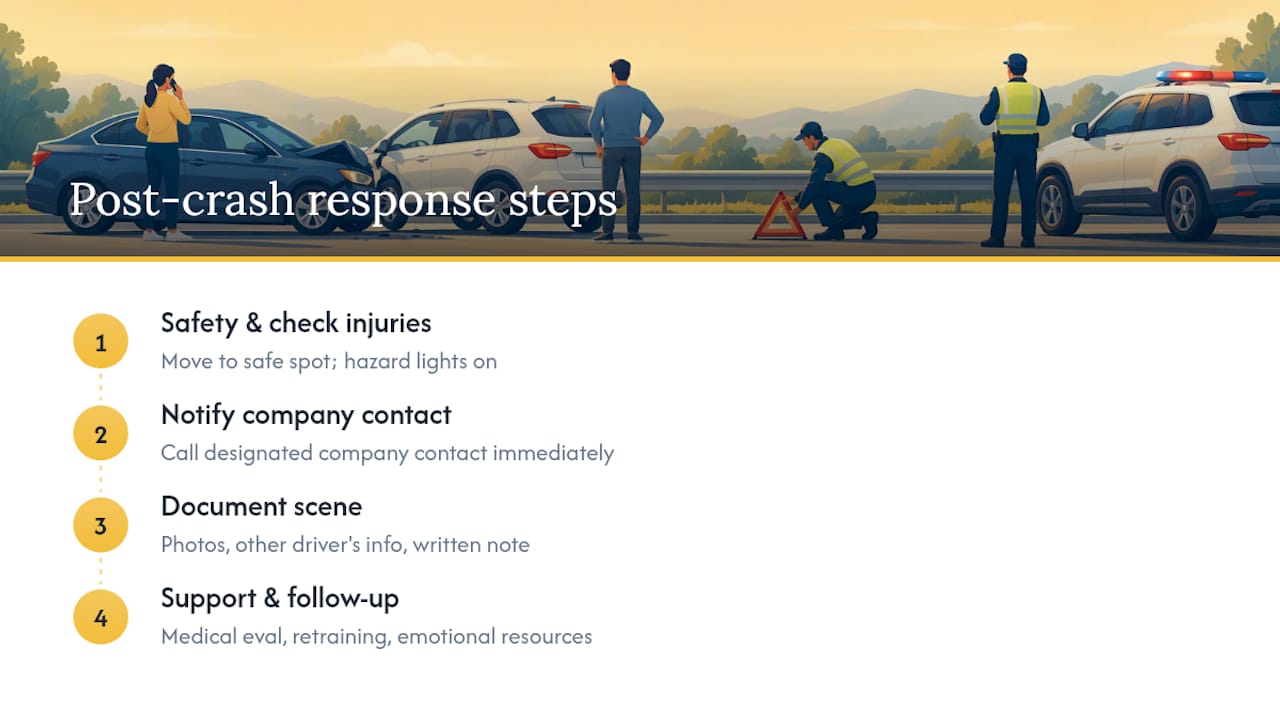
First, drivers move to a safe location if the vehicle is operable and turn on hazard lights. Checking for injuries comes next, followed by calling emergency services if anyone is hurt or the roadway is blocked. Second, drivers notify a designated company contact, not just a supervisor who happens to be reachable, so the report starts moving through the system immediately. Third, documentation matters more than most drivers realize in the moment: photos of vehicle positions and damage, other driver’s insurance and contact information, and a written note of what happened while memory is fresh.
Fourth, support extends beyond the paperwork. A driver involved in a serious crash may need medical evaluation even without obvious injury, since some symptoms of concussion or whiplash surface hours later. Employers should have a clear post-incident protocol that includes mandatory retraining, as covered earlier, and a path to emotional support resources for drivers dealing with the aftermath of a serious collision, since psychological effects can outlast physical ones. Keep a laminated card or phone-accessible checklist in every company vehicle listing emergency numbers, the company’s incident hotline, and the first three steps, so no driver has to recall the full procedure from memory under stress.
Legal and regulatory compliance specific to workplace driving programs
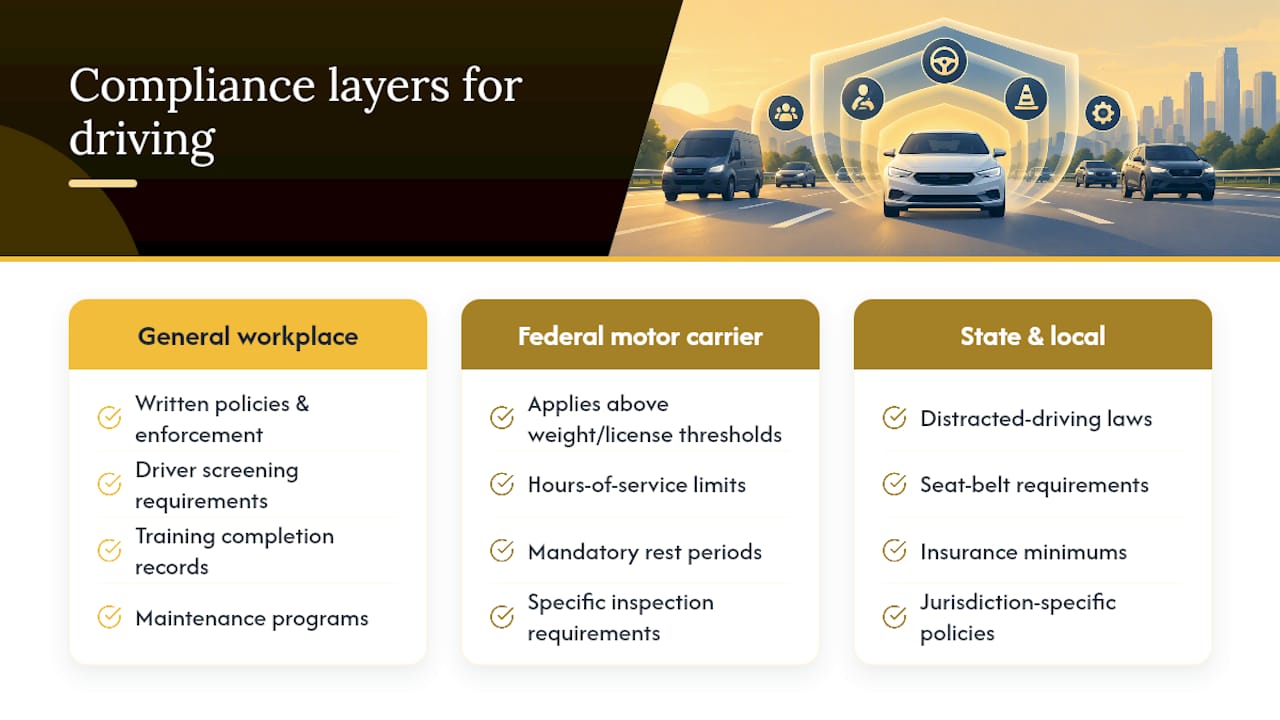
Compliance obligations for a workplace driving program depend heavily on what the organization does and where it operates, so treat any general checklist as a starting point rather than a final answer. OSHA’s guidance for employers notes that motor vehicle crashes remain a leading cause of workplace death, which is why written policies, screening, and enforcement are treated as core safety obligations rather than optional extras.
Employers operating commercial vehicles above certain weight thresholds, or drivers holding a commercial license, fall under additional federal motor carrier rules that go beyond general workplace safety guidance. Hours-of-service limits, mandatory rest periods, and specific inspection requirements apply to that category of driver and vehicle, and the applicable rules depend on vehicle class and cargo, so employers in that situation should confirm requirements with the relevant transportation authority rather than relying on general safety guidance. State and local rules add another layer: distracted driving laws, seat belt requirements, and insurance minimums vary, and a policy written for one jurisdiction may not satisfy another.
Recordkeeping is where compliance gaps usually surface during an audit or after a claim. Retain signed driver agreements, MVR check results, training completion records, and maintenance logs for the period recommended by legal counsel or your insurer, since these documents are often the first thing requested after a serious incident. A program built around the components in this guide, written policy, screening, training, and maintenance, covers the substance most regulators and insurers look for, but the specific retention periods and licensing thresholds that apply to your organization should be confirmed with a qualified professional or the relevant regulatory body rather than assumed from general guidance.
Employee health and wellness considerations affecting safe driving
Fatigue and medication effects are two of the most underestimated risk factors in a workplace driving program, largely because neither shows up in a standard vehicle inspection or MVR check. Drowsy driving impairs reaction time and judgment in ways that can resemble impaired driving, and drivers often underestimate how tired they actually are until performance already suffers. Written policies should address drowsy driving explicitly, not just impairment from alcohol or drugs, and should give drivers a clear, low-friction way to report that they are too fatigued to drive a scheduled route without facing punitive consequences for doing so.
Scheduling design plays directly into this. Long shifts, back-to-back routes, and irregular hours all raise fatigue risk, and journey management, meaning realistic route planning that accounts for rest breaks, is one of the areas OSHA highlights as part of reducing risk beyond training alone.
Medication effects deserve their own line in the policy. Many common prescriptions and over-the-counter drugs, including some allergy medications and pain relievers, carry drowsiness warnings that drivers may not connect to their work driving duties. Encourage drivers to review medication labels and consult a physician or pharmacist about driving safety when starting a new prescription, and build a simple, confidential process for drivers to flag a temporary fitness-to-drive concern without feeling it will cost them shifts or standing. A program that only screens for licenses and violations, while ignoring fatigue and medication, is missing a real source of risk that MVR checks cannot catch.
Practical pitfalls and common mistakes safety managers make
The most common mistake is treating training as a single event rather than a cycle: a one-time session at onboarding fades fast without scheduled refreshers and mandatory post-incident retraining. The second is deploying telematics or video monitoring without pairing it with coaching and a clear privacy policy, which breeds resentment instead of behavior change. The third is skipping simple recordkeeping, since a missing signed agreement or lapsed inspection log is exactly what surfaces during an audit or after a claim.
— Charles
How Drive With Care can help: partnership, pledge campaigns, and resources
Building a program from scratch is easier with tools that make the human stakes visible, not just the policy language. Pledge campaigns and survivor-driven playbooks can be woven directly into a training rollout to give drivers a personal reason to buy in, not just a compliance requirement to check off.

- Safety Supporter Partnership: a starting point for organizations wanting to support educational outreach alongside their own program.
- Community Safety Partner Partnership: suited to employers who want to pair workplace training with broader community pledge campaigns.
Explore these options or donate now to support the educational resources and survivor programs behind Safer Roads Now.
Sources
A few agency resources cover most of what a safety manager needs to get started without paying for a template library.
- Motor vehicle safety – Employers | OSHA
- Work-related motor vehicle crash prevention (NIOSH/CDC guide)
- Effectiveness of in-vehicle monitoring with feedback and coaching
- NSC Defensive Driving Courses: Train Your Employees
FAQ
Is SafeDriver a legitimate program?
There is no single, universally recognized program called “SafeDriver,” so legitimacy depends on the specific provider and its content. Employers should evaluate any named training vendor against the core components outlined by OSHA and NIOSH/CDC: written policy alignment, MVR screening, structured training, and documented refresher cadence.
What does a workplace safety program include?
A complete workplace driving safety program includes a written policy covering seat belts, distraction, and impairment, driver screening through MVR checks, initial and refresher training, vehicle maintenance procedures, and ongoing monitoring of leading indicators. OSHA’s guidance also emphasizes journey management and scheduling design as part of the full picture, not training alone.
What is the drive safe program?
“Drive safe” is generally used as a descriptive term for workplace driving safety programs rather than a single standardized name, and its content varies by employer and industry. Most such programs combine the same core elements: policy, screening, training, maintenance, and monitoring, following the structure recommended by NIOSH and CDC.
How much does a safe driver course cost?
Course costs vary widely by format and provider, ranging from free agency-published materials to paid online modules and instructor-led sessions; the NSC offers both self-study and classroom options with member pricing available. Organizations should budget based on delivery format, group size, and whether ongoing refresher training is included in the price.

