

Keep at least a few seconds between you and the car ahead in normal, dry conditions, and increase that gap in rain, at night, or behind a truck. Check it by picking a fixed object on the road, counting from when the car ahead passes it to when your bumper does. If you arrive before finishing counting to three seconds, you’re too close.
TL;DR:
- A three-second following gap is the minimum under ideal conditions, but drivers should increase it to four seconds or more in rain, snow, or at night.
- Drivers must adjust their following distance when towing, driving on steep grades, or following large vehicles, typically adding at least one second per 10 feet of vehicle length.
- Using a fixed object ahead and counting aloud from when the vehicle ahead passes it until your front bumper reaches the same point is the most effective way to measure your following distance.
- On slippery surfaces or with poor visibility, increasing the gap beyond four seconds is crucial, and slowing down significantly is necessary on ice or snow.
- Habit formation tools like driving contracts and safety pledges help ensure that drivers consistently maintain safe following gaps and turn safety rules into automatic behaviors.
Table of Contents
- What the Safe Following Distance Rules Actually Mean
- When to Add Seconds to Your Following Distance
- How to Measure Following Distance While You’re Driving
- Special Situations That Break the Normal Rules
- Everyday Habits That Actually Keep the Gap
- How Drivewithcare Turns This Rule Into a Habit
- A Habit Worth Building Before Your Next Drive
- Practice the Gap, Then Make It a Promise
- Sources
What the Safe Following Distance Rules Actually Mean
The old advice was a 2-second gap. Most safety authorities have since shifted to a count that covers a longer reaction and stopping time, with 3 seconds often recommended as the safer baseline. That distinction between reaction time and braking distance is the whole point of a time-based rule. Reaction time is how long your brain takes to notice a problem and your foot takes to hit the brake. Braking distance is what happens after that, once the car is actually decelerating. A safe following distance has to cover both, which is why counting car lengths never works. Car lengths don’t scale with speed; seconds do.
Guidance varies a little depending on where you look:
- The California DMV recommends a count-to-three method using a roadside object.
- NSW Government calls for 3 seconds normally, rising to 4 or 5 in poor conditions or at higher speeds.
- The Pennsylvania drivers manual pushes drivers toward a full 4 seconds on highways, where higher speeds eat up more distance before you even react.
None of these contradict each other. They’re all landing on the same idea from slightly different angles: give yourself more than the bare minimum.
When to Add Seconds to Your Following Distance
Three seconds is a floor, not a fixed number you use everywhere. Certain conditions eat into your margin fast, and the fix is always the same: buy back time by opening the gap.
- Wet roads — tires lose grip, braking distance stretches. Move to 4 seconds.
- Ice or snow — traction drops so much that seconds alone won’t save you (more on this below).
- Night driving — your sight distance shrinks to your headlights’ reach. Add a second or two.
- Heavy traffic — sudden stops ripple backward fast. More gap means more reaction room.
- Following a truck or trailer — bigger vehicles need longer to stop and block your view ahead. FMCSA guidance on commercial vehicle following distance recommends spacing scaled to vehicle length, roughly a second per 10 feet at lower speeds.
- Towing something — your own vehicle now stops slower than usual, so treat yourself like the “big vehicle.”
- Steep downhill grades — gravity works against your brakes, so the margin needs to grow even on dry pavement.
- You’re tired or distracted — your personal reaction time just got longer, so compensate by giving the car ahead more room.
The pattern across all of these: something is either slowing your braking or slowing your reaction. Either way, seconds are the fix.
How to Measure Following Distance While You’re Driving
You don’t need a stopwatch or a gadget. Pick something fixed up ahead, a sign, an overpass shadow, a mile marker, anything that isn’t moving.
- Start counting the moment the rear bumper of the car ahead passes that object.
- Count out loud: “one thousand one, one thousand two, one thousand three.”
- Stop counting when your own front bumper reaches the same spot.
- If you get there before you finish counting to three (or four, in poor conditions), you’re following too closely.
On highways, do this check every few minutes since speed and traffic density shift constantly. In stop-and-go traffic, the count matters less than staying far enough back to see the brake lights of the car two ahead of you. Behind trucks or buses, pick an object further out. Their length alone eats into your margin before you’ve even started counting.
Special Situations That Break the Normal Rules
Ice changes everything. On slippery surfaces, stopping distances can multiply far beyond what they’d be on dry pavement, and a standard 3 or 4-second count stops being a reliable safety margin. The fix isn’t a bigger number of seconds. It’s slowing down significantly and treating every gap as if it needs to be several car lengths longer than instinct says.
Large vehicles create their own problem. Trucks and buses take longer to stop and hide what’s happening on the road ahead of them. Add distance, and avoid lingering in their blind spots, especially just behind and to either side of the trailer — advice detailed in the DEF Tank Refill on the Road: Fleet Operator’s Guide.
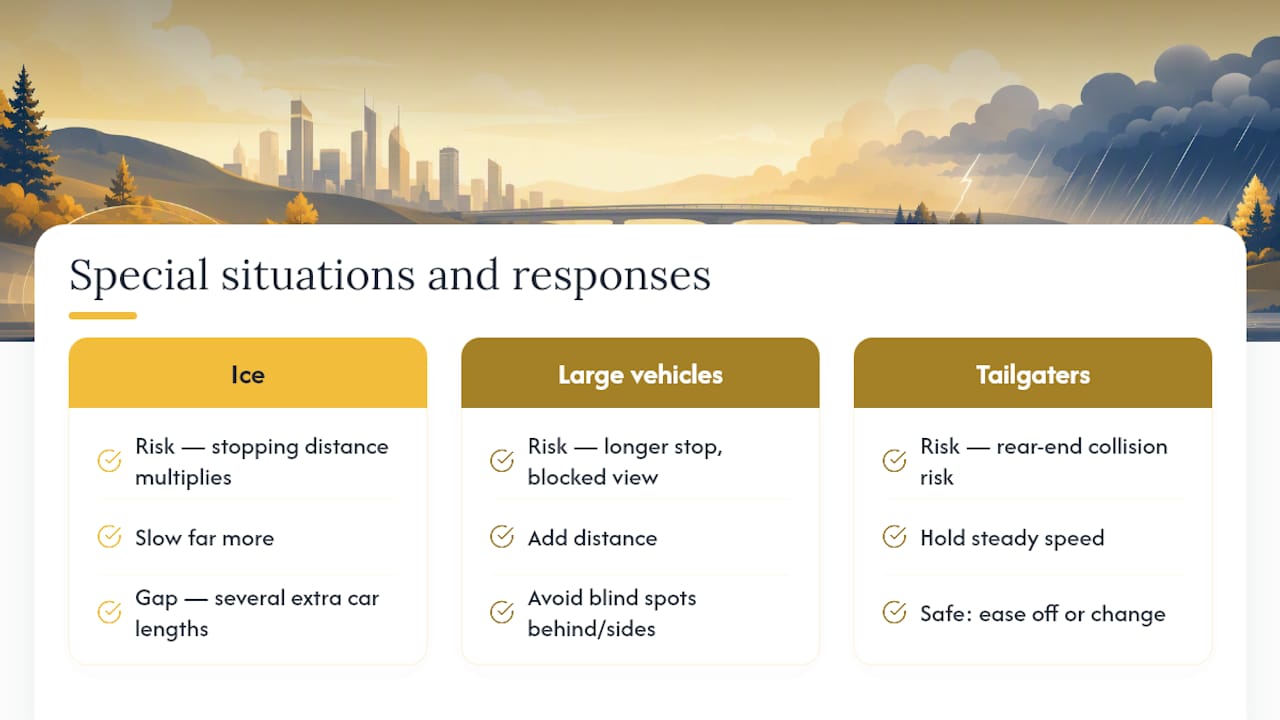
Tailgaters are the trickiest one, because the instinct to brake and “teach them a lesson” is exactly backward. Hold your speed steady, resist brake-checking, and when it’s safe, either ease off slightly to open room ahead or change lanes to let them pass.
Pro Tip: If someone’s riding your bumper, don’t slow down abruptly to make a point. A sudden brake tap can trigger a rear-end collision that’s legally and physically worse for you, even though the tailgater caused the risk.
Everyday Habits That Actually Keep the Gap
Knowing the rule and living it are two different things. These are the habits that make the gap stick.
- Drive at a speed where you can stop within what you can actually see. If your headlights or the road curve limit visibility, your speed should match that, not the posted limit.
- Brake early and gently instead of late and hard. Early braking preserves your gap; last-second braking closes it and forces the car behind you to react too.
- Pick lanes that let you keep space, not just move faster. Weaving into a tighter gap to gain one car length rarely saves real time and always costs margin.
- Practice the count-to-object check on every single drive, not just when you feel unsafe. It takes seconds and turns a rule into instinct.
- Use a written commitment if you’re coaching a new driver. A teen or family safe driving contract turns an abstract rule into something concrete both people agreed to.
None of this is complicated. It’s repetition that makes it automatic, the same way checking mirrors becomes automatic after enough drives.
How Drivewithcare Turns This Rule Into a Habit
Rules are easy to read and easy to forget. That gap is exactly what Drivewithcare’s Safer Roads Now initiative is built around, since human error accounts for the overwhelming majority of crashes, and following too closely is one of the most common and most preventable versions of that error.
Pairing a habit like the count-to-object check with a written commitment measurably increases how consistently drivers stick with it, which is why Drive With Care’s programs build pledges and family agreements directly into their driver education work. The organization’s safety awareness resources and downloadable teen driving contract exist for exactly this reason: turning a rule you read once into something you actually practice.
A Habit Worth Building Before Your Next Drive
Every serious crash I’ve read about that involved a rear-end collision shares one detail: someone was following closer than they realized. That’s the frustrating part. It’s one of the easiest habits to fix, and one of the easiest to let slide the moment traffic gets heavy or you’re running late. Try the count-to-object check on your very next drive, even for thirty seconds. If you want something that sticks longer than a good intention, the Drive With Care pledge is a low-effort way to make the commitment real.
— Charles
Practice the Gap, Then Make It a Promise
Reading about following distance and actually keeping one under pressure are different skills, and Drivewithcare builds resources for the gap between them.

The safety awareness hub breaks down how human error, including tailgating, contributes to the vast majority of crashes on the road, with practical guidance you can apply the same day you read it. If you’re coaching a new driver, the safe driving contract for teens and parents turns the count-to-object habit into a two-person commitment instead of a one-sided lecture. And if you want a low-pressure way to rehearse how you’d actually react in a tense moment, the safety reset rehearsal walks through exactly that.
None of these cost anything, and none require more than a few minutes. If you’re ready to formalize the habit, take the Drive With Care safety pledge today, or check the volunteer page if you want to help bring this kind of education to your own community.
Sources
- Safe stopping distance | NSW Government
- Section 8: Safe Driving – California DMV
- Stopping distances | The AA
- Managing space | Pennsylvania drivers manual
- CMV driving tips – Following too closely | FMCSA

