

Prevent road rage by planning extra time before you drive, staying calm behind the wheel, and refusing to engage when another driver acts aggressively. Most incidents escalate because one person answers provocation with provocation. The rest of this guide covers exactly what to do before you start the car, while you’re in traffic, and if a confrontation actually catches up with you.
TL;DR:
- Recognizing early signs like tailgating, horn use, and sudden lane changes allows drivers to respond calmly and prevent escalation.
- If confronted by an aggressive driver, locking doors, avoiding eye contact, and driving to safe, public locations are critical safety steps.
- Reporting dangerous behavior with specific details helps authorities identify repeat offenders while prioritizing personal safety over trying to get clearer information.
- Practicing calm responses through short rehearsals before drives can improve reactions during stressful situations, especially for new or anxious drivers.
Table of Contents
- What Road Rage Prevention Really Means
- The Early Warning Signs of an Aggressive Driver
- How to Prevent Road Rage Before You Even Start Driving
- Staying Calm in Traffic: Tactics That Actually Work
- What to Do If an Aggressive Driver Confronts or Follows You
- Reporting Aggressive Driving the Right Way
- Drive With Care’s Practical Tools for Safer Driving
- Why Traffic Stress Turns Into Road Rage
- How Road Rage Affects Mental Health and Long-Term Safety
- Can Technology Help Prevent Road Rage, or Does It Make Things Worse?
- The Push for Better Road Rage Education
- A Short Note on Practicing Calm Before You Need It
- Take the Next Step With Drive With Care
- Sources
What Road Rage Prevention Really Means
People use “aggressive driving” and “road rage” like they’re the same thing, but they’re not, and the difference matters for both safety and the law. Aggressive driving covers unsafe behaviors behind the wheel: tailgating, speeding through a yellow light, weaving between lanes without signaling. Road rage is aggressive driving that crosses into intentional violence or intimidation. Think tailgating (aggressive driving) versus swerving into someone’s lane on purpose to force them off the road, or getting out of the car to confront another driver (road rage).
That distinction has real legal weight now. Utah’s H.B. 30, effective July 1, 2024, created a specific criminal offense for a “road rage event,” defined as an act committed with intent to endanger or intimidate another road user. Other states are watching how it plays out, and the rules on what counts as a chargeable offense vary by jurisdiction. Always check your own state’s statutes before assuming a confrontation is “just an argument” rather than a crime.
The stakes are straightforward: aggressive encounters raise the odds of a crash, and a small share turn violent, sometimes involving weapons or physical assault. Two things worth remembering when you’re deciding how to react:
- Aggressive driving is a behavior pattern; road rage is often a specific, intentional act.
- Laws differentiating the two are getting sharper, not softer, in several states.
- Your safest legal position is almost always to disengage, not confront.
The Early Warning Signs of an Aggressive Driver
Aggressive drivers usually telegraph their state before things get dangerous, and catching those signals early buys you time to react instead of just brace. Watch for tailgating that seems personal, sudden hard braking, weaving in and out of lanes without much regard for other cars, headlight flashing, or a horn that’s being leaned on rather than tapped. Aggressive hand gestures are an obvious tell, but subtler cues matter too: prolonged eye contact through a rearview mirror, a driver mirroring your lane changes, or tense body language visible through a windshield.
The pattern that predicts trouble: a driver who’s already agitated tends to interpret ordinary traffic mistakes, someone merging a little late, a slow left-turner, as a personal insult. That misreading is the psychological engine behind most road rage events, and it’s why staying neutral yourself matters so much once you spot the signs.
Common early indicators to watch for:
- Persistent tailgating that doesn’t ease off when you change lanes
- Repeated horn use beyond a quick warning tap
- Weaving or abrupt lane changes without signaling
- Headlight flashing aimed at your vehicle specifically
- Visible gestures, shouting, or leaning out a window
How to Prevent Road Rage Before You Even Start Driving
Most road rage prevention happens before you touch the ignition. Traffic experts consistently point to stress and time pressure as the biggest triggers, which means the drive itself is often just the spark, not the fuel. The fuel gets loaded earlier.
Here’s a sequence that works:
- Build in a buffer. Check traffic conditions and add ten to fifteen extra minutes to your estimated drive time. Rushing is the single easiest trigger to eliminate, and it costs you nothing but a slightly earlier departure.
- Run a quick emotional check. If you just had an argument, got bad news, or are already tense, notice it before you drive. Emotion doesn’t stay in the house. It rides in the passenger seat.
- Practice a short reset before you pull out. This is where Drive With Care’s Safety Reset Rehearsal comes in: a brief, repeatable practice where you mentally walk through how you’ll respond if someone cuts you off or leans on their horn, before it actually happens. Rehearsing the calm response in advance makes it far more available in the moment, the same way pilots rehearse emergency checklists they hope never to use.
- Adjust the environment. Set the seat, mirrors, and temperature before you’re moving. Choose calming audio, a podcast, familiar music, over talk radio that spikes your heart rate with breaking news or heated callers.
- Set passenger expectations, especially for teen drivers. A teen driving agreement that spells out how to handle an aggressive driver gives a new driver a script to follow instead of a panic response to improvise.
Pro Tip: Keep the Safety Reset Rehearsal to under five minutes. Picture one specific scenario, someone tailgating you on the highway, say it out loud: “I’ll ease into the right lane and let them pass.” Rehearsing the exact words trains your response faster than a vague intention to “stay calm.”
Staying Calm in Traffic: Tactics That Actually Work
Once you’re moving, prevention shifts from planning to execution. The goal is simple even when the traffic isn’t: don’t give an aggressive driver anything to react to, and don’t let their behavior change yours.
- Keep distance, always. A following distance of at least three to four seconds gives you room to react and removes the temptation to brake-check anyone. Following too closely is one of the most common triggers you can control entirely on your own.
- Treat the left lane as a passing lane, not a home base. Camping in the left lane invites tailgating and horn use from drivers who feel blocked. State DOT guidance specifically flags this as one of the easiest fixes for reducing conflict on highways.
- Skip the eye contact. Locking eyes with an angry driver, even briefly, can read as a challenge. Look at the road, not at the person glaring in your mirror.
- Never return a gesture, a horn blast, or a tailgate. If someone’s riding your bumper and clearly trying to provoke a reaction, resist the urge to brake, speed up, or gesture back. Ease off the gas gradually and let them pass. Matching their speed or their attitude is exactly what escalates a minor annoyance into a dangerous chase.
- Use your horn sparingly and your signals generously. A quick tap to alert someone of danger is fine; leaning on it out of frustration reads as aggression, even when that’s not your intent.
- If someone is fixated on you, change your route. Gradually slow down, move into the right lane, and take the next exit if the behavior continues. There’s no shame in adding five minutes to your drive to remove yourself from a situation that’s heating up.
Safety agencies that study this behavior repeatedly land on the same core advice: give angry drivers room, avoid eye contact, and never let your driving become a response to theirs. Defensive-driving specialists frame it in psychological terms, too. Treating another driver’s mistake as an error rather than a personal insult keeps your own physiological arousal lower, which makes the next right decision easier to make.
What to Do If an Aggressive Driver Confronts or Follows You
This is the scenario every driver worries about but few actually plan for, so having an ordered sequence in your head matters more here than almost anywhere else in this guide.
- Lock your doors and keep windows up. Do this the moment you notice a driver escalating, not after they’ve pulled alongside you.
- Avoid eye contact and stay silent. Don’t mouth an apology, don’t gesture, don’t roll down the window to explain yourself. Safety agencies are consistent on this point: any engagement, even a defensive one, can be read as provocation.
- Create distance. Change lanes, adjust your speed, or take an exit to put space between your vehicle and theirs.
- If you’re being followed, do not drive home. This is one of the most important rules in this entire article. Driving home shows an aggressor exactly where you live. Instead, drive to a police station, fire station, or a busy, well-lit public place like a gas station or grocery store parking lot.
- Call 911 if you feel threatened. Don’t wait to see if it resolves on its own. Give the dispatcher your location, direction of travel, and a description of the other vehicle while you’re still driving to safety.
- Never stop to confront the other driver. Even if you feel wronged, getting out of your car turns a traffic incident into a physical one.
While you’re doing all this, try to safely note details you can pass along once you’re stopped somewhere secure:
- License plate number and state
- Vehicle make, model, and color
- Direction of travel and approximate location
- What the driver did (tailgating, swerving, brandishing something)
If the incident results in any kind of collision or you need to document it afterward, Drive With Care’s accident guide walks through what to record and who to contact.
Reporting Aggressive Driving the Right Way
Not every aggressive driving incident needs a 911 call, but knowing the line matters. If you feel physically threatened, someone is trying to run you off the road, brandishing a weapon, or following you aggressively, call 911 immediately and stay on the line until you’re safe. For behavior that’s dangerous but not an active threat, most states offer a non-emergency line or online reporting tool through their state police or highway patrol.
Whichever route you take, the details that actually help investigators are specific:
- License plate number and state of registration
- Vehicle description (make, model, color)
- Location, direction of travel, and approximate time
- The exact behavior observed (tailgating, weaving, brandishing an object)
Agencies use these reports to identify repeat offenders and patterns on specific stretches of road, which is part of why law enforcement encourages reporting even when no immediate danger is present. The one rule that outranks all the others: never compromise your own safety trying to get a clearer look at a plate or a face. A partial description delivered safely beats a complete one gathered by tailing an aggressive driver yourself.
Drive With Care’s Practical Tools for Safer Driving
Agency guidance tells you what to do. Drive With Care builds the practice into something you can actually rehearse, because knowing the right move and executing it under stress are two different skills.
The Safety Reset Rehearsal is a short, repeatable exercise: picture a specific stressful scenario, someone tailgating, a near miss at a merge, and mentally walk through your calm response before you’re ever in that situation for real. A few minutes of rehearsal a week builds the kind of automatic, non-reactive habit that’s much harder to develop in the heat of the moment.
Beyond the rehearsal itself, a few resources worth knowing about:
- The Safer Roads Now pledge, where thousands of drivers have committed publicly to safer habits behind the wheel
- A teen and parent driving contract that sets clear expectations before a new driver ever hits a highway
- A resource library covering everything from post-accident steps to distraction-prevention challenges
Pro Tip: Run through the Safety Reset Rehearsal with a teen driver in the passenger seat before their first solo highway trip. Rehearsing it together turns an abstract warning into a concrete script they can actually recall under pressure.
Why Traffic Stress Turns Into Road Rage
Road rage rarely comes out of nowhere. It’s usually the final step in a chain that starts with something unrelated to driving at all: a bad night’s sleep, a stressful meeting, a financial worry riding shotgun in someone’s head. Traffic then becomes the pressure valve, and a slow driver or a missed merge gets treated as the cause of a frustration that was actually building for hours.
Time pressure amplifies almost everything. A driver running fifteen minutes late reads a normal traffic slowdown as a personal obstacle rather than an ordinary Tuesday. Add in anonymity, the sense that you’ll never see this other driver again and there are no social consequences for honking or gesturing, and you get a psychological environment that makes people act in ways they’d never consider at a checkout line or in a meeting.
Underlying causes worth naming plainly: chronic stress, learned aggressive habits picked up from family or peers, a sense of entitlement to space on the road, and the simple fact that a car provides a physical barrier that makes confrontation feel low-risk. Experts point to congestion and time pressure specifically as the most reliable triggers, which circles back to why the “leave earlier” advice from earlier in this guide isn’t just a nicety. It removes one of the two biggest fuel sources before you ever start the engine.
How Road Rage Affects Mental Health and Long-Term Safety
The damage from a road rage incident doesn’t end when the other car turns off. A near miss with an aggressive driver spikes adrenaline and cortisol, and that physiological state doesn’t just vanish once you’re safe. Many drivers report feeling shaky, hypervigilant, or unable to concentrate for the rest of the day after a scary encounter.
Repeated exposure compounds the problem. Commuters who deal with aggressive drivers regularly, particularly on high-congestion routes, can develop a kind of chronic driving anxiety: tensing up before merges, avoiding certain roads, or feeling dread before a commute that used to be routine. That anxiety often bleeds into how a person drives, creating a cycle where stress makes someone a slightly worse, more reactive driver, which raises their odds of another bad encounter.
There’s a safety cost layered on top of the mental health one. Elevated stress narrows attention and slows reaction time, the opposite of what you need behind the wheel. A driver who’s still rattled from a confrontation ten minutes earlier is more likely to miss a hazard, misjudge a gap, or overreact to the next minor provocation. Breaking that cycle is part of why brief calming techniques, deep breathing, adjusting the cabin environment, taking a short break at a rest stop, aren’t just comfort measures. They’re a direct safety intervention.
Can Technology Help Prevent Road Rage, or Does It Make Things Worse?
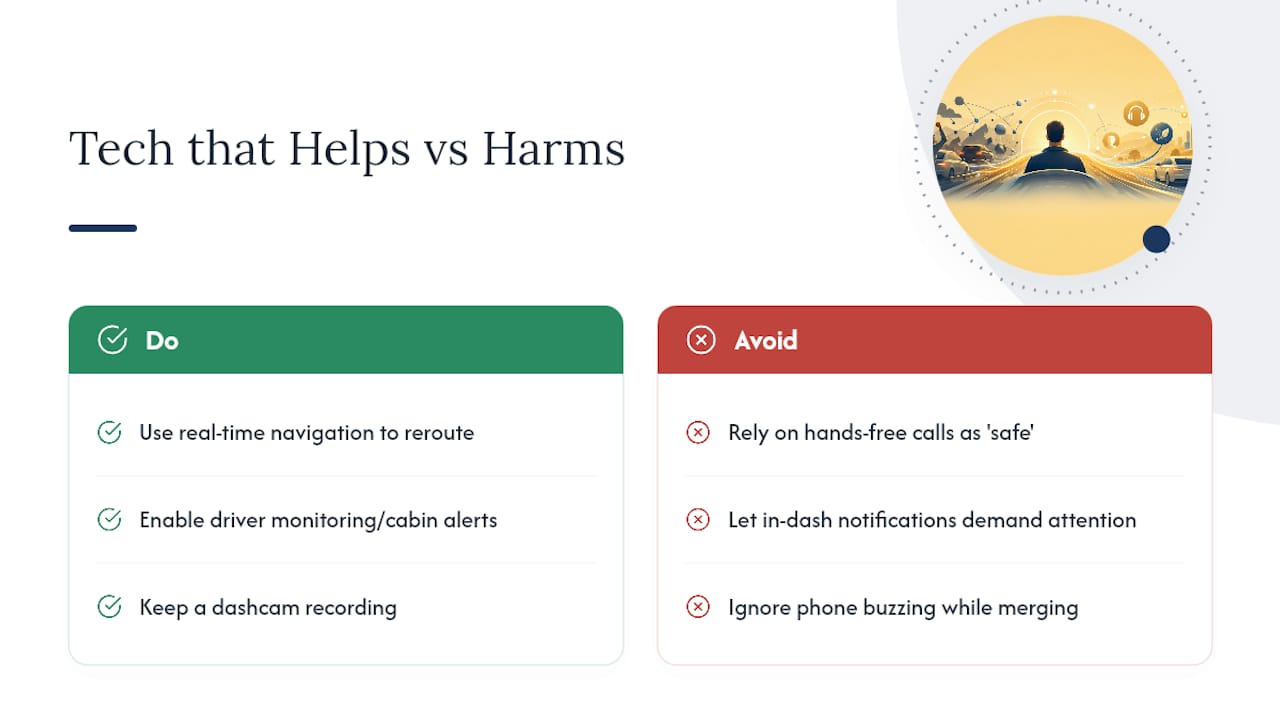
Vehicle technology cuts both ways here, and it’s worth being honest about which apps and features actually help versus which ones quietly add fuel to the fire. Navigation apps that reroute around congestion in real time remove one of the biggest triggers before it happens: unexpected delays that eat into a driver’s buffer. Some newer vehicles include cabin sensors or driver monitoring systems that detect signs of stress or fatigue and prompt a break, though this technology is still far from universal.
On the other side, hands-free calling, in-dash notifications, and constant navigation prompts can add a low-level cognitive load that leaves less mental bandwidth for patience. A phone buzzing with a text while you’re already navigating a merge doesn’t cause road rage on its own, but it shortens the fuse. Dashcams deserve a specific mention: they’re broadly a net positive for prevention, since knowing an interaction is recorded tends to discourage both parties from escalating, and footage becomes valuable evidence if you do need to file a report.
The honest takeaway is that no app replaces the behavioral habits covered earlier in this guide. A good navigation app that gets you there on time does more for road rage prevention than almost any feature marketed as a “calm driving” tool, simply because it removes the time pressure that causes most incidents in the first place.
The Push for Better Road Rage Education
Road rage hasn’t gotten less common just because more people know the term. That’s part of why agencies at every level, from the National Highway Traffic Safety Administration down to individual state DOTs, keep producing prevention materials aimed at drivers directly rather than assuming the message will spread on its own.
Driving schools have started weaving de-escalation into standard curricula rather than treating it as an afterthought tacked onto a defensive-driving unit. Some corporate fleet programs now require aggressive-driving awareness training as part of onboarding, recognizing that a company vehicle involved in a road rage incident carries liability well beyond the individual driver. Community pledge campaigns, like the one Drive With Care runs, work differently than a one-time training session: they ask drivers to make a public, ongoing commitment, which research on behavior change suggests sticks better than a single lecture or pamphlet ever could.
The common thread across nearly every serious program is the same: knowing the rules isn’t enough. Drivers need to actually rehearse the calm response before they’re tested on a real highway, which is exactly the gap a program like the Safety Reset Rehearsal is built to close.
A Short Note on Practicing Calm Before You Need It
Most driving advice fails for one predictable reason: it’s information delivered to a calm reader who then has to apply it while adrenaline is running high and a stranger is inches from their bumper. That gap between knowing and doing is the whole game in road rage prevention, and it’s the part conventional safety pamphlets tend to skip.
A short rehearsal closes that gap better than another list of tips ever will. Picture the scenario you dread most, maybe it’s someone tailgating you on a two-lane road with no shoulder, say your planned response out loud, and repeat it until the words come faster than the panic does. It sounds almost too simple to matter. But pilots, surgeons, and emergency responders all train this way for a reason: rehearsed responses survive stress better than good intentions do.
Try it before your next drive. Pick one scenario, spend five minutes on it, and notice whether the real thing feels even slightly more manageable the next time it happens.
— Charles
Take the Next Step With Drive With Care
Reading about prevention gets you halfway there. The other half is practice and community, which is exactly what Drive With Care builds its programs around instead of just publishing another checklist.

Start with the Safety Reset Rehearsal if you want a concrete exercise you can run through this week, it takes minutes and gives you a rehearsed response instead of a hope that you’ll stay calm when it counts. If you’re ready to make it public, take the Safer Roads Now pledge and join the thousands of drivers who’ve committed to safer habits on the road. And if you want to support the programs, survivor resources, and neurological research behind this work, a donation to Drive With Care funds the education and community partnerships that keep these tools free for every driver who needs them. Pick one action from this list and take it before you drive again.
Sources
This guide draws on official prevention advice from the Utah Highway Safety Office on the state’s updated road rage law, the Washington State Department of Licensing on confrontation safety steps, and the Texas Department of Transportation on prevention tactics. Behavioral guidance comes from Utah State University Extension and Hackensack Meridian Health. Reporting details are backed by the Illinois State Police, and broader federal context comes from NHTSA’s aggressive driving materials. For legal questions specific to your situation, Jose A Loayza Law offers additional perspective on road rage statutes and criminal thresholds.
- Road Rage | Utah Highway Safety Office
- Road rage | Washington State Department of Licensing
- Tips to avoid aggressive driving – Texas Department of Transportation
- How to avoid and manage road rage | Utah State University Extension

