

The single most important habit for merging safely: accelerate through the ramp until your car matches highway speed, signal early, check your mirrors and blind spot, then commit to a gap of at least 3 to 4 seconds and go. Traffic already on the highway has the right of way, so the responsibility to merge safely, not just courteously, sits entirely with you.
TL;DR:
- Building speed along the entire acceleration lane is crucial before checking blind spots and merging, to prevent gaps from closing unexpectedly.
- Confirm a safe gap using landmark counting and aim for at least four seconds, especially around large trucks, adverse weather, or dense traffic.
- Practice acceleration, gap judgment, and shoulder checks separately to build confidence and avoid hesitation or rushing during actual merges.
- Always yield to highway traffic and avoid stopping on the ramp, circling for a better gap, or waiting for external signals, which increase crash risk.
- Eye contact is unreliable at high speeds; your signals, consistent speed, and physical shoulder checks communicate your intentions most effectively.
Table of Contents
- Step-by-Step Highway Merging Tips for a Smooth Entry
- How Do You Judge a Safe Gap and Speed When Merging?
- What Mistakes Do New Drivers Make Most Often?
- How Can You Practice Highway Merging Before It Feels Automatic?
- Where This Advice Comes From
- Do Merging Rules Change From State to State?
- What Should You Do if No One Lets You Merge?
- Does Eye Contact Actually Help When You’re Merging?
- What Nervous New Drivers Get Wrong About Merging
- Ready to Practice? Drive With Care Has the Tools
- Sources
Step-by-Step Highway Merging Tips for a Smooth Entry
Merging feels chaotic the first few times because everything happens at once. Break it into a fixed sequence, though, and it becomes almost mechanical. Here’s the order that driving instructors and state driver’s manuals consistently recommend.
- Get set before the ramp. Adjust your mirrors, glance at the ramp’s shape and length, and note where the highway traffic is flowing so you’re not guessing once you’re already accelerating.
- Signal as soon as you’re on the straight part of the ramp. Flip your blinker early enough that drivers already on the highway see it and can react, not the instant before you merge.
- Use the entire acceleration lane. This lane exists specifically so you can match the flow of traffic, not just reach the end of the pavement. Pennsylvania’s driver’s manual is explicit about this: build speed the whole way down the ramp, don’t just coast toward the merge point.
- Check your mirrors, then physically turn your head to check the blind spot. Mirrors alone miss a full car length or more next to your rear door. This shoulder check is the step new drivers skip most, and it’s the one that actually prevents side collisions.
- Pick your gap and commit. Once you’ve confirmed a safe opening, steer smoothly into it. Don’t second-guess halfway through the lane change.
- Cancel your signal and settle in. Re-establish a safe following distance behind the car ahead of you instead of matching its bumper.
That sequence, sometimes taught as SMOG or SMILE (Signal, Mirror, Over the shoulder, Go), works because it forces you to look before you move rather than moving and hoping. State Farm’s merging guidance reinforces the same order: signal, accelerate, check, then merge, never the reverse.
Pro Tip: Say the steps out loud the first few times you practice, even alone in the car. Talking through “signal, mirror, shoulder, gap, go” trains the sequence into muscle memory faster than silently running through it in your head.
The biggest failure point isn’t any single step. It’s rushing steps 3 and 4 together, checking your blind spot before you’ve actually built enough speed to use the gap you just found. By the time you’re ready to move, the gap has closed. Build speed first. The checking and the merging come after.
How Do You Judge a Safe Gap and Speed When Merging?
A safe gap is one you can count to using a fixed landmark, like a sign, an overpass shadow, or a light pole. Watch the car ahead of the gap pass that landmark, then start counting: “one, two, three.” If your car reaches the same landmark before you hit three, the gap is too tight. Four seconds give you an even bigger cushion, especially useful around trucks and buses.
Speed matters as much as spacing. Match the actual flow of traffic on the highway, not the posted ramp speed and not the highway’s posted limit if real traffic is moving slower or faster than that number. The U.S. DOT’s speed management guidance treats speed differential, the gap between your speed and surrounding traffic, as one of the biggest risk factors in merge-related crashes.
A few adjustments worth building into your gap judgment:
- In rain, fog, or at night, extend your gap target beyond 4 seconds since stopping distances and visibility both suffer.
- Around large trucks or buses, aim for a noticeably bigger gap. Commercial vehicles need more room to stop than passenger cars.
- If the ramp is short or traffic is dense, treat the merge like a yield: inch forward only when a gap opens, and avoid stopping outright unless traffic ahead has fully stopped.
NHTSA’s crash data links a meaningful share of lane-change and merge collisions to poor spacing and inadequate scanning, which is exactly what the landmark count and shoulder check are designed to fix.
One exception worth knowing: the zipper merge explained by Florida Accident Guides, where cars from two lanes alternate one at a time, only applies during lane closures or heavy, near-stopped congestion. It is not appropriate for a standard high-speed ramp entry, where you should be finding your own gap and matching speed, not alternating with a specific car.
What Mistakes Do New Drivers Make Most Often?
Most merging accidents trace back to a handful of repeatable habits, not bad luck. Recognizing them in advance is half the fix.
- Stopping on the ramp. Acceleration lanes exist so you can build speed, and stopping on one forces you into a much smaller, harder-to-judge gap later.
- Rolling slowly instead of accelerating. Creeping down the ramp at 35 mph and expecting to merge into 65 mph traffic creates a dangerous speed differential right at the merge point.
- Skipping the shoulder check. Mirrors have blind spots by design; a quick head turn is the only way to confirm what’s actually next to you.
- Hesitating mid-merge. Starting the lane change, then freezing, confuses everyone around you far more than committing decisively.
- Cutting off trucks or buses. Their stopping distance is longer than yours, so a gap that looks fine for a sedan may not be fine for an 18-wheeler.
- Waiting for someone to wave you in. Courtesy is not a plan. Find your own gap instead of counting on another driver to make room.
How Can You Practice Highway Merging Before It Feels Automatic?
Confidence comes from repetition in low-stakes conditions, not from reading about it. A few ways to build that repetition safely:
- Ride along and observe first. Watch how an experienced driver times signals, speed, and gap selection before you try it yourself.
- Practice during off-peak hours. Early Sunday mornings or late evenings have lighter traffic, which gives you more room for error while you’re still building the habit.
- Break the maneuver into drills. Practice just the acceleration-lane speed-matching one day, then just gap judgment, before combining both into a full merge.
- Use commentary driving. Narrate what you see out loud, “car in blind spot, gap opening ahead,” to force yourself into active scanning instead of passive steering.
- Work up to busier ramps gradually. Each successful merge in easier conditions makes the next one, in slightly heavier traffic, less intimidating.
Pro Tip: Keep a simple mental cue running every single time: Signal, Mirror, Shoulder, Gap, Commit. Five words, same order, every merge, until it stops feeling like a checklist and starts feeling like instinct.
Where This Advice Comes From
The step sequence and gap guidance here draw on state driver’s manual language, NHTSA’s safety research on lane-change and merge crash risk, and standard driving-instructor curriculum. A Safer Roads Now program was built around this kind of practical, repeatable instruction because human error, not mechanical failure, is behind the overwhelming majority of crashes.
Beyond this article, Drivewithcare’s resource library includes practice checklists and teen-parent driving agreements, plus a second set of materials covering broader safe-driving topics. The organization’s pledge program has already collected thousands of individual commitments to safer driving habits, built through partnerships with driving schools and local safety agencies.
Do Merging Rules Change From State to State?
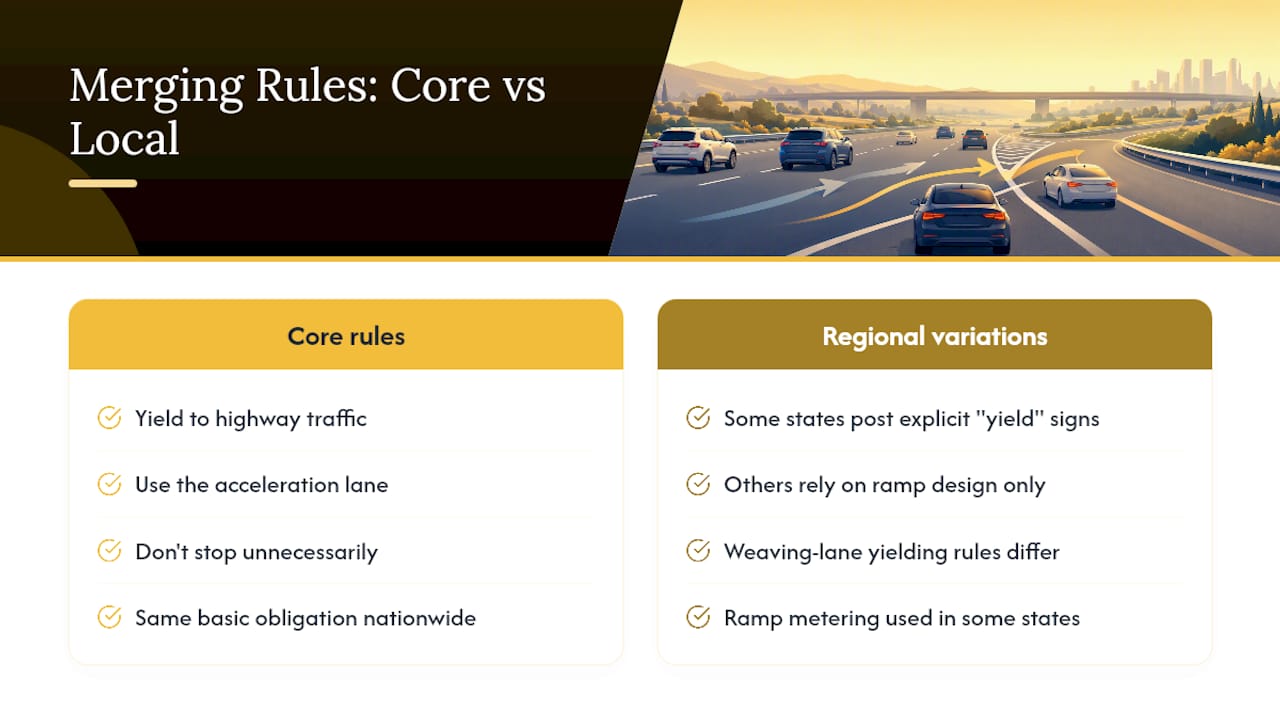
The core mechanics, yield to highway traffic, use the acceleration lane, don’t stop unnecessarily, stay consistent everywhere in the United States. What varies is how ramps are engineered and how local law treats specific situations.
Some states post explicit “yield” signs at merge points, legally obligating entering traffic to wait for a gap; others rely on acceleration-lane design alone without a formal yield sign, though the underlying obligation to merge safely is the same. Weaving lanes, where an exit ramp and entrance ramp share the same short stretch, carry their own local rules about which vehicles yield to which, and those rules can differ by state or even by specific interchange design.
Ramp metering, the traffic lights some states install on entrance ramps to space out merging cars during rush hour, is another regional variation. Not every state uses it, but where it exists, treat the light exactly like a stop-and-go signal, not a suggestion.
The safest approach is universal: check your specific state’s driver’s manual for details on your local interchange types, since Pennsylvania’s DMV guidance, for example, spells out weaving-lane yielding in more detail than many neighboring states. When in doubt on an unfamiliar highway, assume the more cautious rule, yield fully, until you’ve confirmed local signage says otherwise.
What Should You Do if No One Lets You Merge?
Stay calm and stay committed to finding your own gap rather than waiting for permission. Not every driver on the highway is paying attention, and some genuinely won’t slow down to accommodate you, regardless of how clearly you’ve signaled.
If the lane next to you is truly solid with no opening, slow slightly rather than speeding up, since a small reduction in your speed often opens a gap behind the car you were trying to get in front of. Avoid the instinct to swerve into a gap you’re not certain about just because you feel pressured. A missed exit or an extra lap around the block costs you nothing; a forced merge into too small a gap can cost a lot more.
Never stop on the ramp to wait for a “perfect” opening unless the traffic ahead of you has already come to a complete stop. A stopped car on an active acceleration lane is far more dangerous than a driver circling for another chance. If your ramp consistently ends without a gap forming, that’s often ramp design or rush-hour volume working against you, not a personal failure on your part. Give yourself permission to slow down, reassess, and try the next available gap instead of forcing the first one.
Does Eye Contact Actually Help When You’re Merging?
Eye contact helps far less on a highway than it does at a four-way stop, and relying on it can slow your decision-making at exactly the wrong moment. At merge speeds, drivers are often 100 feet or more apart, moving fast enough that a driver’s head turn or glance is nearly impossible to read reliably.
What actually communicates your intentions is behavior: your turn signal, your steady acceleration, and the visible commitment of your car moving smoothly toward the gap you’ve chosen. A driver who sees your signal on early and your speed climbing to match theirs reacts to that, not to whether you happened to catch their eye.
That said, don’t ignore the other driver entirely. A quick glance can tell you whether they’re distracted, on a phone, or genuinely unaware you’re there, information that matters more than any wave or nod. If a driver’s behavior suggests they haven’t seen you at all, that’s your cue to find a different gap rather than assume they’ll make room once they notice.
What Nervous New Drivers Get Wrong About Merging
The conventional advice on merging spends too much time on courtesy, “wave if someone lets you in,” and not nearly enough on the two things that actually prevent crashes: speed matching and the physical shoulder check. Plenty of new drivers can recite the etiquette. Far fewer have built the habit of actually turning their head instead of trusting a mirror.
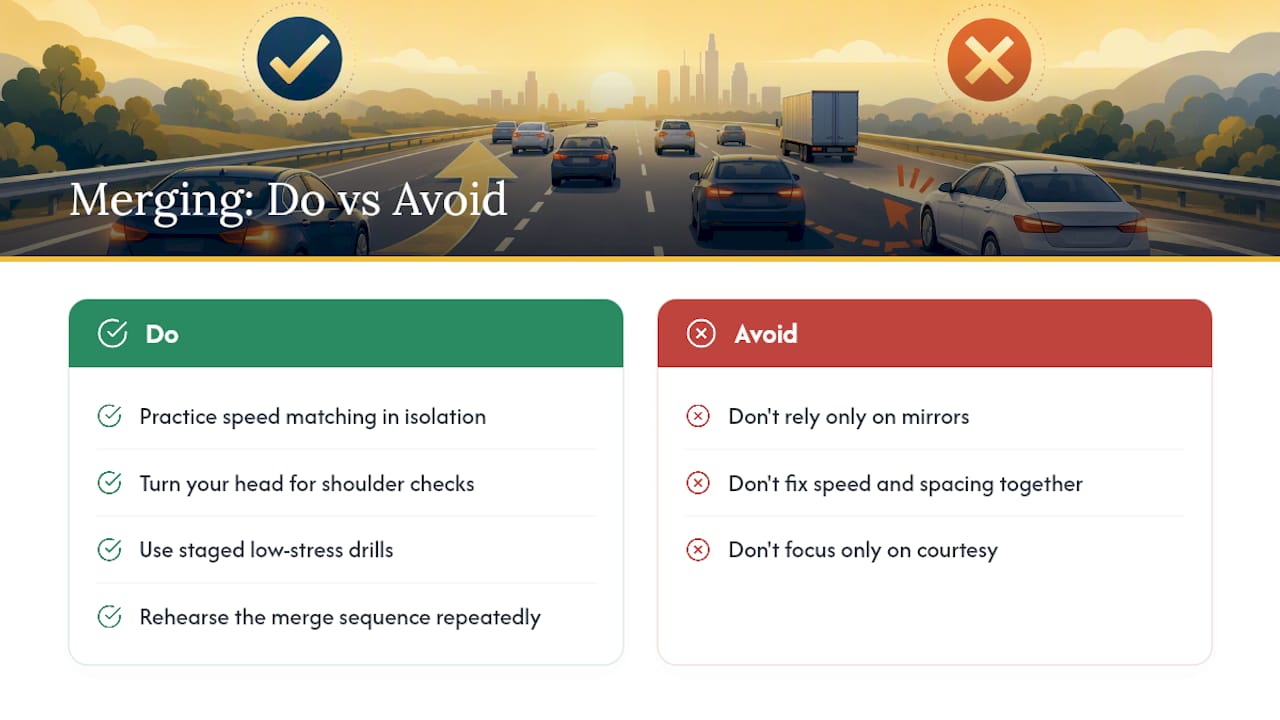
If this article has one priority to push above the rest, it’s this: practice the acceleration-lane speed match in isolation before you ever combine it with gap selection. Most hesitation at the merge point comes from a driver realizing mid-ramp that they haven’t built enough speed, then trying to fix two problems, speed and spacing, at once. Separate the skills in practice, and the real merge stops feeling like a single terrifying decision and starts feeling like a sequence you’ve already rehearsed.
Confidence here isn’t a personality trait. It’s the direct result of repetition under low-stress conditions, which is exactly why staged drills matter more than any single tip in this piece.
— Charles
Ready to Practice? Drive With Care Has the Tools
Reading about merging only gets you so far. Practice resources are built specifically to close the gap between knowing the steps and actually trusting yourself to execute them under real traffic.

The organization’s free practice materials include staged drill guides and a teen-parent driving agreement that turns supervised practice into a structured, repeatable program instead of a one-time lecture. If you want a simple way to reinforce the habits covered here, take the Drive With Care safety pledge and commit to the same sequence, signal, mirror, shoulder, gap, commit, every time you get behind the wheel. And because these programs run entirely on donations rather than fees to drivers or families, consider supporting Safer Roads Now directly so more new drivers get access to the same practice materials before their first solo merge, not after a close call.
Sources
- How to Merge onto the Highway – State Farm®
- NHTSA — (safety guidance document)
- Negotiating Highways and Interchanges | Pennsylvania DMV

