
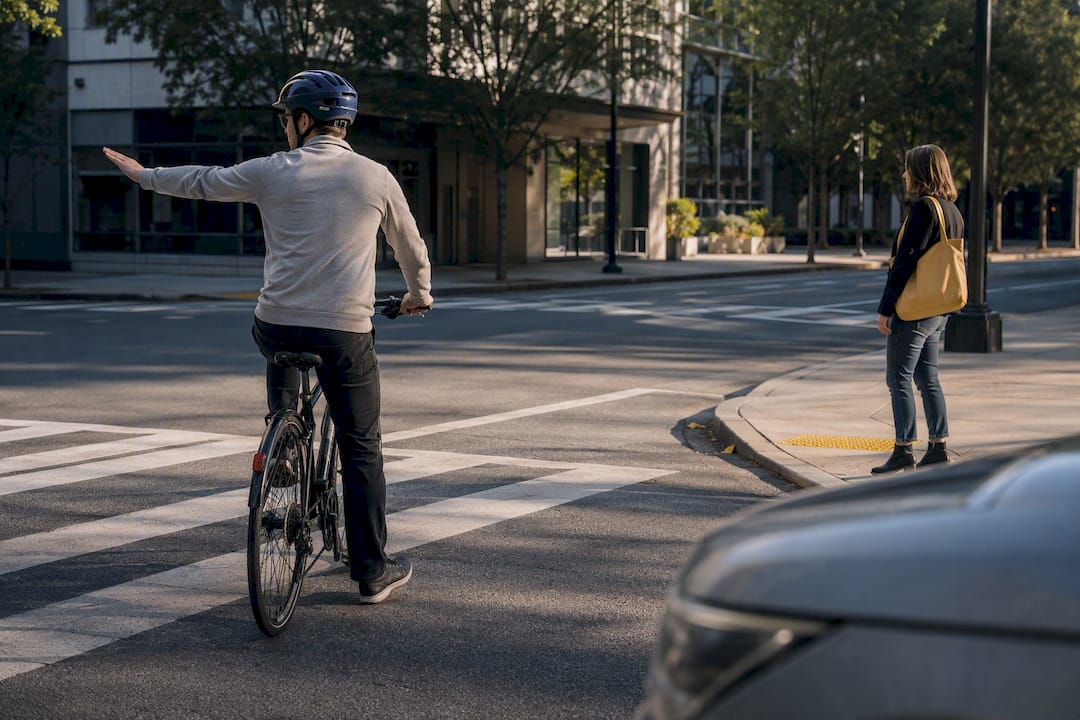
Sharing the road means every person moving through traffic, whether behind a wheel, on two wheels, or on foot, accepts responsibility for being visible, predictable, and generous with space. The single action that prevents the most crashes: adapt your speed and following distance to actual conditions, not just the posted limit. Cyclists usually count as vehicle operators under state law, which matters when you’re deciding who has the right-of-way.
TL;DR:
- Drivers should always perform a head check before turning or merging to reliably spot cyclists and motorcycles in blind spots.
- Maintain at least three seconds following distance in normal conditions, and extend to four seconds or more during adverse weather or heavy traffic.
- Cyclists legally operate as vehicles in most states, and may leave bike lanes or ride in the middle of the lane when deemed unsafe or necessary.
- Pedestrians have the right-of-way at crosswalks, and drivers must approach crossings and driveways with extra caution to prevent accidents.
- Adhering to simple habits such as checking mirrors, signaling early, and respecting space enhances safety more than complex enforcement or new technology.
Table of Contents
- Drivers: The Behaviors That Actually Prevent Collisions
- What Cyclists and Motorcyclists Are Legally Allowed to Do
- Where Pedestrians Stand and What Drivers Owe Them
- Visibility, Space, and Communication: The Three Rules That Cover Everything
- Is a Cyclist Legally a Vehicle, and Can Police Stop Them?
- Four Rules Worth Memorizing Before Your Next Trip
- Where to Verify the Rules in Your State
- Why Education, Not Just Enforcement, Changes Outcomes
- A Straight Answer on Whose Job This Really Is
- Take the Pledge and Put These Rules Into Practice
- Sources
Drivers: The Behaviors That Actually Prevent Collisions
Most crashes between cars and vulnerable road users trace back to a handful of repeated mistakes, not bad luck. Mirrors alone miss cyclists and motorcycles sitting in your blind spot, which is why driver manuals insist on a physical head check before every lane change or turn. A quick shoulder glance takes one second and catches what your mirror geometry can’t.
Here’s what actually matters on every drive:
- Turn your head and look before merging, turning, or opening a door into traffic.
- Give cyclists at least three feet of lateral clearance. Getting closer than that risks “dooring” or clipping a handlebar.
- Never pass a stopped car at a crosswalk. Drivers behind it can’t see the pedestrian who’s already stepped out.
- Around trucks and buses, remember their stopping distance is far longer than yours and their blind spots wrap around both sides.
- Treat a cyclist riding in the middle of the lane as normal, not as an obstruction to punish with a close pass.
Pro Tip: Before you open your car door on a street with bike traffic, use your far hand to reach the handle. It naturally turns your body toward the mirror, so you catch an approaching cyclist before the door swings.
What Cyclists and Motorcyclists Are Legally Allowed to Do
Cyclists ride as vehicle operators in most states, which means riding with traffic, obeying signals, and signaling turns the way any driver would. That legal status cuts both ways: it protects a cyclist’s place in the lane, and it also means traffic laws apply to them just as they apply to you.
Riders sometimes leave the bike lane entirely, and that’s often intentional rather than reckless. State guidance recognizes that cyclists may take the full lane when the lane is too narrow to share safely, when debris or a parked car blocks the shoulder, or when they’re setting up for a left turn.
Motorcyclists bring their own patterns worth expecting: sudden downshifts before curves, quick lane position changes to stay visible, and a narrower profile that’s easy to lose against a cluttered background.
- Ride with the flow of traffic, never against it.
- Take the full lane when hazards or narrow space make sharing unsafe.
- Use lights day and night, plus reflective gear at dawn, dusk, or in rain.
- Hold a straight, predictable line instead of weaving between parked cars.
Where Pedestrians Stand and What Drivers Owe Them
Pedestrians have the right-of-way at marked and unmarked crosswalks in most jurisdictions, and where no sidewalk exists, the safer practice is walking facing oncoming traffic so you can see what’s coming. Drivers owe pedestrians a slower approach near any crossing point, because people step off curbs at inconsistent moments, chasing a bus or distracted by a phone.
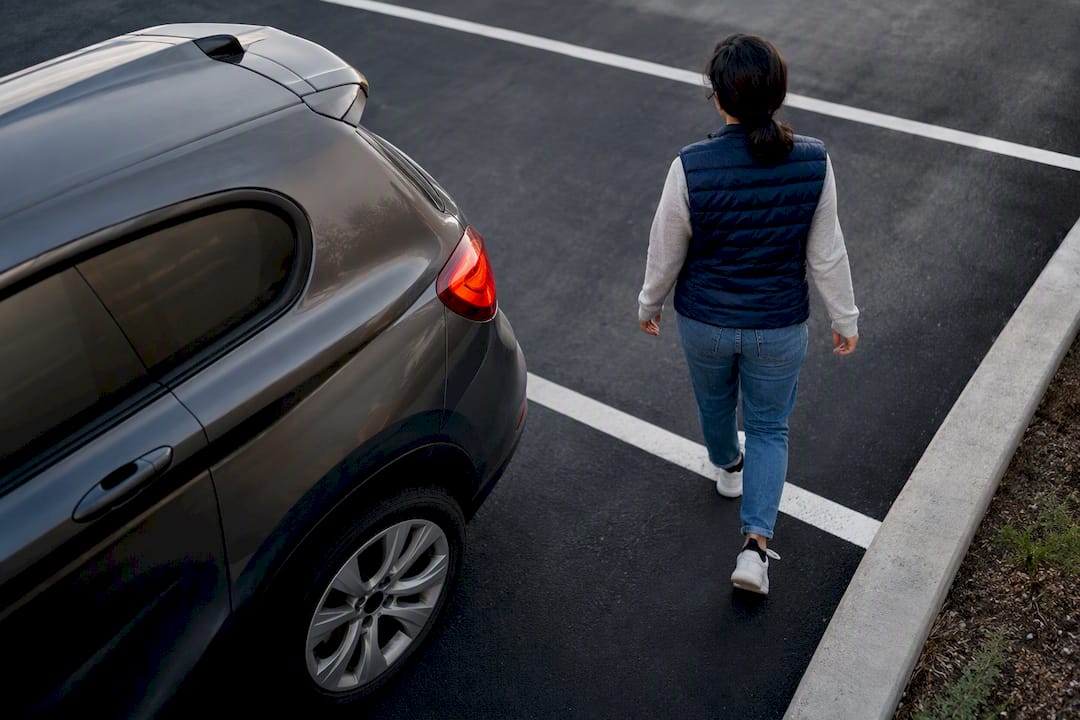
Parking lots and driveways deserve the same caution as crosswalks. Drivers backing out have terrible sightlines, and pedestrians often assume a slow-moving car has already seen them. It usually hasn’t.
Visibility, Space, and Communication: The Three Rules That Cover Everything
Nearly every defensive-driving system boils down to three pillars: visibility, space, and communication. Master those three and you’ve covered the vast majority of situations that turn dangerous.
- Visibility. Use headlights in low light even when not legally required, wear reflective gear if you’re a cyclist or pedestrian at night, and make eye contact with a driver before crossing in front of them. Head checks belong here too, catching what mirrors miss.
- Space. Apply the three-second following rule, extending it to four seconds or more in rain, fog, or heavy traffic. Keep an escape route open, meaning don’t box yourself in with no way to brake or swerve.
- Communication. Signal turns well before you make them. Cyclists should use hand signals when approaching a turn, and hold a consistent lane position so drivers can predict what happens next.
Rear-end collisions are common enough that safe following distance alone prevents a large share of them; about four in ten crashes involve one vehicle striking another from behind, usually because someone was following too closely for conditions. Bad weather and darkness don’t just make individual mistakes worse, they compress your reaction window, so the same three pillars need more margin, not a different approach.
Is a Cyclist Legally a Vehicle, and Can Police Stop Them?
Yes. In many states, bicycles are legally classified as vehicles, and officers can stop a cyclist for running a stop sign, riding without lights at night, or other traffic violations the same way they’d stop a car.
Being legally in the right doesn’t prevent a collision. Right-of-way rules shift by situation, intersection type, and local ordinance, so the practical move is to drive as though the other person might not know, or might not follow, the rule that technically protects you.
- Look up your state’s DMV or DOT driver manual before assuming a rule applies everywhere.
- Bicycle-specific statutes (lane position, sidewalk riding, helmet requirements) vary widely by state and even by city.
- When rules are unclear, defer to whichever action leaves the most room for error.
Four Rules Worth Memorizing Before Your Next Trip
- Keep three seconds of following distance in normal conditions, four or more in rain, fog, or heavy traffic.
- Before opening a car door on a street with bike traffic, check your mirror and glance back.
- If a cyclist has left the bike lane, assume they’re avoiding debris, a pothole, or a parked car door, not being difficult.
- Scan intersections and driveways for pedestrians before every turn, especially right turns on red.
Pro Tip: Run through these four checks out loud during your first few drives until they become automatic. It sounds silly. It also works.
Where to Verify the Rules in Your State
Federal guidance from the U.S. DOT’s Safe System approach lays out the shared-responsibility framework behind most state programs. Your state’s DMV or DOT site has the actual driver manual, bike statutes, and pedestrian right-of-way rules that apply where you live, and those details shift enough between states that it’s worth checking directly rather than assuming. Drivewithcare’s own safety resources collect further reading and community program details for anyone who wants to go deeper.
Why Education, Not Just Enforcement, Changes Outcomes
Human error drives the overwhelming majority of crashes, which is the premise behind Drivewithcare’s Safer Roads Now initiative. Rules matter, but rules alone don’t change behavior at the moment it counts, in a rushed left turn or a close pass on a narrow road.
That’s the gap education fills. Pairing personal stories from survivors with practical checklists like the ones above tends to stick longer than a statistic ever does. If you’re looking for a concrete way to put this into practice, A pledge program gives you a simple, low-friction starting point.
A Straight Answer on Whose Job This Really Is
The most persistent myth in road safety is that it’s someone else’s problem, the other driver’s, the cyclist’s, the city’s for not building a better bike lane. That framing lets everyone off the hook. The data on human error says otherwise: most crashes trace back to a decision someone made in the seconds before impact, not a design flaw or a rule that didn’t exist.
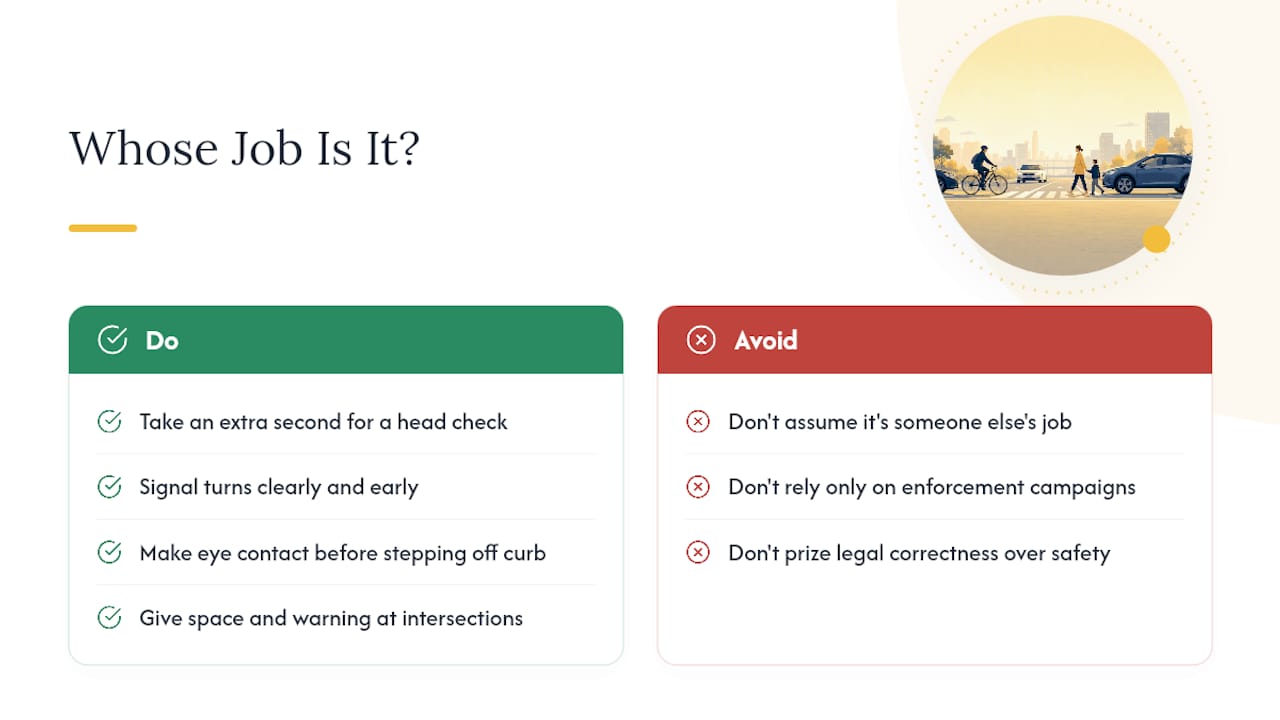
What gets missed in typical safety messaging is how boring the actual fix is. It’s not a new technology or a smarter intersection. It’s a driver who takes the extra second for a head check, a cyclist who signals a turn nobody was watching for anyway, a pedestrian who makes eye contact before stepping off the curb. None of that is glamorous. All of it works, consistently, in ways that enforcement campaigns alone don’t.
If there’s one place conventional advice undersells the point, it’s this: legal correctness is not the goal. Being right about who had the light doesn’t un-crash a car. The goal is arriving at the same intersection with enough space and enough warning that the legal question never has to get tested.
— Charles
Take the Pledge and Put These Rules Into Practice
Reading a checklist is one thing. Committing to it is another. Drivewithcare’s safety pledge turns the habits covered here, head checks, following distance, giving cyclists room, into a concrete personal commitment rather than a vague intention.

The pledge program exists because human error causes most crashes, and awareness alone rarely changes behavior on its own. Signing on connects you to a community of drivers, cyclists, and pedestrians who’ve made the same commitment, backed by Drivewithcare’s broader safety resources for anyone who wants to go further, from teen driving agreements to survivor support. Take the pledge today and make these micro-rules part of how you actually drive, ride, and walk.
Sources
- Safe System approach toward zero traffic deaths | U.S. DOT FHWA
- Dmv
- Chapter 11: Sharing the road | NY DMV

