
National Traffic Safety Awareness Month is a month-long observance dedicated to promoting safer roads and reducing traffic injuries and deaths, most commonly listed as running throughout August in U.S. awareness calendars. Its purpose is simple: get drivers, passengers, and pedestrians thinking about the behaviors behind most crashes and pushing them toward safer habits. Some regions and countries mark similar campaigns at different times of year.
TL;DR:
- Effective road safety campaigns combine public messaging with enforcement and grassroots activities to significantly reduce risky driving behaviors.
- August is the primary month for U.S. traffic safety observance, but many countries schedule their campaigns at different times based on local factors.
- Interactive actions like pledges, vehicle checks, and community events have a higher likelihood of changing driver habits than passive awareness efforts.
- Small, specific commitments and community involvement create lasting behavior change despite skepticism about awareness months’ overall impact.
Table of Contents
- What Road Safety Awareness Month Highlights: The Risks Behind Most Crashes
- When Is Road Safety Awareness Month Observed?
- How to Observe and Promote Road Safety This Month
- Road Safety Habits Worth Practicing All Year
- Drive With Care Spotlight: What We Do and How You Can Plug In
- Toolkits and Campaign Pages Worth Bookmarking
- Where This Observance Came From
- Do Awareness Campaigns Actually Change Behavior?
- The Numbers That Make August Matter
- Why Pledges and Community Work Actually Stick
- Support Road Safety This Month: Donate, Pledge, or Partner
- Sources
What Road Safety Awareness Month Highlights: The Risks Behind Most Crashes
Every awareness campaign has to pick its battles, and the ones that dominate August programming aren’t random. Distracted driving, speeding, impaired driving, and drowsy driving account for the overwhelming majority of preventable crashes on American roads, which is why they get top billing year after year.
The numbers explain the urgency. On average, nine people are killed daily in distracted-driving crashes, and NHTSA reported 3,208 distracted-driving deaths in 2024. That’s nearly a school-bus worth of preventable deaths every year attributable to something as small as a glance at a phone.
Awareness alone rarely moves the needle. What works is combining public messaging with visible enforcement efforts, plus grassroots activity at the community level. The month tends to focus attention on:
- Distracted driving, especially phone use behind the wheel
- Speeding and aggressive driving patterns
- Impaired driving from alcohol or drugs
- Drowsy driving, particularly on long summer road trips
When Is Road Safety Awareness Month Observed?
In the United States, National Traffic Awareness Month typically runs from August 1 through August 31, according to widely used awareness calendars. But that date isn’t universal, and treating it as a global standard is a mistake.
India, for example, observes its National Road Safety Month in January rather than August, and other countries schedule their own campaigns around local school calendars, weather patterns, and travel seasons. Singapore and several other nations run road safety pushes tied to specific holiday travel periods instead of a fixed month.
Before organizing anything, check locally:
- Your national transport ministry or department of transportation website
- Local or state police department pages, which often list enforcement-tied campaign dates
- National road safety nonprofit calendars for country-specific timing
Assuming the U.S. schedule applies everywhere is one of the most common planning mistakes.
How to Observe and Promote Road Safety This Month
You don’t need a title or a budget to make an impact this August. The most effective actions are small, repeatable, and social.
- Sign the pledge, then ask three people to join you. Taking the Drive With Care safety pledge only takes a minute, and pledges spread faster when you personally invite people rather than just posting a link.
- Volunteer at a car-seat check or visibility event. School-zone visibility campaigns and car-seat inspection days need hands, not expertise, and they put you in direct contact with families who benefit most.
- Start a workplace “designated texter” system. One person handles messages for the group during a drive; everyone else’s phone stays away. It sounds small, but it removes the temptation entirely rather than relying on willpower.
- Turn on your phone’s driving mode or a call/text blocker. These tools work better than good intentions because they remove the decision point.
- Amplify the message on social media. Tag local police departments, schools, or driving instructors when you post about the pledge or an event. Local partnerships tend to spread further than generic hashtags.
- Do a five-minute vehicle check. Tires, brake lights, mirrors, and wiper blades all matter more in August, when road trip mileage spikes.
Interactive activities beat passive ones. A pledge drive, a hands-on car-seat check, or a “be seen” reflective-gear challenge tends to stick with people longer than a flyer or a lecture ever will.
Pro Tip: If you’re organizing something at work or school, pair it with a existing calendar event, like a school open house or a company all-hands, instead of asking people to show up for something new. Piggybacking on existing traffic gets you triple the participation.
Road Safety Habits Worth Practicing All Year
Awareness month works best as a reminder, not a one-time event. A simple mnemonic helps the habits stick: the 5 C’s of safe driving are Careful, Courteous, Cautious, Considerate, and Conscious. Each one targets a different failure point, from following distances to yielding right of way to simply paying attention.
The flip side is just as important. A handful of behaviors show up in crash reports over and over:
- Phone use while driving, even at stoplights
- Driving under the influence of alcohol, drugs, or heavy fatigue
- Speeding, particularly in school zones and residential streets
- Aggressive maneuvers like tailgating or unsafe lane changes
If you’ve got teens in the house, August is a natural moment to bring this up. Skip the lecture and try a family driving agreement instead. Something as concrete as “no phone in hand while the car is moving, no exceptions” tends to land better than a general “be safe out there.”
Drive With Care Spotlight: What We Do and How You Can Plug In
Drive With Care built its core initiative, Safer Roads Now, around a hard truth: human error accounts for up to 96% of traffic incidents. That statistic shapes everything the program does, from the pledge campaign to the community partnerships.
Thousands of drivers have already signed the Drive With Care safety pledge, turning a private commitment into a public one. The pledge works because it’s personal, not because it’s punitive.
The organization partners directly with driving schools and local agencies to fold safety education into existing programs rather than competing with them. Practical ways to get involved:
- Volunteer as a community safety ambassador at local events
- Explore awareness and partnership programs if you represent a school, corporate sponsor, or local agency
Toolkits and Campaign Pages Worth Bookmarking
Good intentions run out of steam without materials to back them up. A few resources cover most of what an organizer or educator actually needs.
| Resource | Best used for |
|---|---|
| NHTSA distracted driving page | National statistics, enforcement campaign details |
| Brake Road Safety Week action pack | Ready-made classroom and event activities |
| Drive With Care resources page | Downloadable pledge materials and community toolkits |
The NHTSA page is the go-to for hard numbers and details on federal enforcement pushes. Brake’s action pack removes the guesswork from event planning entirely. Drive With Care’s resource library is built specifically for people organizing at the community level, not federal campaign managers.
Where This Observance Came From
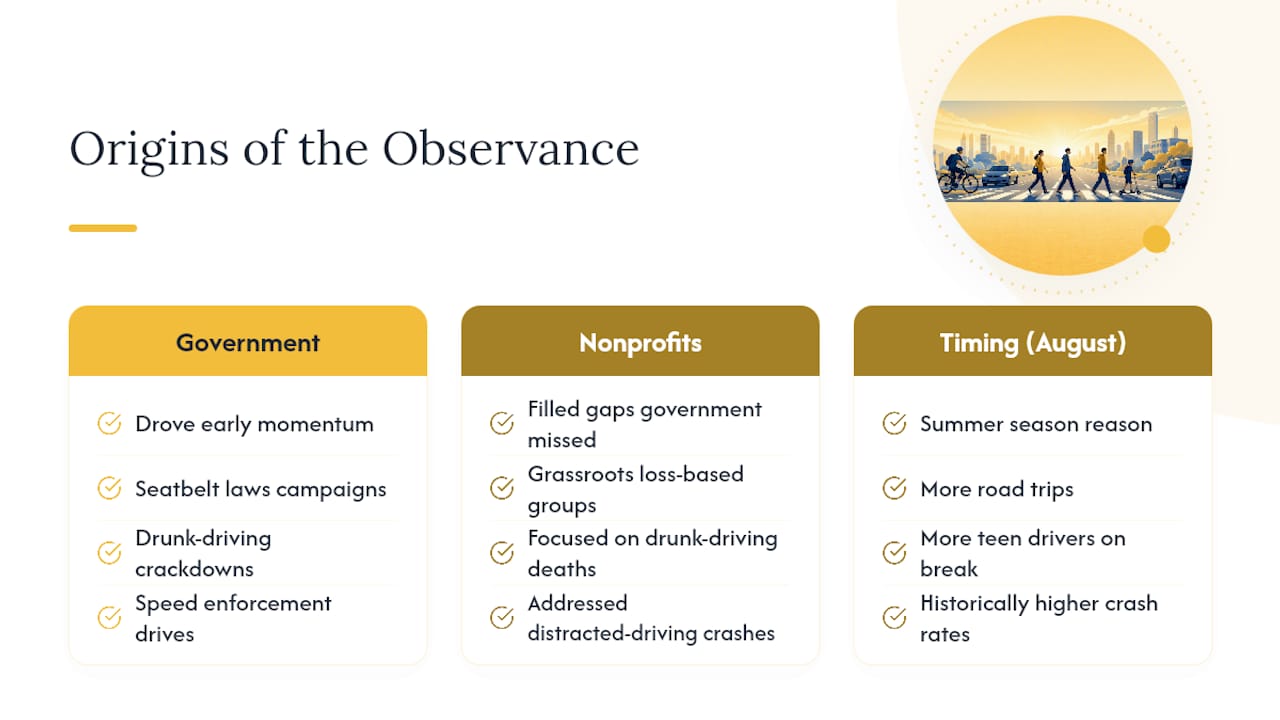
Traffic safety awareness campaigns didn’t start as one unified national effort. They grew out of decades of separate government and nonprofit initiatives, each targeting a specific crash cause, that eventually consolidated into the calendar of themed months and weeks recognized today.
Government agencies drove much of the early momentum. Seatbelt laws, drunk-driving crackdowns, and speed enforcement campaigns in the late 20th century each came with their own public messaging pushes, often tied to holiday travel spikes when crash rates jumped. Over time, these separate pushes coalesced into broader annual observances that awareness calendars now label under names like National Traffic Safety Awareness Month or National Traffic Awareness Month.
Nonprofits played a parallel role, often filling gaps that government campaigns couldn’t reach. Grassroots groups organized around specific losses, drunk-driving deaths, distracted-driving crashes, pedestrian fatalities, and pushed for both policy change and public education. That combination of top-down government messaging and bottom-up community advocacy is still how most road safety campaigns operate today, including August’s observance.
The reason the timing landed on August in many U.S. calendars likely traces to the season itself. Summer brings more road trips, more teen drivers on break from school, and historically higher crash rates, making it a logical window for a renewed public push before the school year resumes.
Do Awareness Campaigns Actually Change Behavior?
Skepticism about awareness months is fair. A single themed month doesn’t fix decades of driving habits, and critics are right to point that out. But the data on paired campaigns tells a more specific story than blanket skepticism allows.
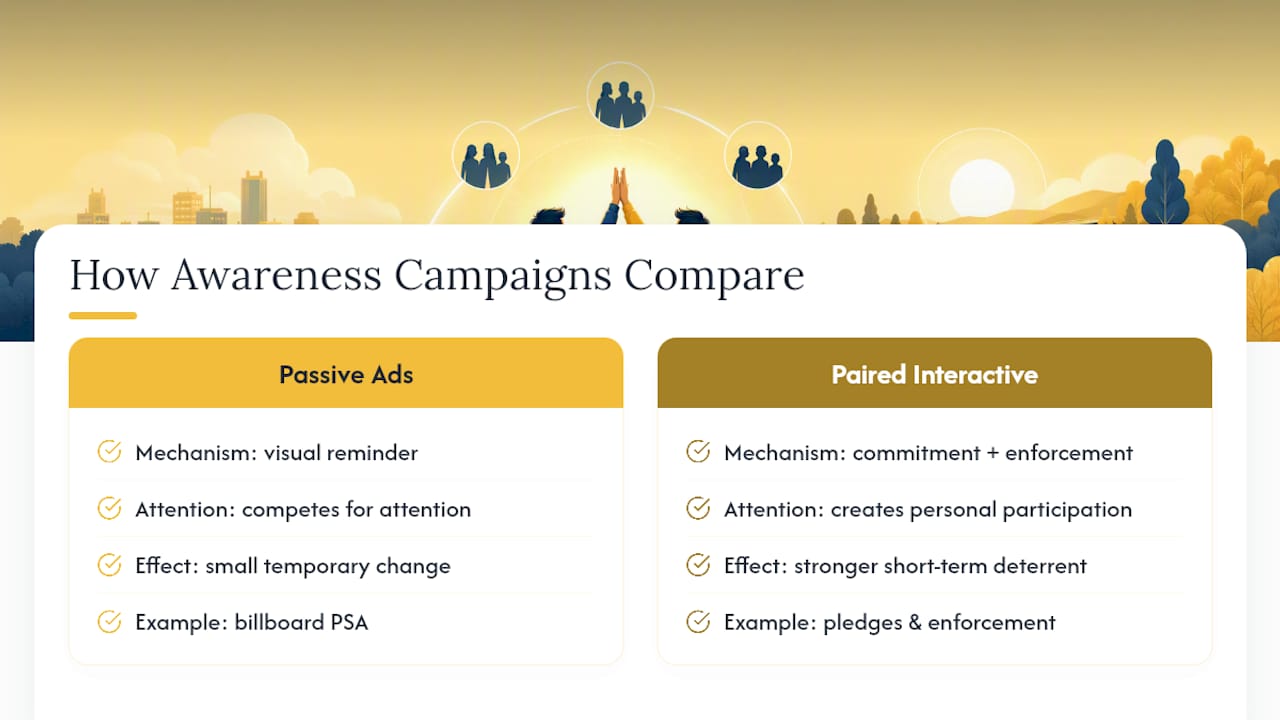
NHTSA’s approach of combining national advertising with visible law enforcement crackdowns, campaigns like “Put the Phone Away or Pay,” creates two effects at once: a reminder that the behavior is dangerous, and a short-term deterrent because people know enforcement is active. That combination tends to outperform messaging alone, which is a big part of why NHTSA keeps pairing ads with enforcement pushes rather than running PSAs in isolation.
The effectiveness gap tends to show up between passive and interactive campaigns specifically. A billboard about distracted driving competes with a hundred other billboards for a driver’s attention span. A pledge drive that asks someone to sign their name, or a “be seen” reflective-gear challenge that gets kids physically participating, creates a moment of personal commitment that a passive ad can’t replicate.
The honest takeaway: awareness months work best as one piece of a layered strategy, not a standalone fix. Enforcement, education, and community pledges each cover a gap the others miss. That layered approach is exactly why Drive With Care pairs its pledge campaign with driving school partnerships instead of relying on messaging alone.
The Numbers That Make August Matter
Some numbers are worth repeating because they explain why this observance exists at all. Nine people die every day in distracted-driving crashes, and NHTSA’s 2024 count of 3,208 distracted-driving deaths puts a hard figure on a behavior most drivers underestimate in themselves.
Distracted driving is only one slice of the picture, but it’s a representative one. Speeding, impaired driving, and drowsy driving each carry their own toll, and they frequently overlap. A fatigued driver is also more likely to speed to make up lost time, and an impaired driver is more likely to be distracted on top of it. Crash data rarely isolates a single cause cleanly, which is exactly why awareness campaigns target multiple risky behaviors simultaneously rather than picking just one.
August’s timing compounds the risk. Road trip volume rises, teen drivers who’ve been off the road during the school year get back behind the wheel more often, and longer daylight hours mean more hours of exposure to risk overall. That’s part of why NHTSA treats partnering with state and local police as central to reducing risky driving, rather than treating national messaging as sufficient on its own.
None of these numbers are meant to scare anyone off the road. They’re meant to explain why a dedicated month, backed by enforcement and community action, still has work to do every single year.
Why Pledges and Community Work Actually Stick
The instinct to dismiss a pledge as a feel-good gesture is understandable, and mostly wrong. A pledge works because it converts a private intention into a public commitment, and public commitments carry weight that private resolutions don’t. When someone signs their name and shares it with a friend or coworker, they’ve created a small social accountability loop that a PSA can never replicate.
What tends to get underestimated is how much interactive, hands-on activity outperforms passive messaging. A car-seat check, a reflective-gear challenge, a family driving agreement signed at the kitchen table, these create a moment of participation rather than just exposure to information. That distinction is where most of the real behavior change happens, not in the volume of ads run during August.
If you take one thing from this month, make it small and specific: sign something, ask someone else to sign it too, and do one hands-on activity instead of just sharing a link.
— Charles
Support Road Safety This Month: Donate, Pledge, or Partner
Drive With Care exists because education and support work better together than either does alone, and this August, there are three direct ways to back that approach. Every dollar donated funds traffic safety education programs, survivor support resources, and neurological research into brain injury from crashes, work that most standard safety campaigns don’t touch.

If you’d rather commit your own behavior first, sign the Drive With Care pledge and share it with at least one other person, that’s the step research on interactive engagement suggests actually changes habits. Schools, driving instructors, and local agencies looking to build safety education into existing programs can explore partnership opportunities directly with the team. And if reducing phone use behind the wheel is your personal goal this month, this guide on cutting screen time offers realistic, adult-focused steps that pair well with a designated-texter habit.
Ready to put money behind the mission? Donate now and help fund the education, survivor support, and research that keep Safer Roads Now running past August.
Sources
- Distracted Driving Awareness Month (Safety Research & Education Center, UC Berkeley)
- April is Distracted Driving Awareness Month | NHTSA
- National Traffic Awareness Month 2026: August 2026 | Awareness Days
- Observance of National Road Safety Month, 2025 from 1st January to 31st January, 2025 | Ministry of Road Transport & Highways
- Road Safety Week Action Pack 2026 | Brake (New Zealand)

